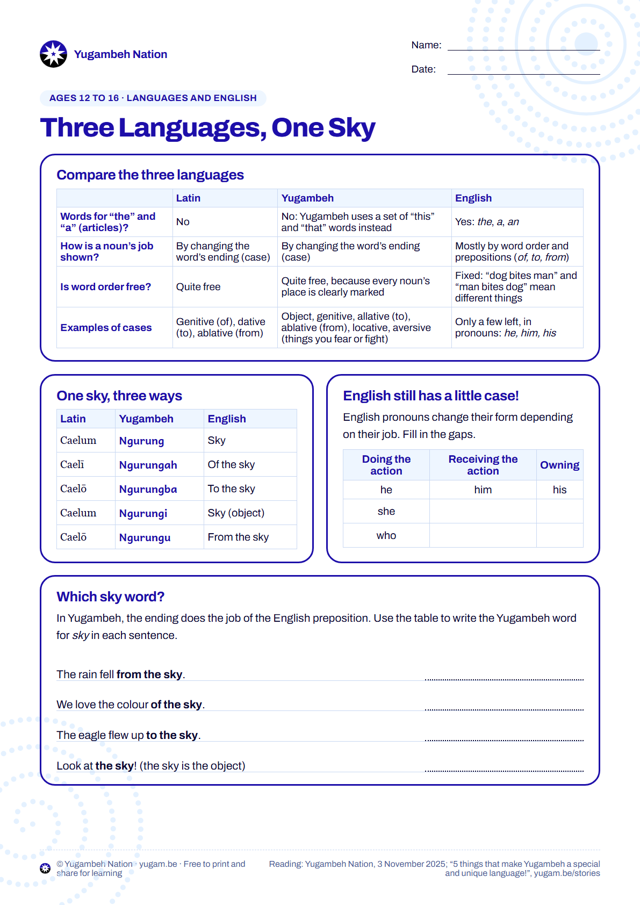
Compare how Latin, Yugambeh and English show a word’s job in a sentence, from case endings to prepositions and word order, then discuss what it tells us about languages.
Download nowPDF · 459 KBPrints on A4. Free to print and share for learning; please keep the Yugambeh Nation’s name on it.
What students do
- Compare how Latin, Yugambeh and English show a word’s job
- Discuss what grammar tells us about languages and respect
Australian Curriculum
- Year levels
- Years 7 to 10
- Learning areas
- LanguagesEnglish
- A_TSIC1Diverse languages and cultural expressions, and the right to maintain and control themCulture
- A_TSIC2Unique ways of being, knowing, thinking and doingCulture
- A_TSIP3Contributions acknowledged locally, nationally and globallyPeople
Suggested links to version 9.0 of the Australian Curriculum cross-curriculum priorities: First Nations histories and cultures. Summaries are in our own words; see ACARA for the full organising ideas.
More worksheets
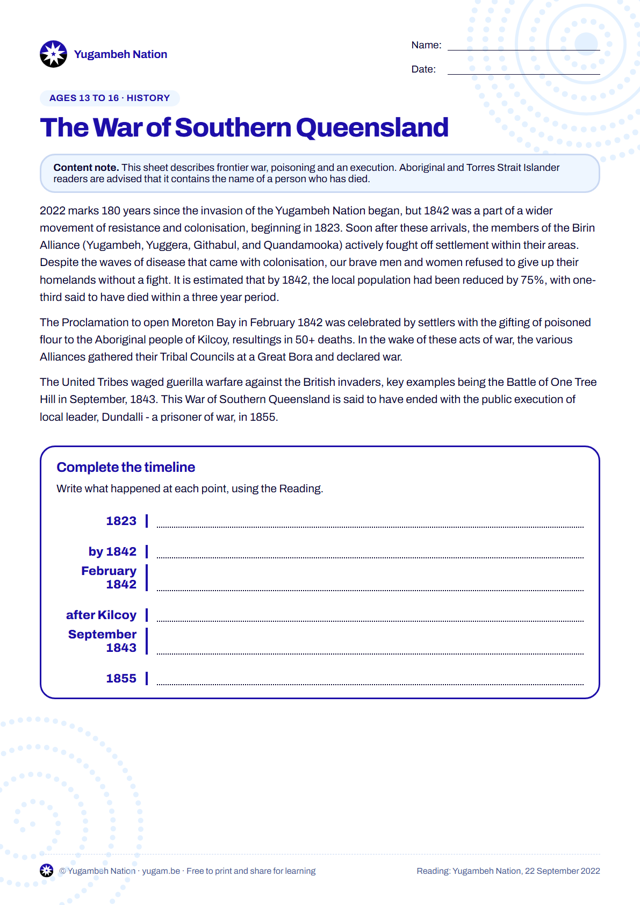
The War of Southern Queensland, 1823 to 1855
Read how the Birin Alliance resisted invasion from 1823, how war was declared after the Kilcoy poisoning, and how the war ended with Dundalli’s execution in 1855.
View and download →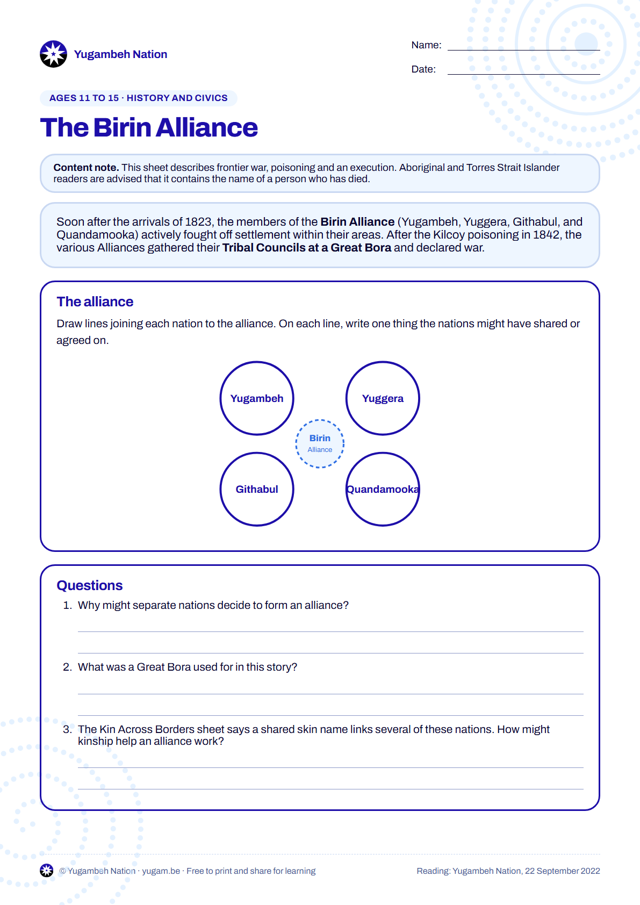
The Birin Alliance: Nations Working Together
Explore how the Yugambeh, Yuggera, Githabul and Quandamooka formed the Birin Alliance to resist invasion, and think about why nations form alliances.
View and download →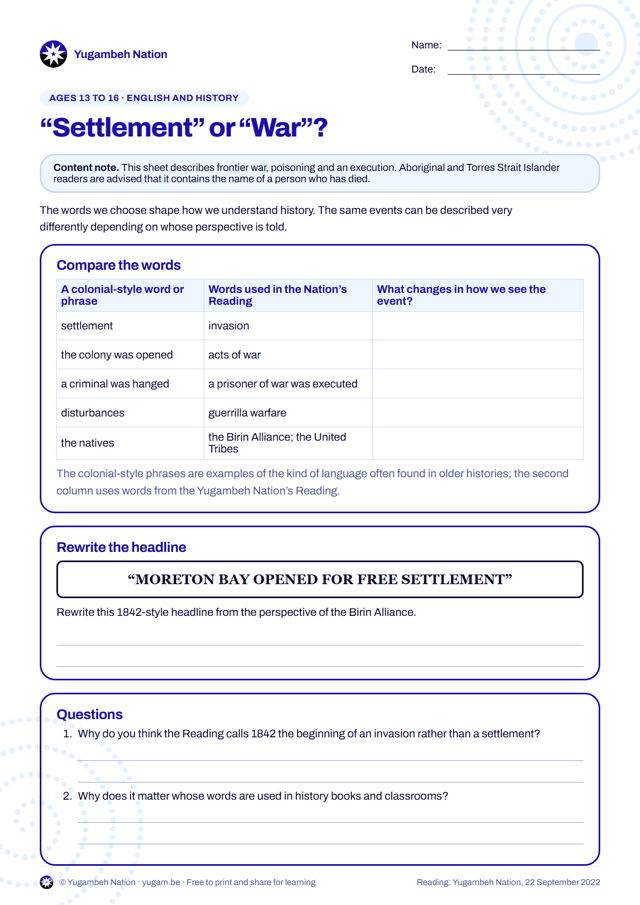
“Settlement” or “War”? Words and Perspective
Compare the words used to describe the same events from a colonial point of view and from the Yugambeh Nation’s, and rewrite a headline from a different perspective.
View and download →