Home / Downloads
Digital downloads
Free worksheets for learning about Yugambeh language, history and culture; for classrooms, families and anyone keen to learn. Each one links to the Australian Curriculum.
129 worksheets
For younger learners
Colouring, counting, words, games and stories for primary school ages. 66 worksheets.
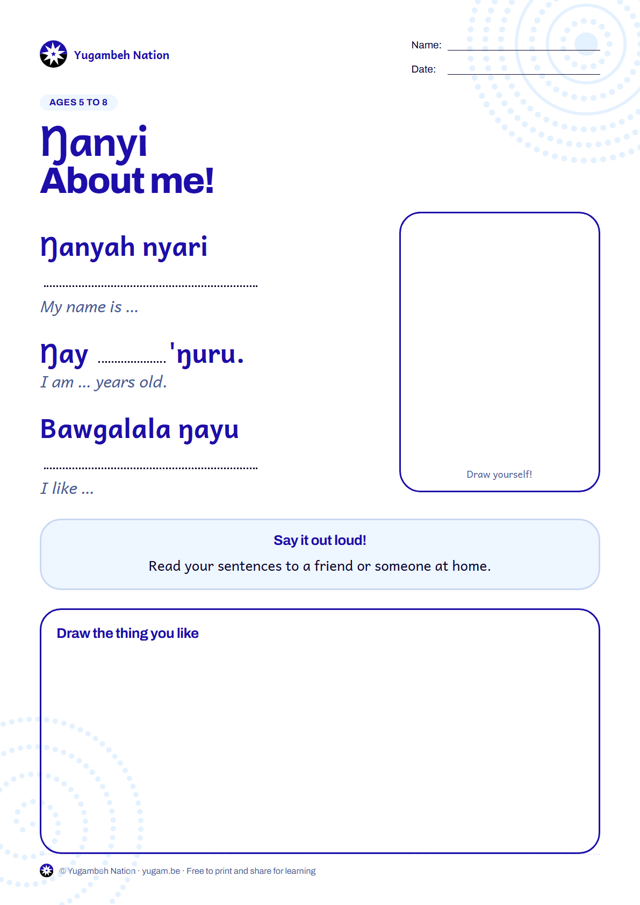
About Me (Ŋanyi)
A worksheet featuring three simple questions in Yugambeh language: My name is… I am … old I like….
View and download →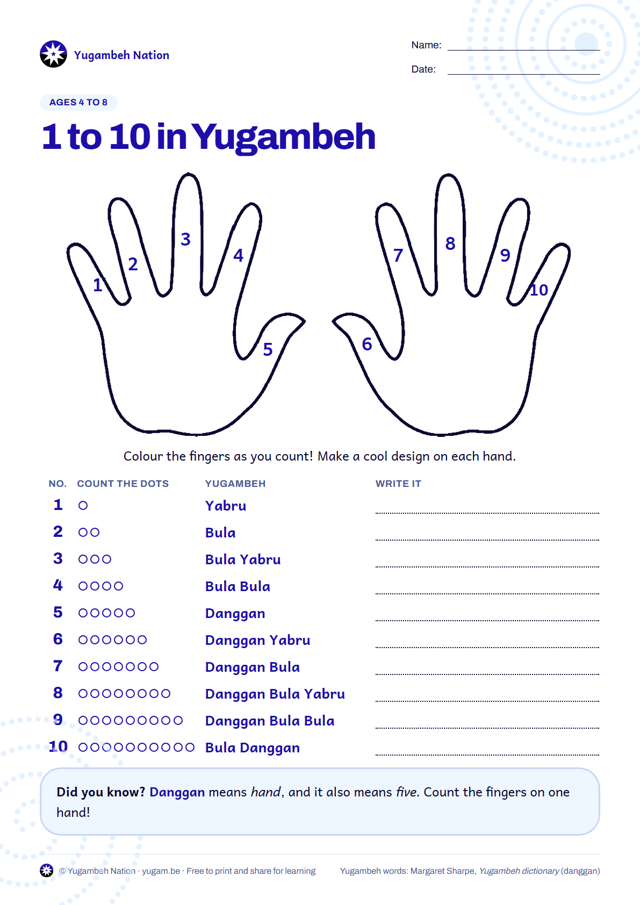
1 to 10 in Yugambeh Language
Learn to count in Yugambeh. Colour them in, make a cool design, and just have fun as you learn Yugambeh numbers.
View and download →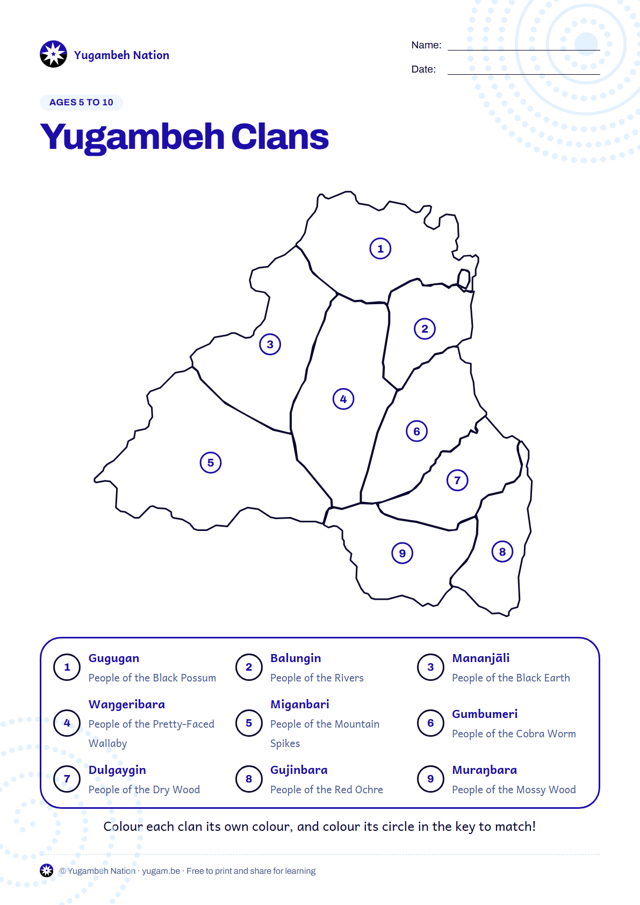
Yugambeh Clan Colouring Worksheet
Colour in a map of the Yugambeh clan groups!
View and download →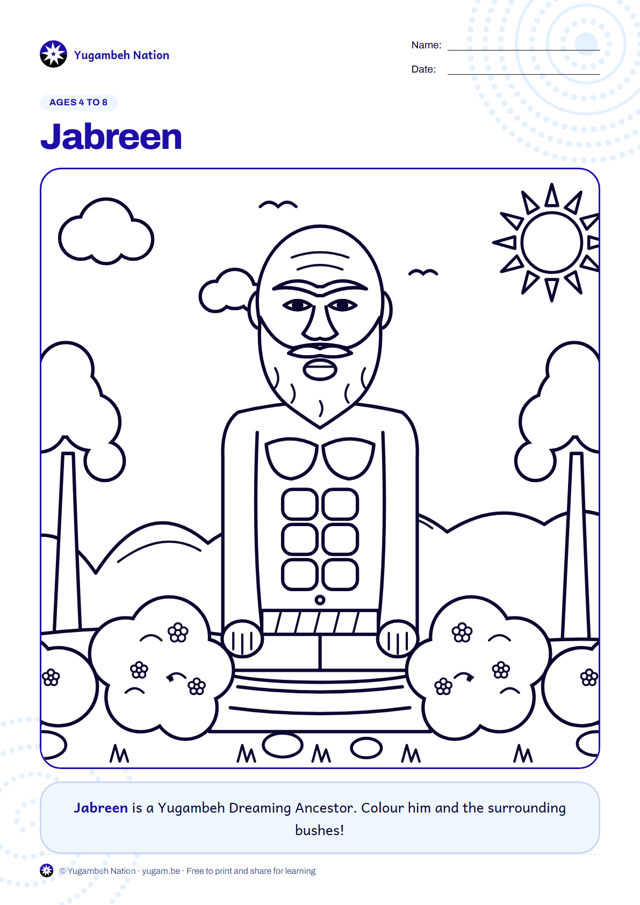
Jabreen Colouring Sheet
Jabreen is a Yugambeh Dreaming Ancestor. Colour him and the surrounding bushes!
View and download →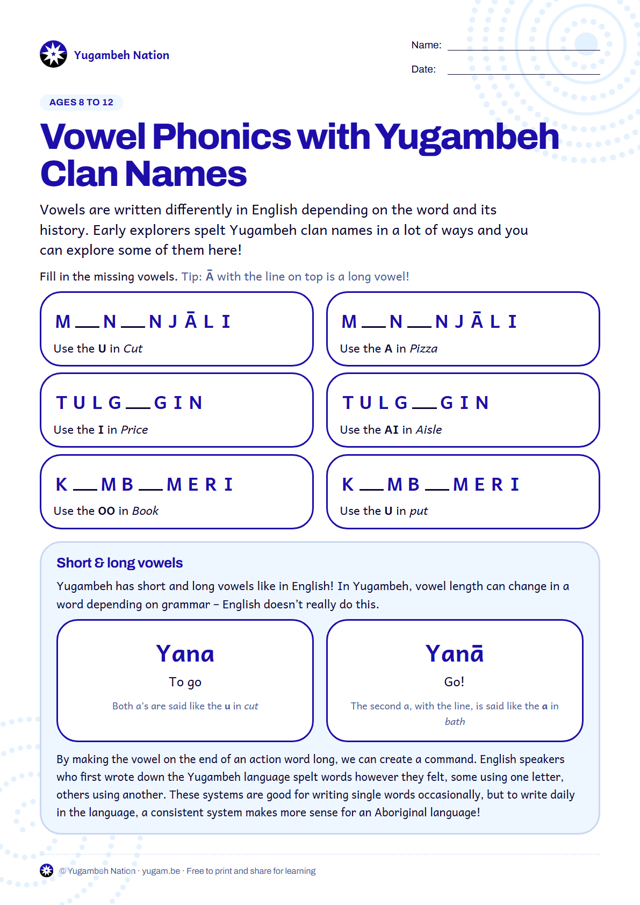
Vowel Phonics with Yugambeh Clan Names
Is it Mununjali or Mananjali? How do I pronounce the i in Tulgigin? Unpack historic spellings of Yugambeh clan names with this simple Phonics Worksheet.
View and download →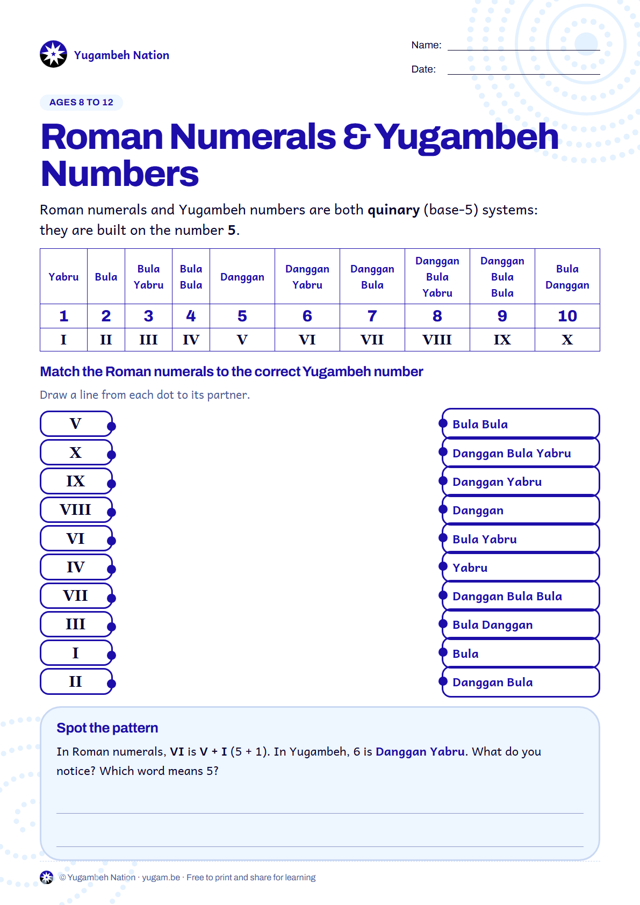
Roman Numerals & Yugambeh Numbers Sheet
Did you know Roman numerals and Yugambeh numbers are both Quinary systems! This means they are based on the number 5. Lots of cultures use or have used a base-5 system, explore the similarities between Roman numerals and Yugambeh numbers in this simple matching worksheet.
View and download →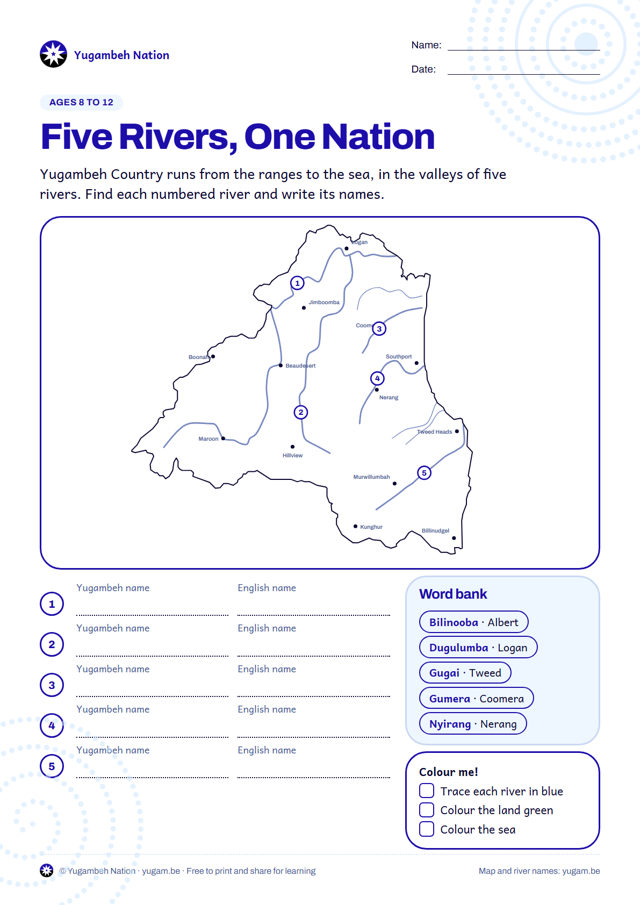
Five Rivers, One Nation: Map Activity
Yugambeh Country runs from the ranges to the sea, in the valleys of five rivers. Find each river on the map and write its Yugambeh and English names.
View and download →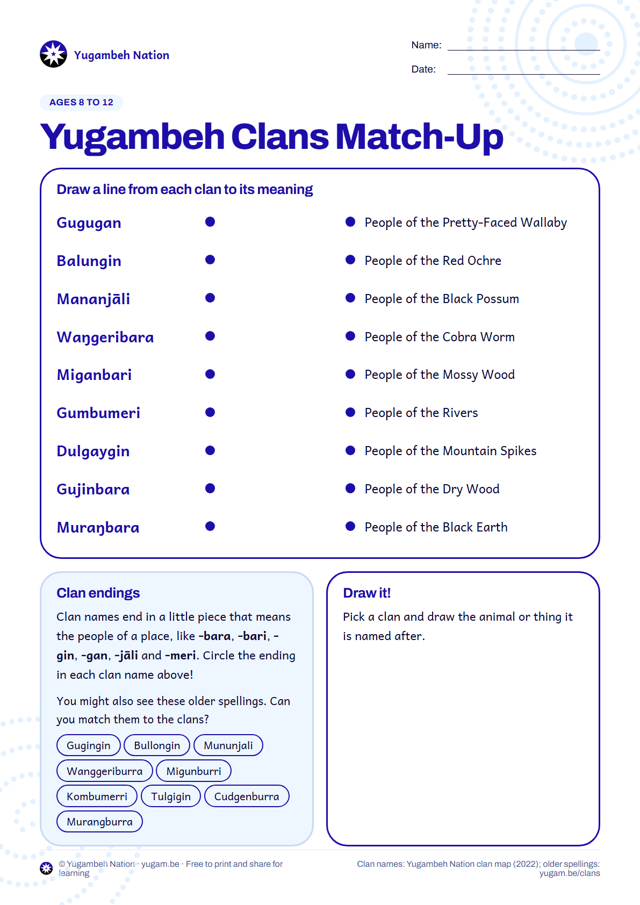
Yugambeh Clans Match-Up
Match each Yugambeh clan to its meaning, spot the clan endings, and draw the animal or thing a clan is named after.
View and download →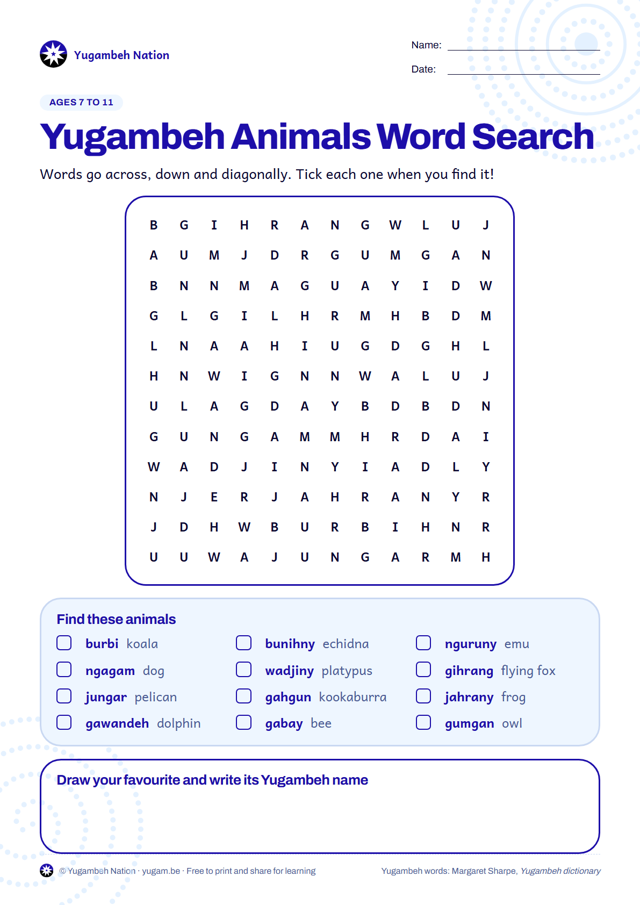
Yugambeh Animals Word Search
Find twelve Yugambeh animal words hidden across, down and diagonally. Includes an answer key.
View and download →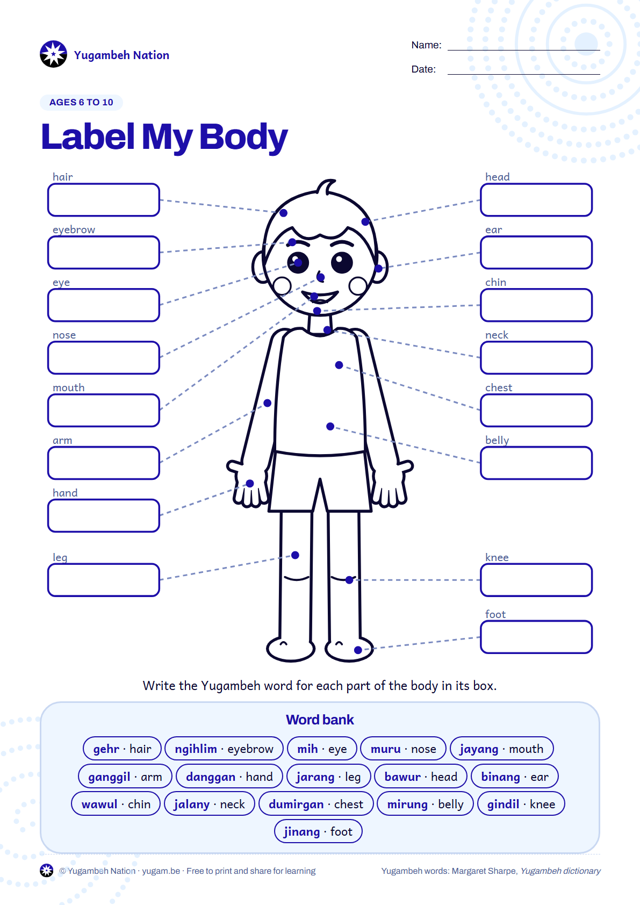
Label My Body in Yugambeh
Learn sixteen Yugambeh words for parts of the body, from hair and eyebrow to knee and foot, by labelling a picture.
View and download →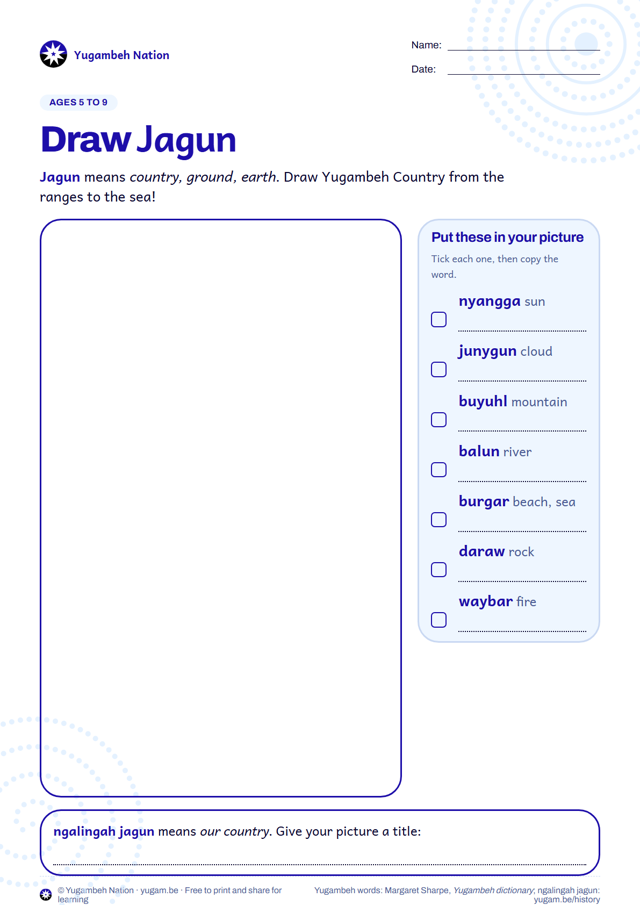
Draw Yugambeh Country
Draw a picture of jagun (Country) with the sun, clouds, mountains, a river, the sea, rocks and a fire, and learn the Yugambeh word for each.
View and download →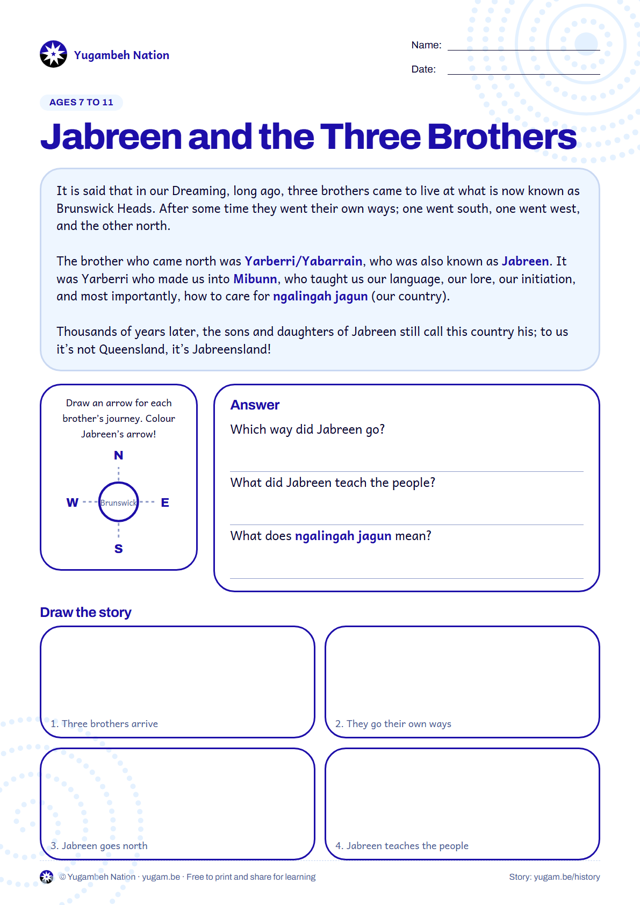
Jabreen and the Three Brothers
Read the story of the three brothers who came to Brunswick Heads, find the directions they travelled, and draw the story in four pictures.
View and download →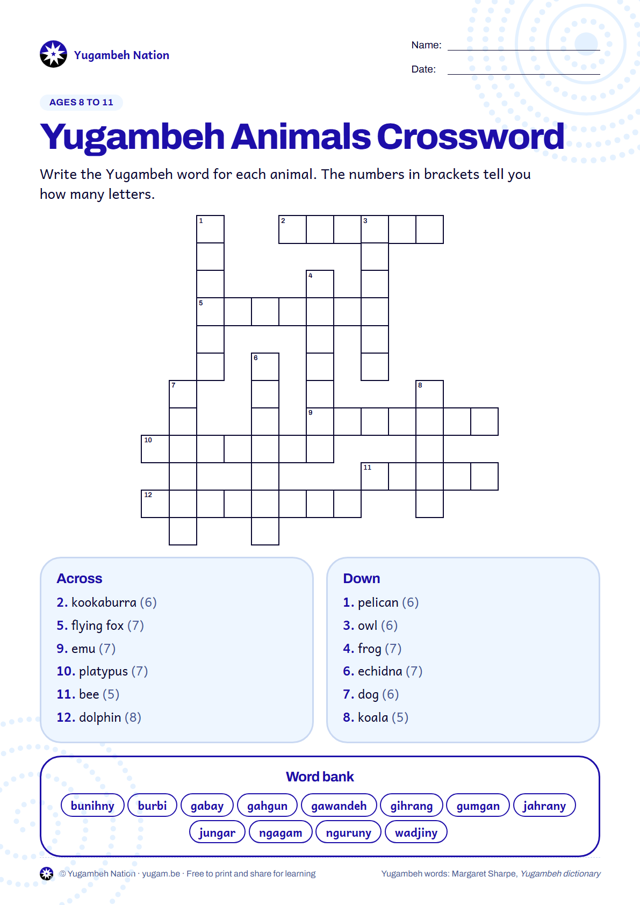
Yugambeh Animals Crossword
A crossword of Yugambeh animal words with English clues and a word bank. Includes an answer key.
View and download →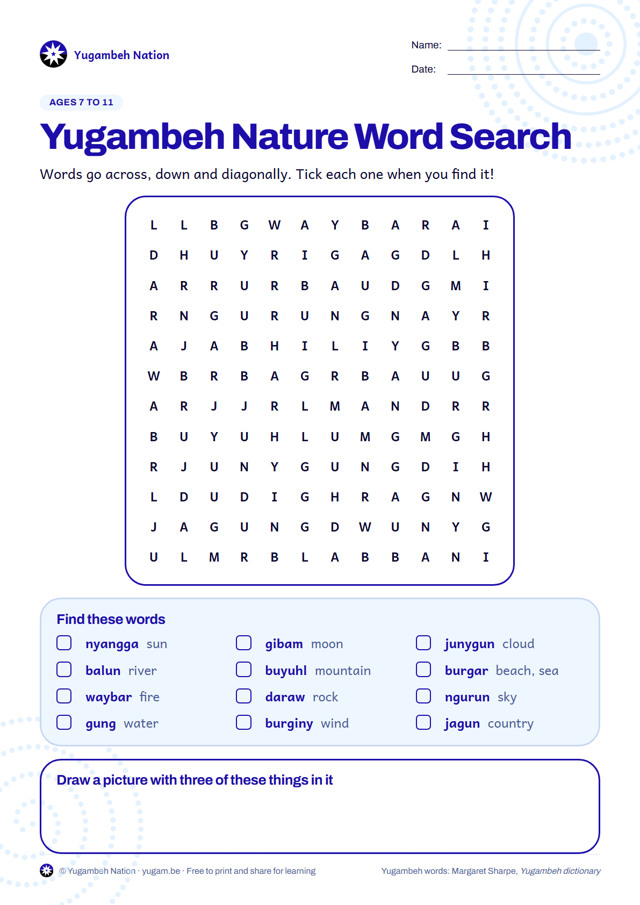
Yugambeh Nature Word Search
Find twelve Yugambeh words for the sun, moon, sky, water and Country. Includes an answer key.
View and download →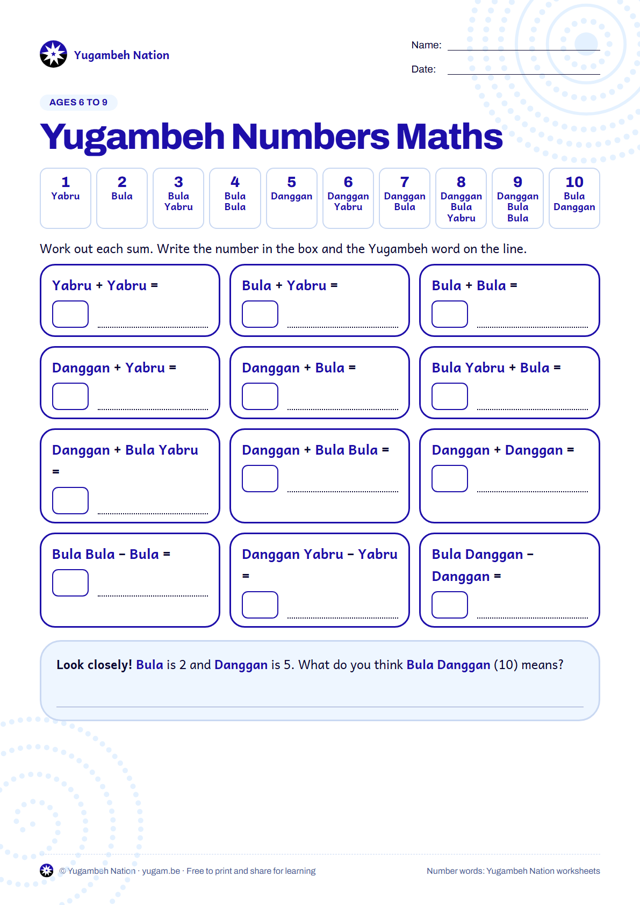
Yugambeh Numbers Maths
Add and take away using Yugambeh number words from Yabru (1) to Bula Danggan (10).
View and download →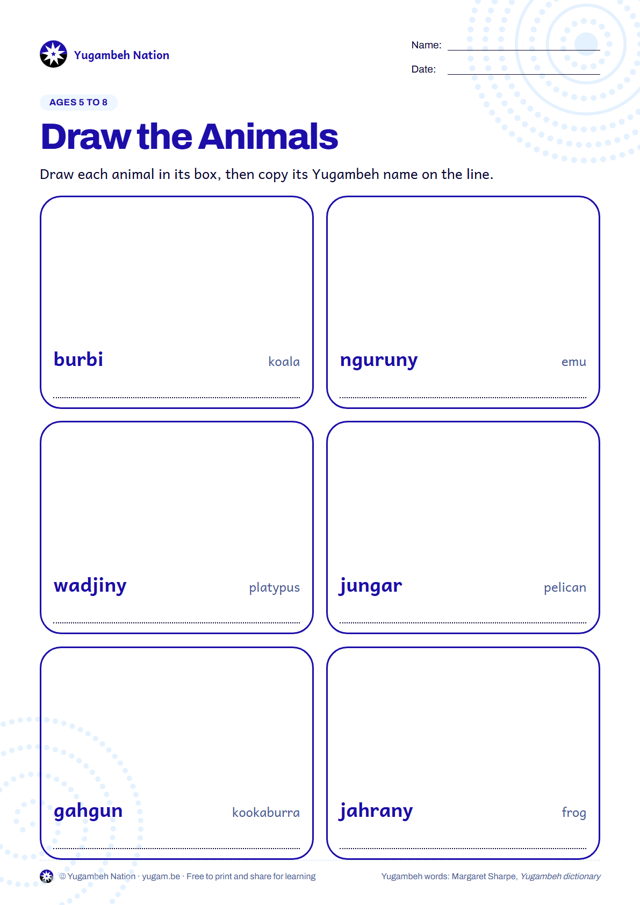
Draw the Animals
Draw six animals and copy their Yugambeh names: koala, emu, platypus, pelican, kookaburra and frog.
View and download →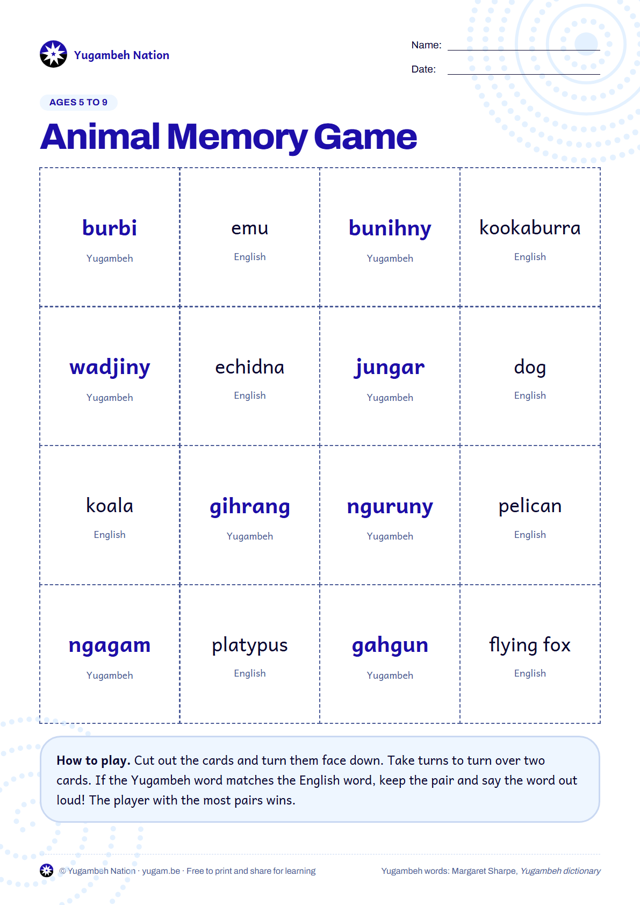
Yugambeh Animal Memory Game
Cut out sixteen cards and play a matching game, pairing each Yugambeh animal word with its English word.
View and download →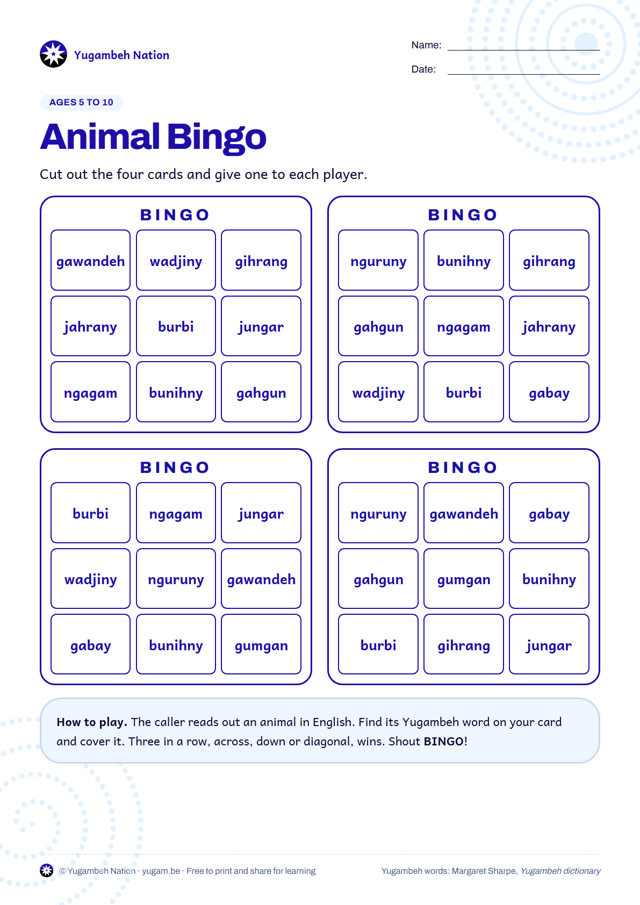
Yugambeh Animal Bingo
Four bingo cards and a set of caller cards for a class game using twelve Yugambeh animal words.
View and download →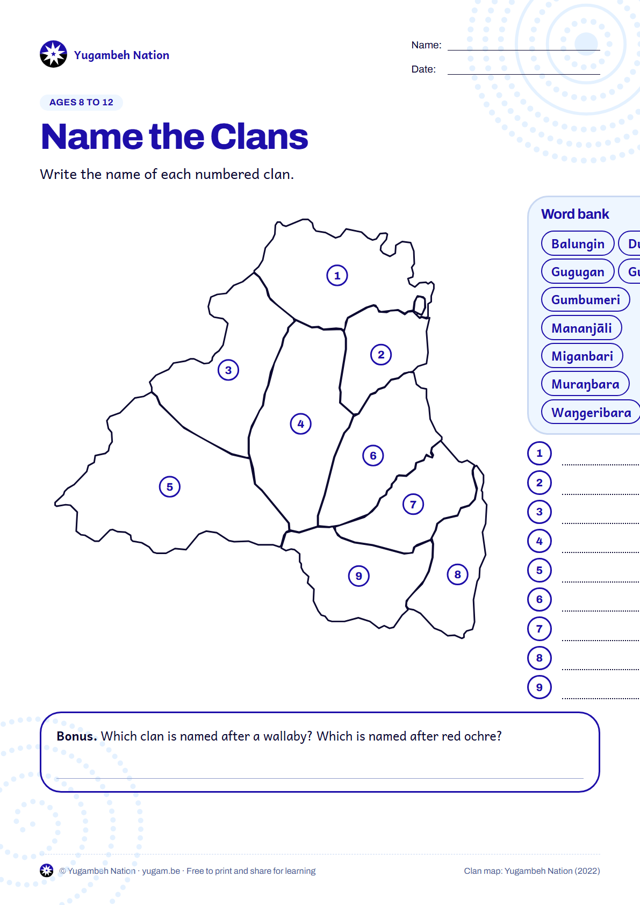
Name the Yugambeh Clans
Use the word bank to write the name of each numbered clan on the map of the Yugambeh Nation.
View and download →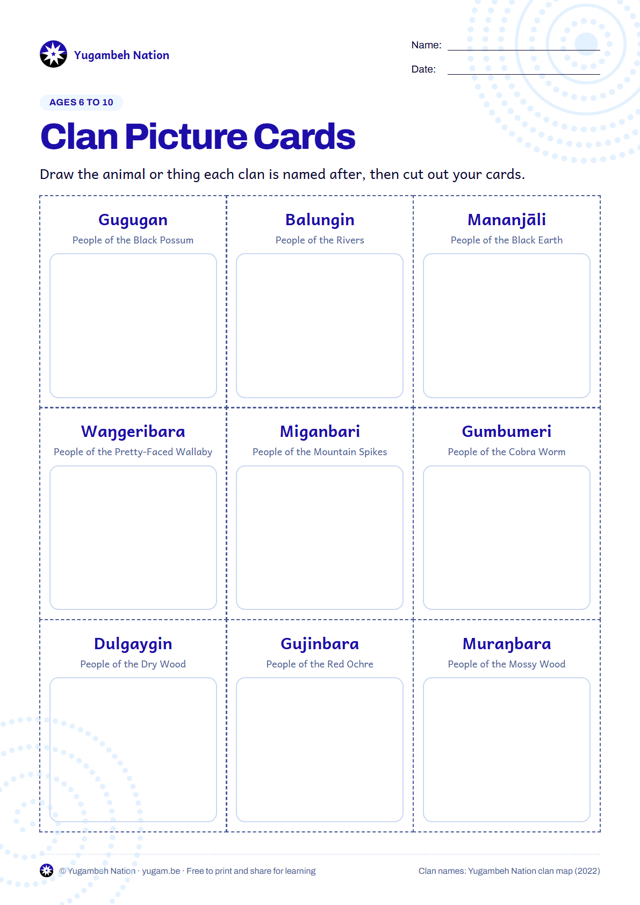
Yugambeh Clan Picture Cards
Nine cut-out cards, one for each Yugambeh clan, with its meaning and a space to draw the animal or thing it is named after.
View and download →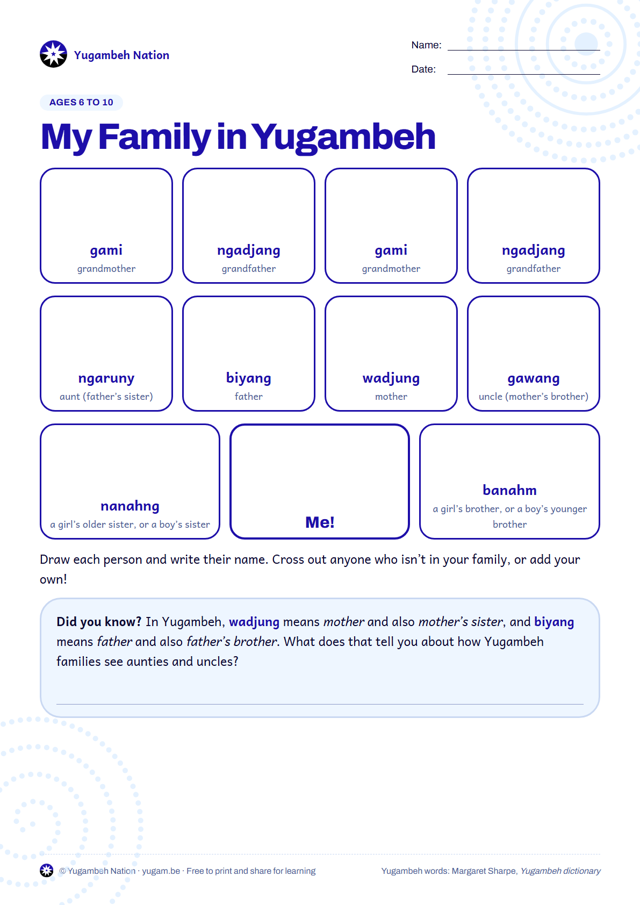
My Family in Yugambeh
Draw your family tree and label it with Yugambeh family words, and find out how Yugambeh family words work.
View and download →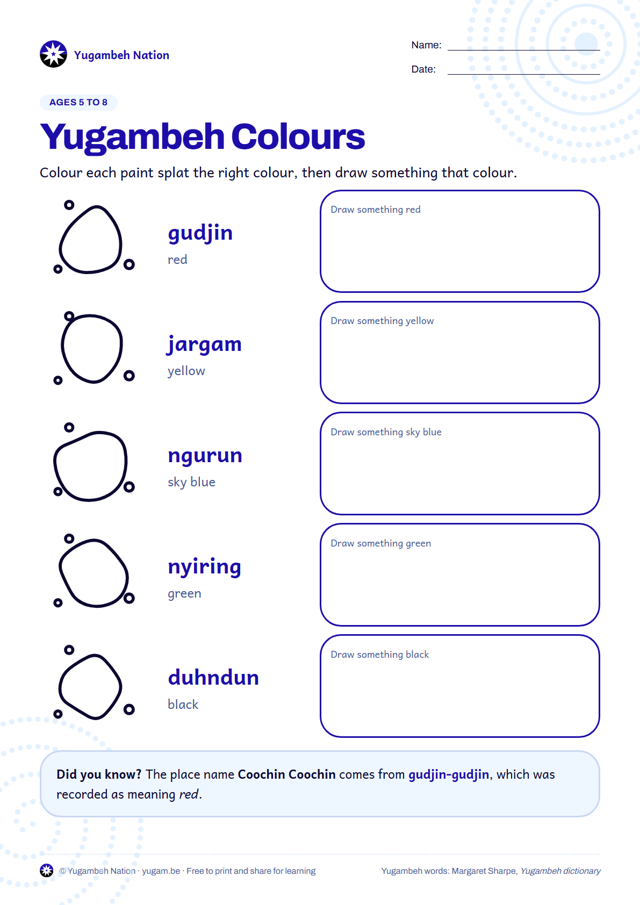
Yugambeh Colours
Learn five Yugambeh colour words, colour in the paint splats and draw something of each colour.
View and download →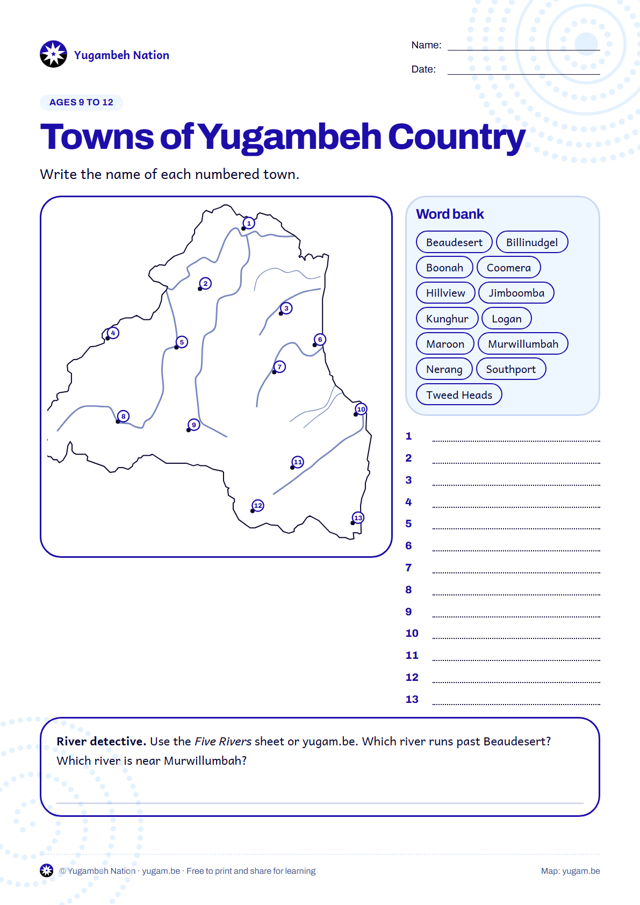
Towns of Yugambeh Country
Find twelve towns on a map of Yugambeh Country, from Logan to Billinudgel, and work out which river each is near.
View and download →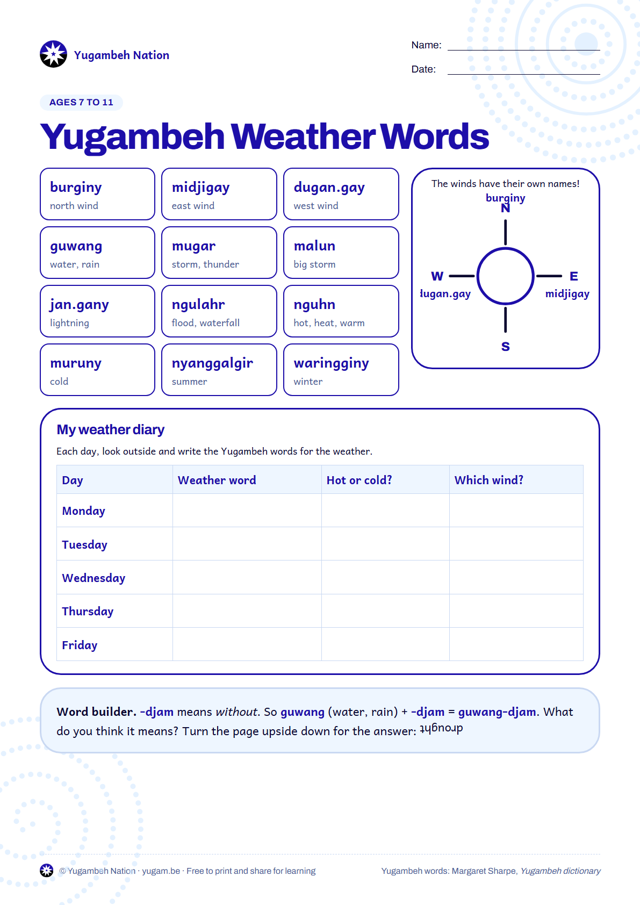
Yugambeh Weather Words
Learn Yugambeh words for winds, rain, storms, hot and cold, summer and winter, then keep a weather diary for a week.
View and download →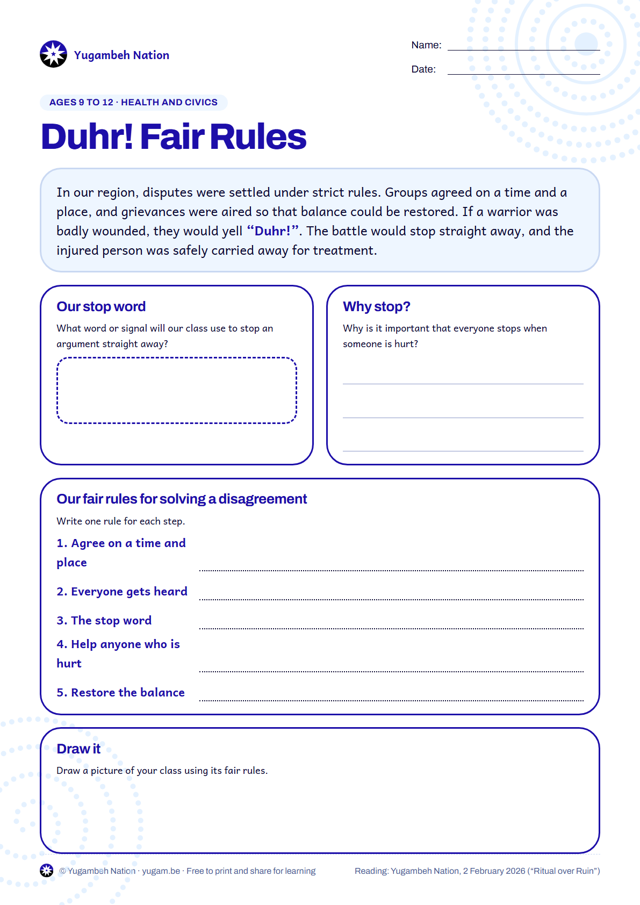
Duhr! Fair Rules for Solving Conflict
Learn how traditional dispute resolution stopped when someone called “Duhr!”, and make your own class rules for solving disagreements fairly.
View and download →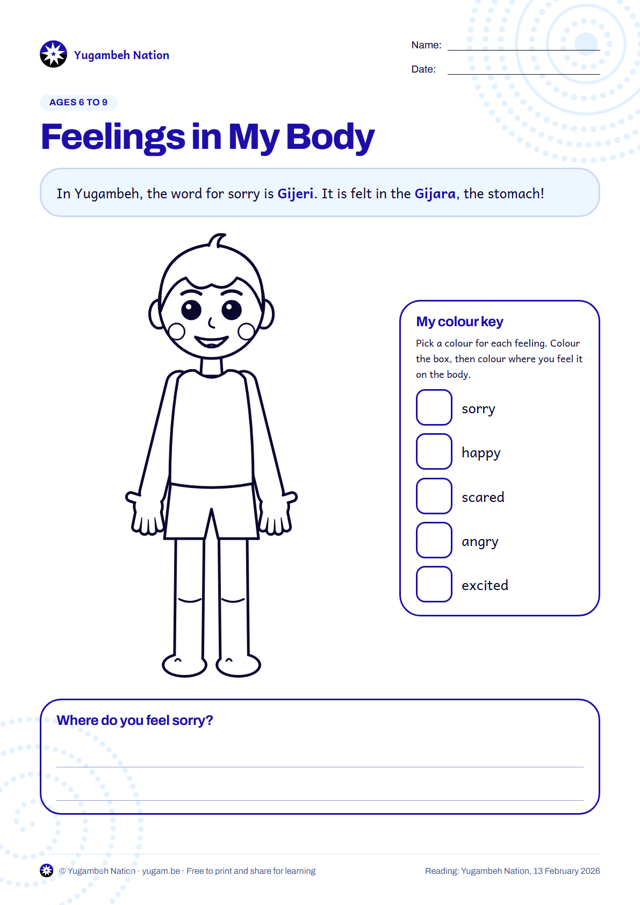
Feelings in My Body
In Yugambeh, sorry (gijeri) is felt in the stomach (gijara). Colour where you feel different feelings in your body.
View and download →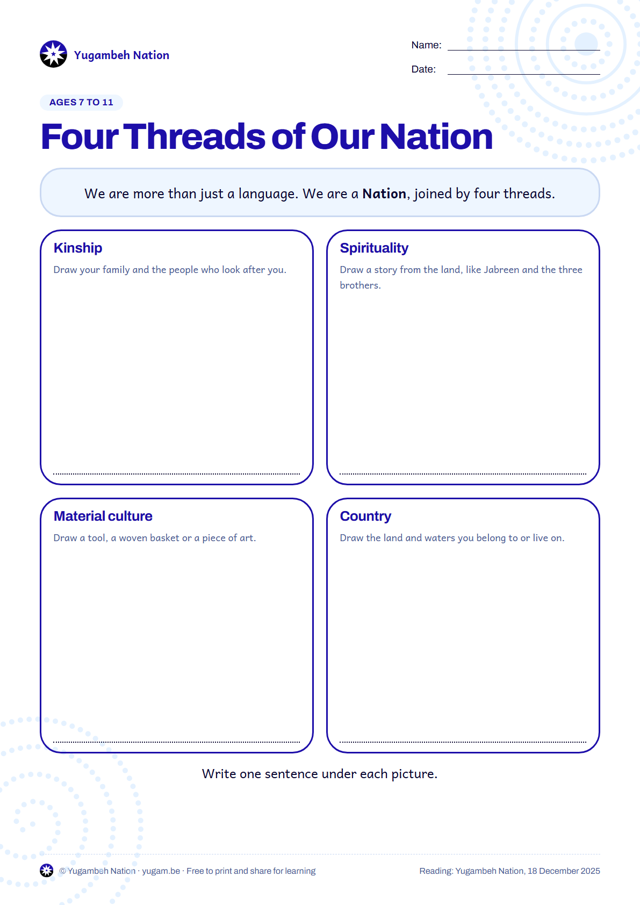
Four Threads of Our Nation
Draw and write about the four threads that make the Yugambeh a Nation: kinship, spirituality, material culture and connection to Country.
View and download →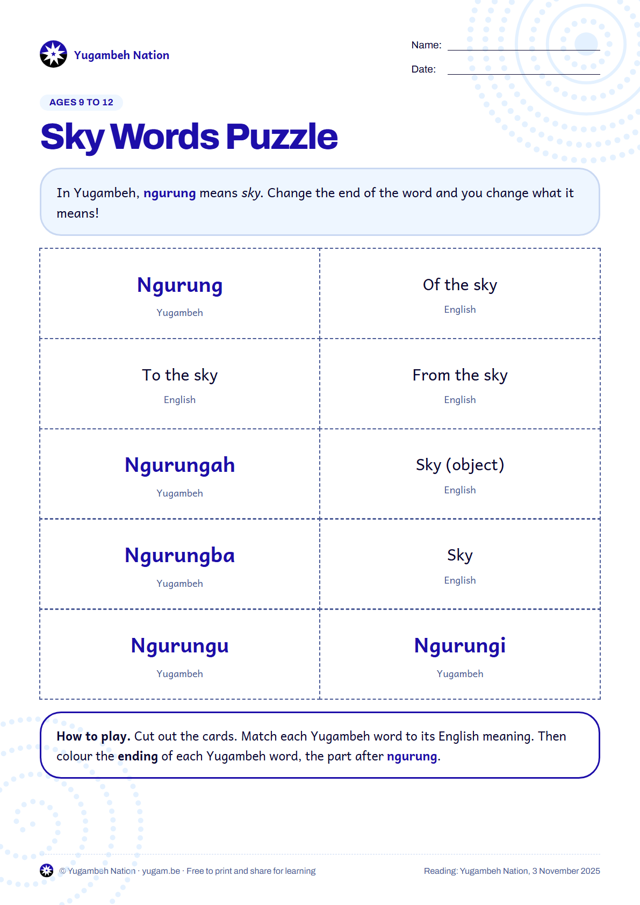
Sky Words: Endings Puzzle
Cut out and match Yugambeh “sky” words to their English meanings, and spot how the ending of the word changes its meaning.
View and download →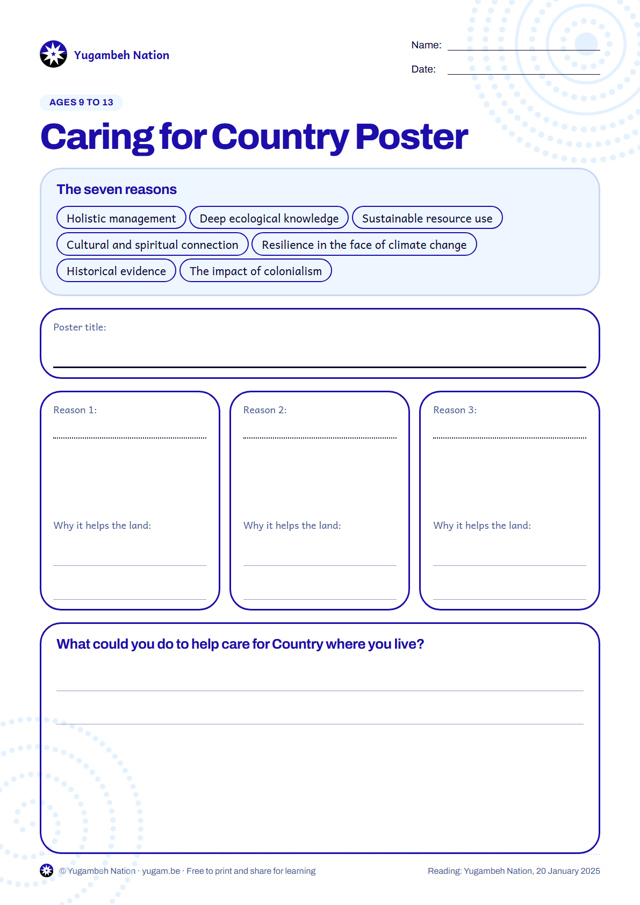
Caring for Country Poster
Choose three of the seven reasons land thrives when cared for by Indigenous people, and make a poster that explains and illustrates them.
View and download →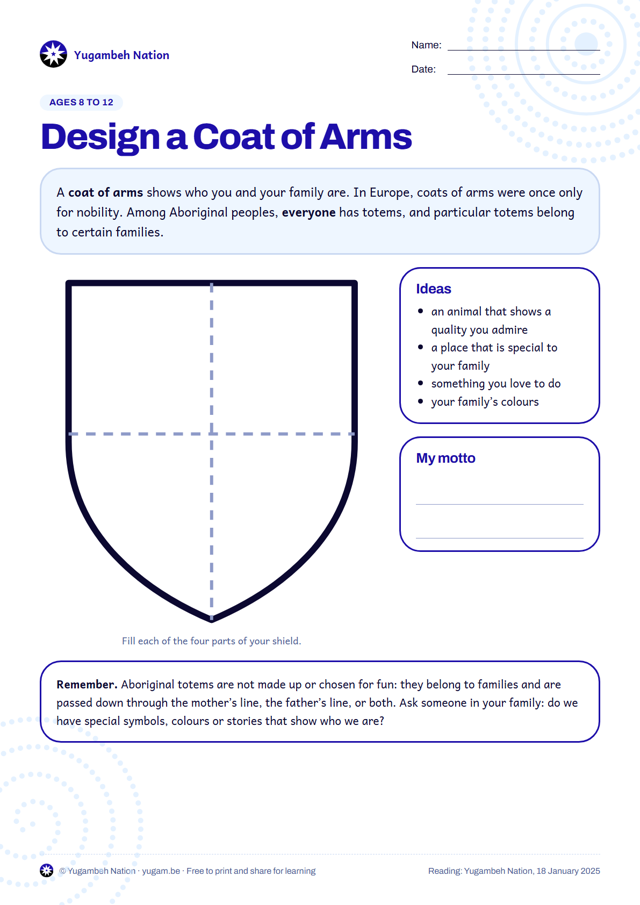
Design a Coat of Arms
Design a European-style coat of arms that shows who you and your family are, and learn why Aboriginal totems are passed down, not made up.
View and download →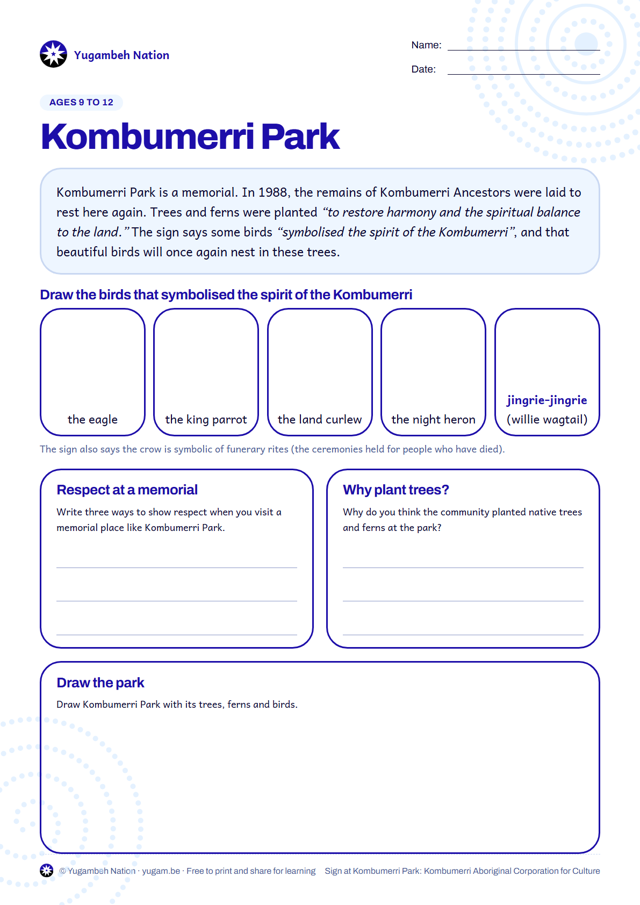
Kombumerri Park: A Place of Memory
Learn about the birds that symbolise the spirit of the Kombumerri, the trees planted at Kombumerri Park, and how to show respect at a memorial place.
View and download →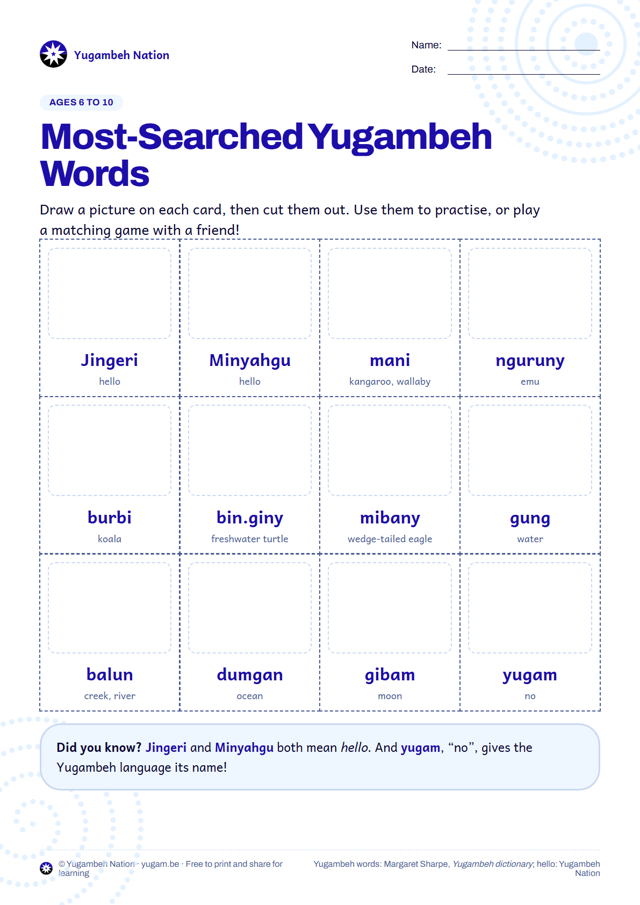
The Most-Searched Yugambeh Words
Twelve of the Yugambeh words people search for most, from Jingeri (hello) to mani (kangaroo), as cut-out flashcards to draw on and practise.
View and download →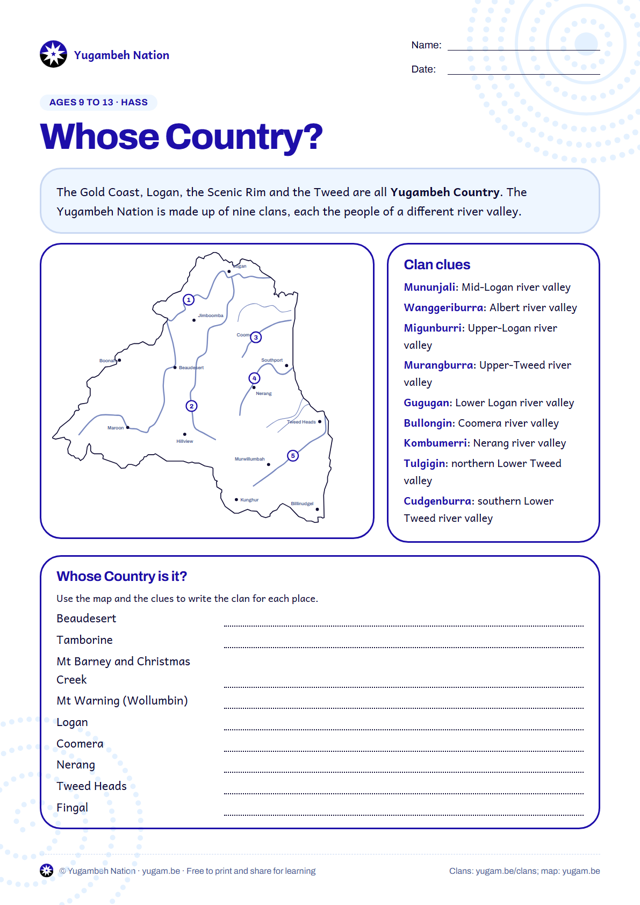
Whose Country? Gold Coast, Logan and the Tweed
Find out who the Traditional Owners of the Gold Coast, Logan and the Tweed are, and match nine places to the Yugambeh clans whose Country they are on.
View and download →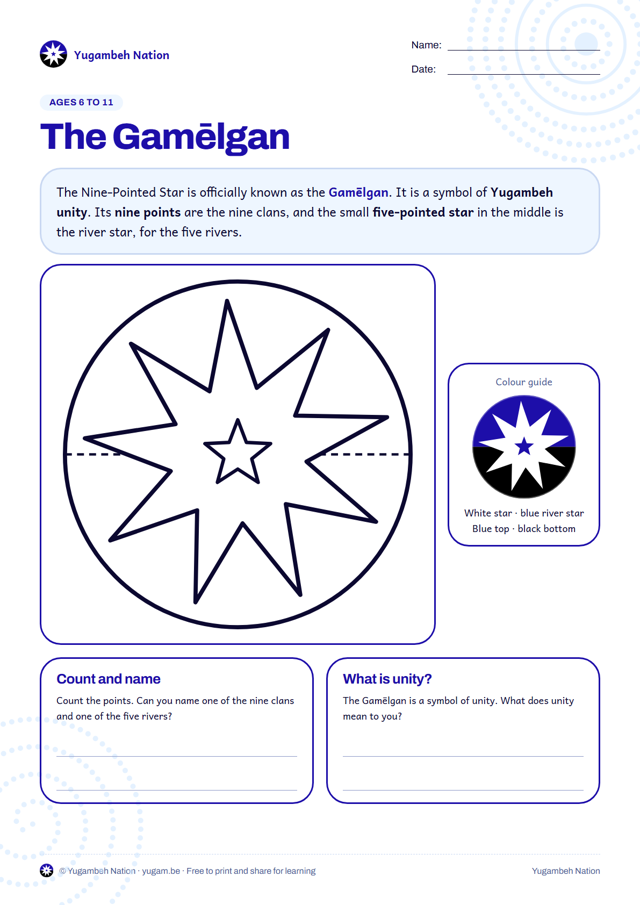
The Gamēlgan: Our Nine-Pointed Star
Colour the Gamēlgan, the Nine-Pointed Star of the Yugambeh Nation, and learn how its nine points stand for the nine clans and its small star for the five rivers.
View and download →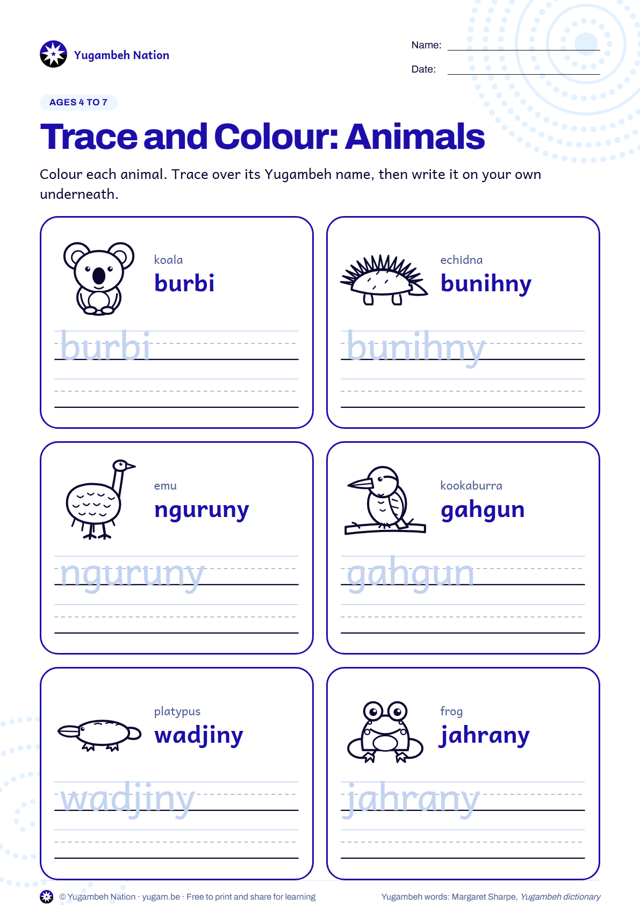
Trace and Colour: Yugambeh Animals
Six animals to colour, each with its Yugambeh name to trace over and then write on your own: koala, echidna, emu, kookaburra, platypus and frog.
View and download →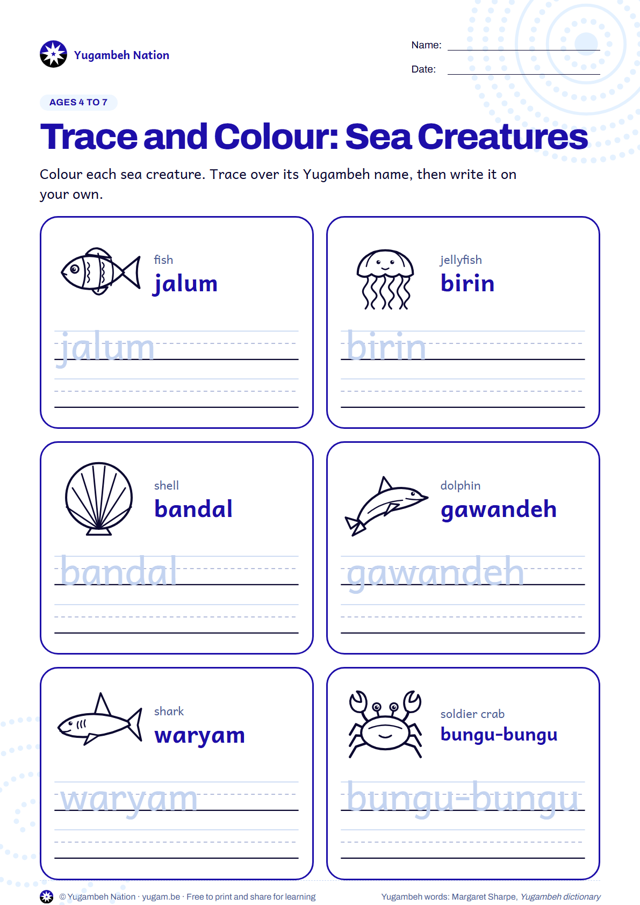
Trace and Colour: Sea Creatures
Six sea creatures to colour, each with its Yugambeh name to trace and write: fish, jellyfish, shell, dolphin, shark and soldier crab.
View and download →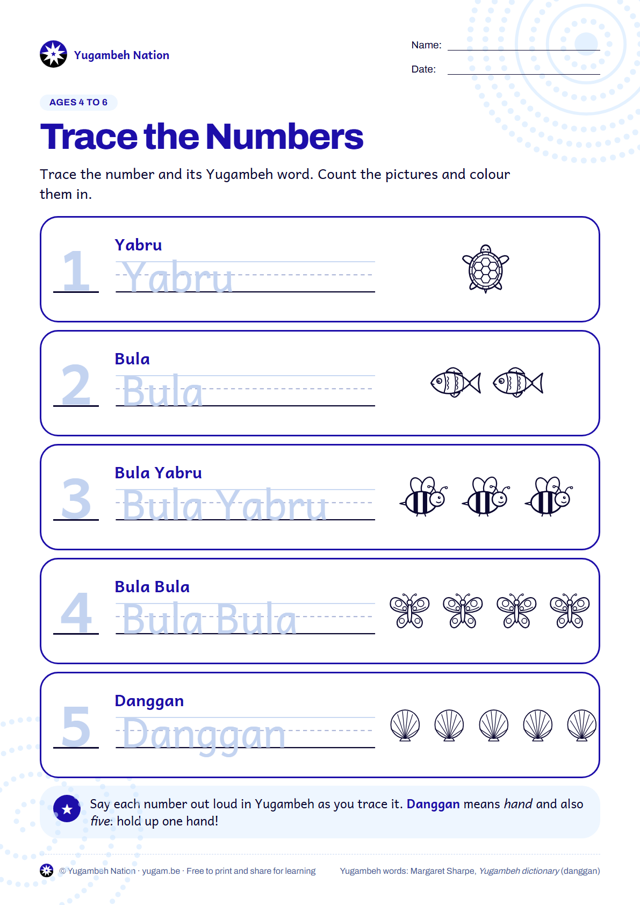
Trace the Yugambeh Numbers 1 to 5
Trace the numbers 1 to 5 and their Yugambeh words, Yabru to Danggan, then count and colour the animals in each row.
View and download →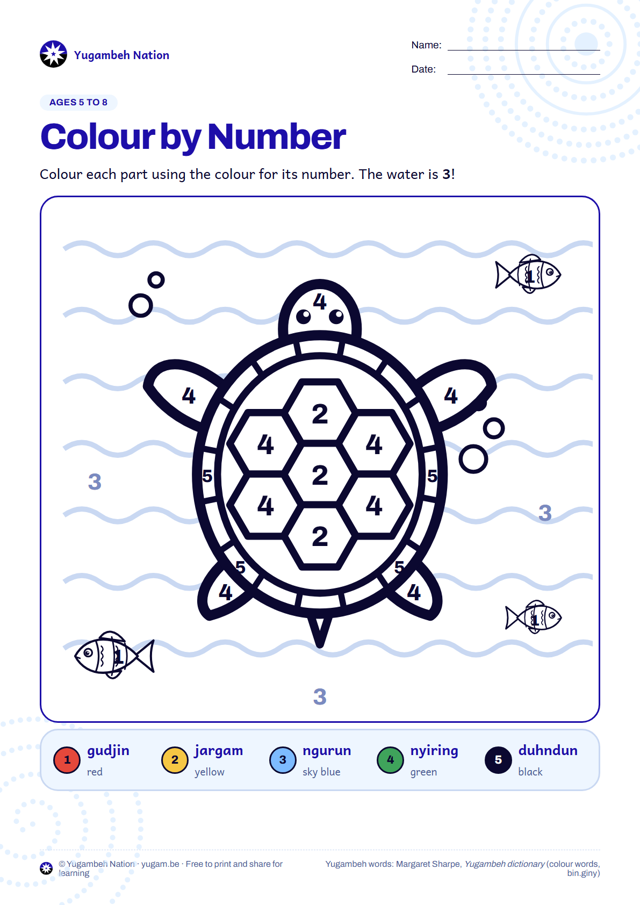
Colour by Number: Bin.giny the Turtle
A colour-by-number turtle swimming in the river. Each number stands for a Yugambeh colour word: gudjin, jargam, ngurun, nyiring and duhndun.
View and download →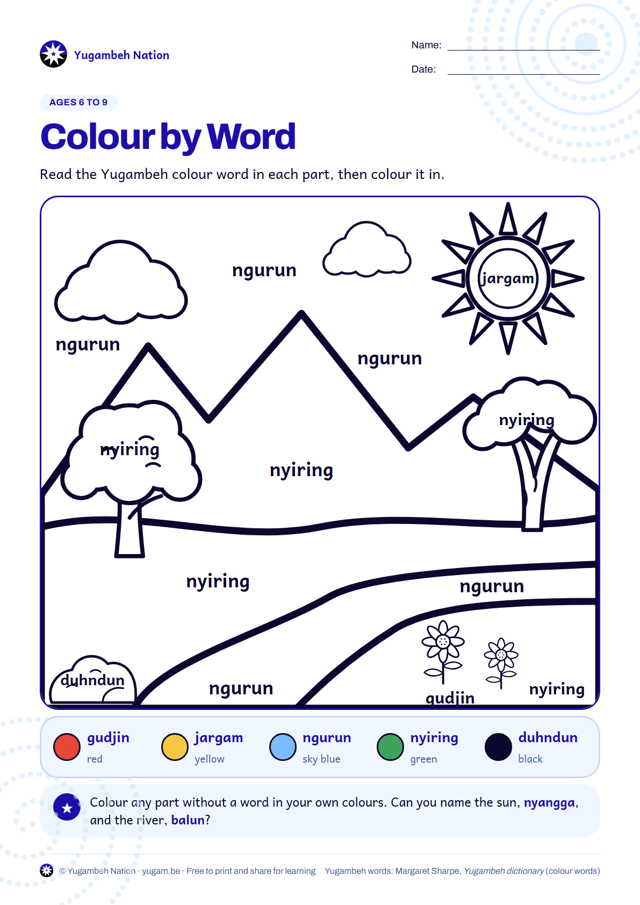
Colour by Word: River Country
Read the Yugambeh colour word in each part of the picture and colour it in: sky, sun, mountains, river, trees, flowers and rocks.
View and download →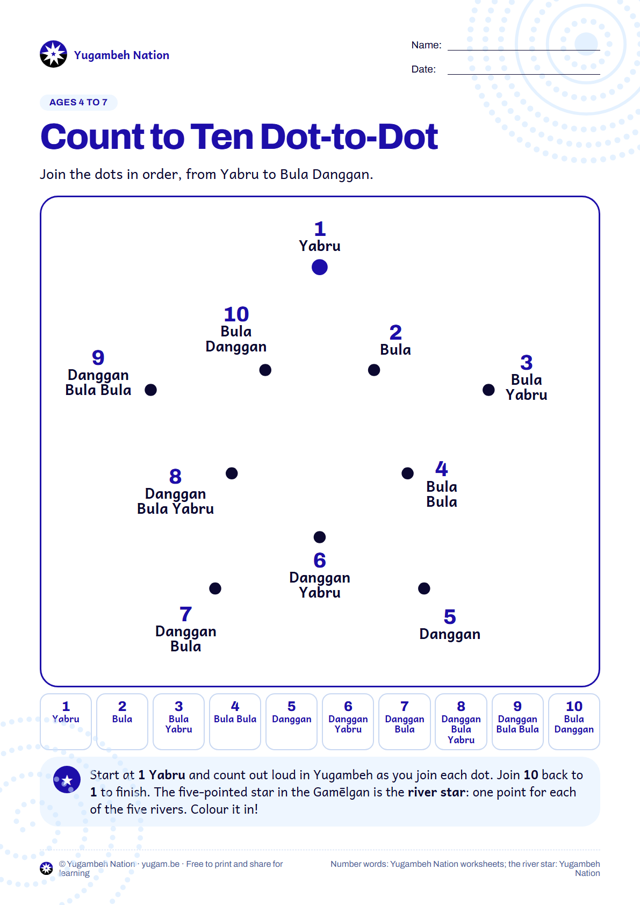
Dot-to-Dot: Count to Ten in Yugambeh
Join the dots from Yabru (1) to Bula Danggan (10) to draw the river star, the five-pointed star in the Gamēlgan that stands for the five rivers.
View and download →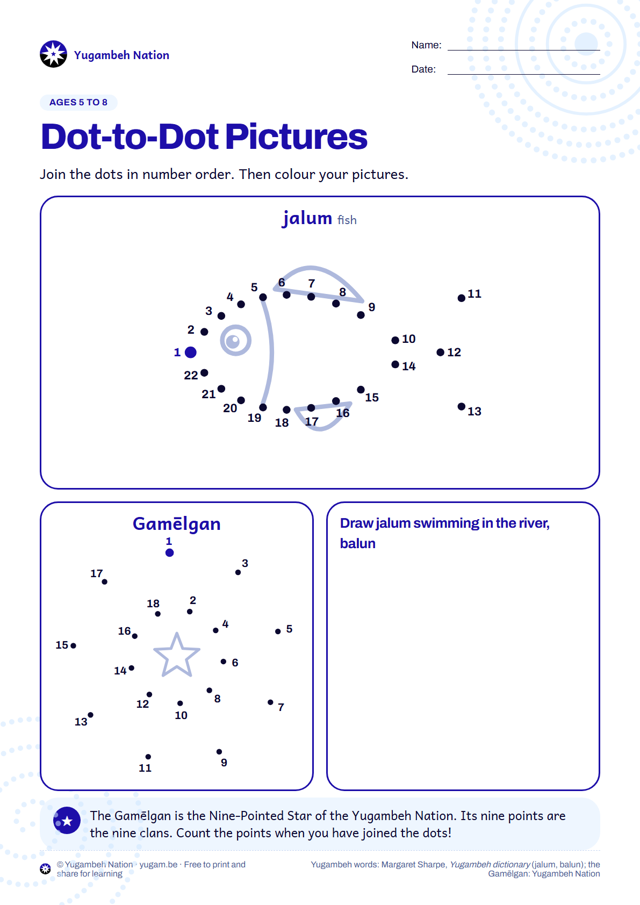
Dot-to-Dot: Jalum the Fish and the Gamēlgan
Two dot-to-dot pictures: join 1 to 22 to find jalum the fish, and 1 to 18 to draw the Gamēlgan, the Nine-Pointed Star whose points are the nine clans.
View and download →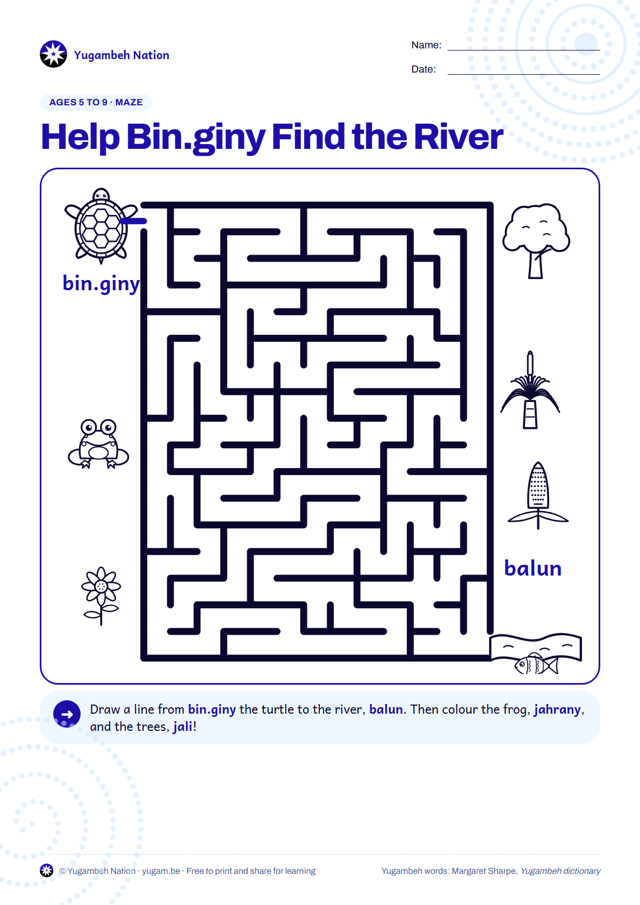
Maze: Help Bin.giny Find the River
Help bin.giny the freshwater turtle find the way through the bush to the river, balun. A maze with Yugambeh words to colour along the way.
View and download →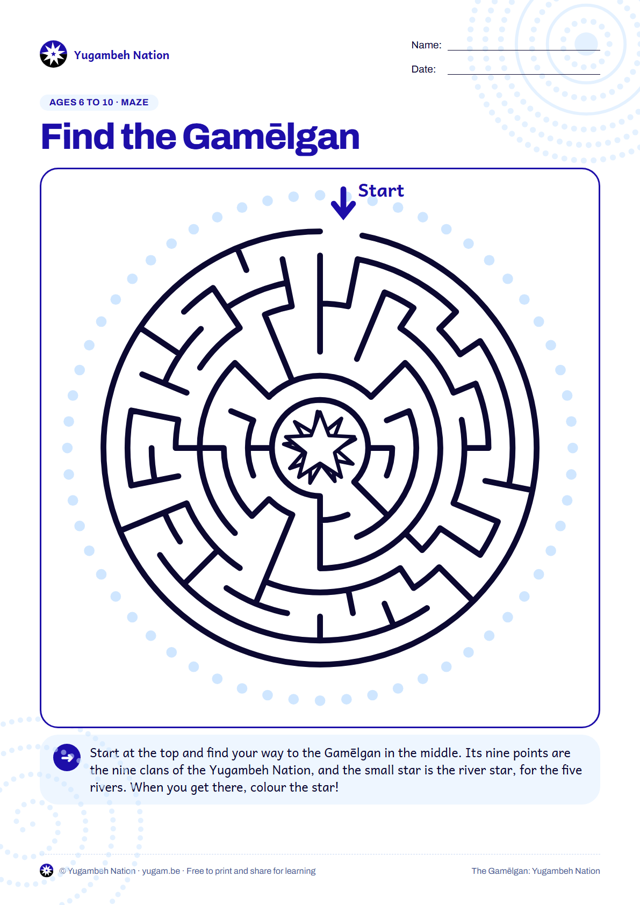
Circle Maze: Find the Gamēlgan
A round maze with the Gamēlgan, the Nine-Pointed Star, at its centre. Find the way in from the outside, then colour the star.
View and download →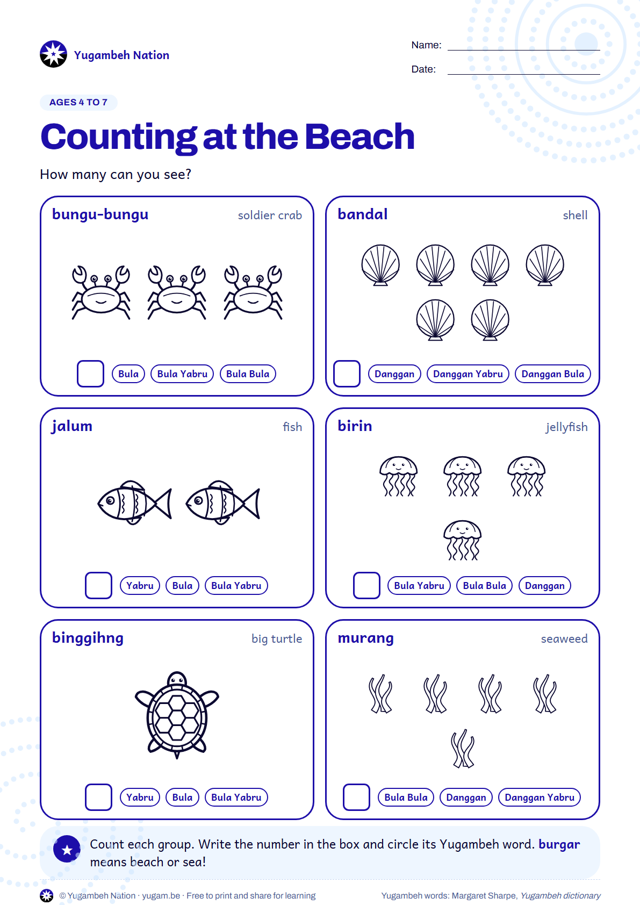
Counting at the Beach
Count the crabs, shells, fish, jellyfish, turtles and seaweed at the beach, then circle the right Yugambeh number word.
View and download →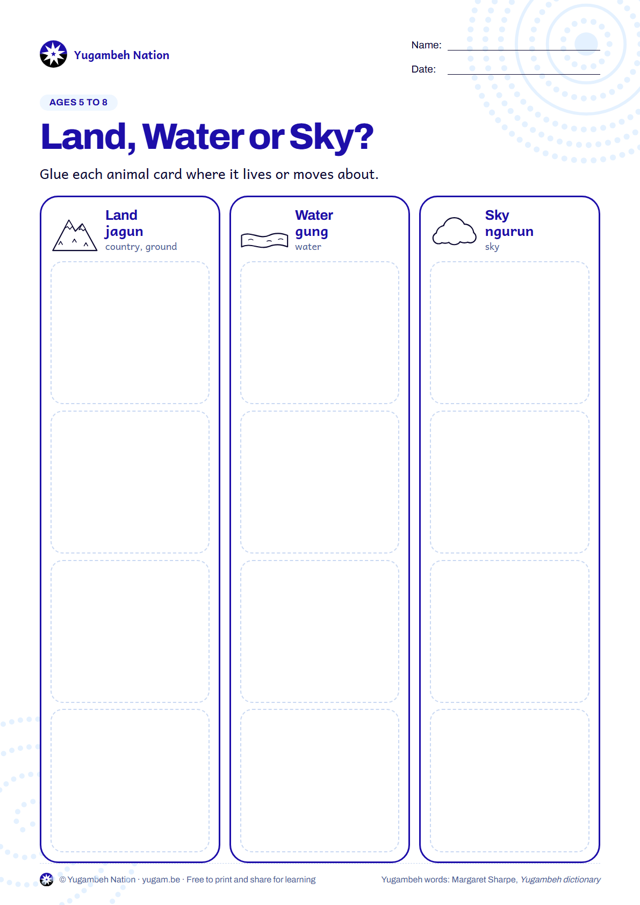
Land, Water or Sky? Animal Sort
Cut out twelve Yugambeh animal cards and sort them: which live on the land, which in the water, and which fly in the sky?
View and download →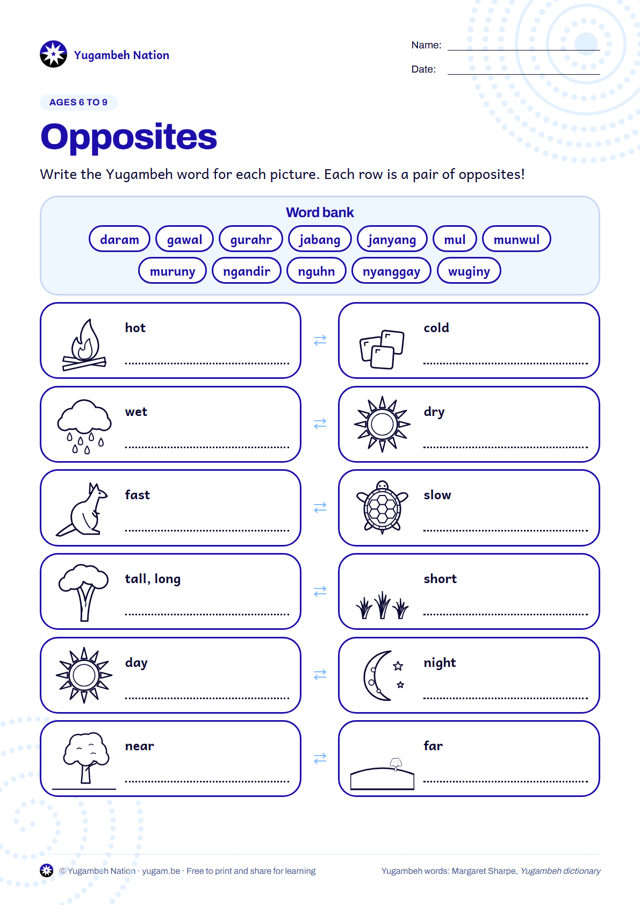
Yugambeh Opposites
Six pairs of opposites in Yugambeh, from nguhn (hot) and muruny (cold) to nyanggay (day) and ngandir (night). Read the words, write them, and colour the pictures.
View and download →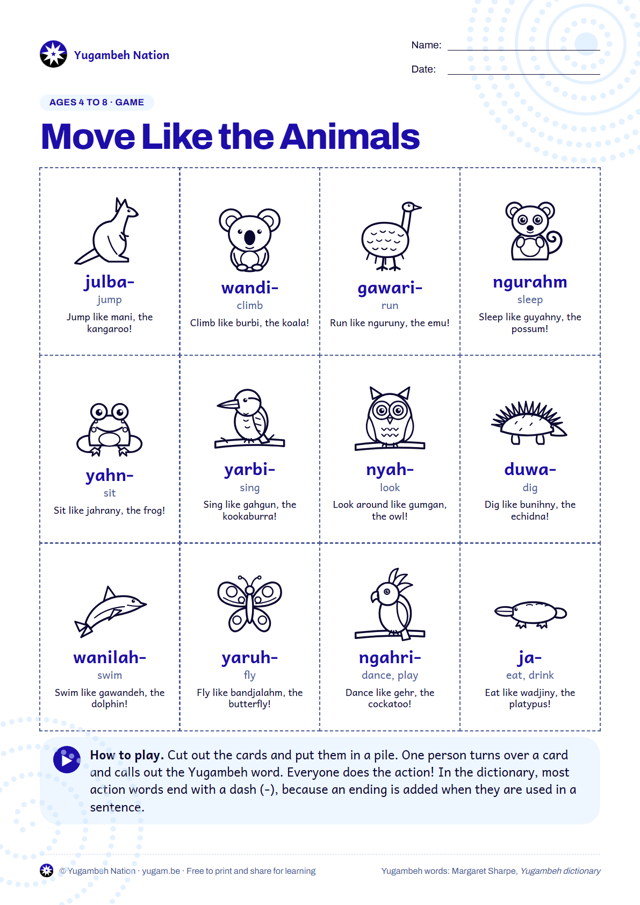
Move Like the Animals: Yugambeh Action Cards
Twelve action cards with Yugambeh action words, from julba- (jump) to yarbi- (sing). Call out a card and everyone moves like the animal!
View and download →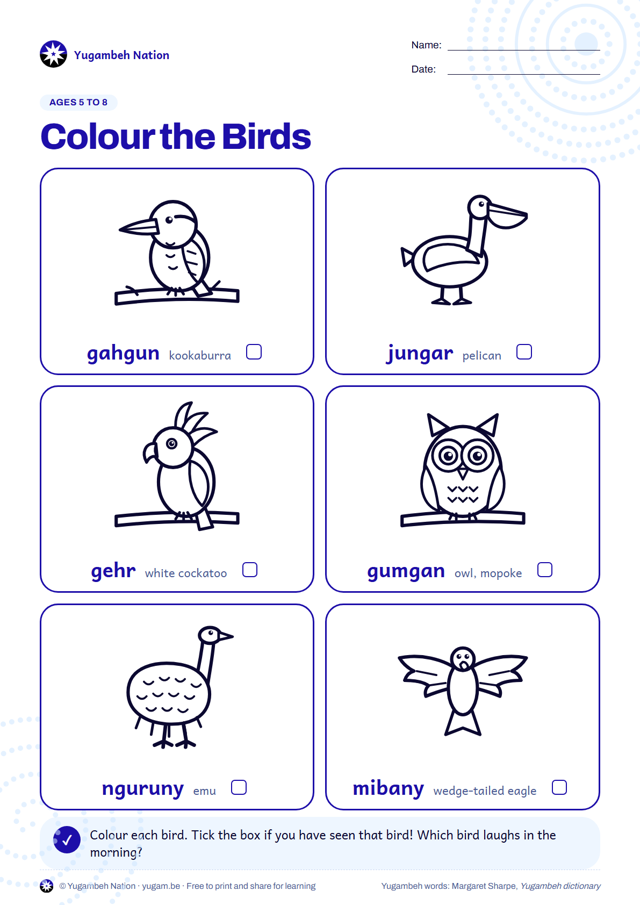
Colour the Birds of Yugambeh Country
Colour six birds and learn their Yugambeh names: gahgun the kookaburra, jungar the pelican, gehr the white cockatoo, gumgan the owl, nguruny the emu and mibany the eagle.
View and download →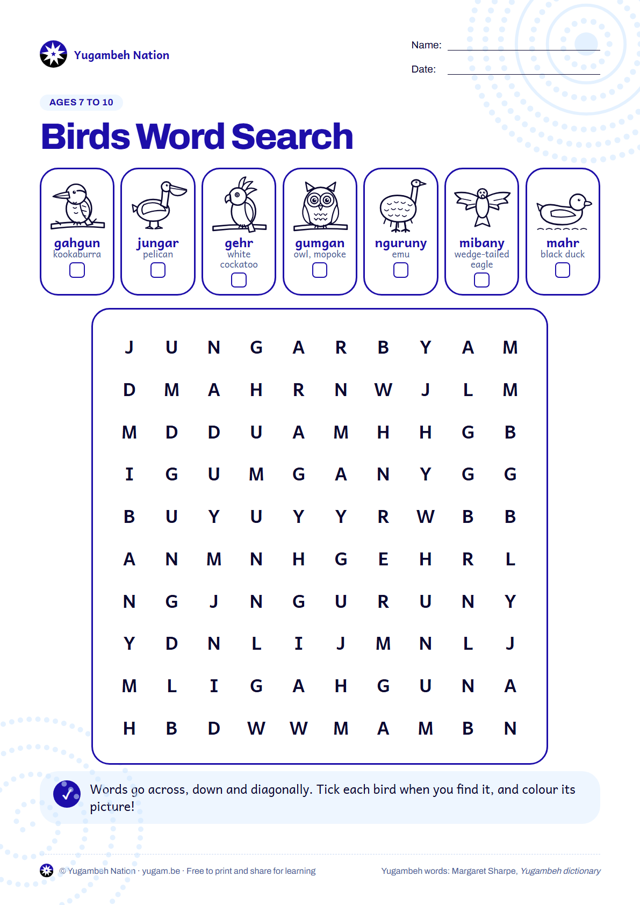
Yugambeh Birds Word Search
Find seven Yugambeh bird names in the grid, with a picture clue for each bird. Includes an answer key.
View and download →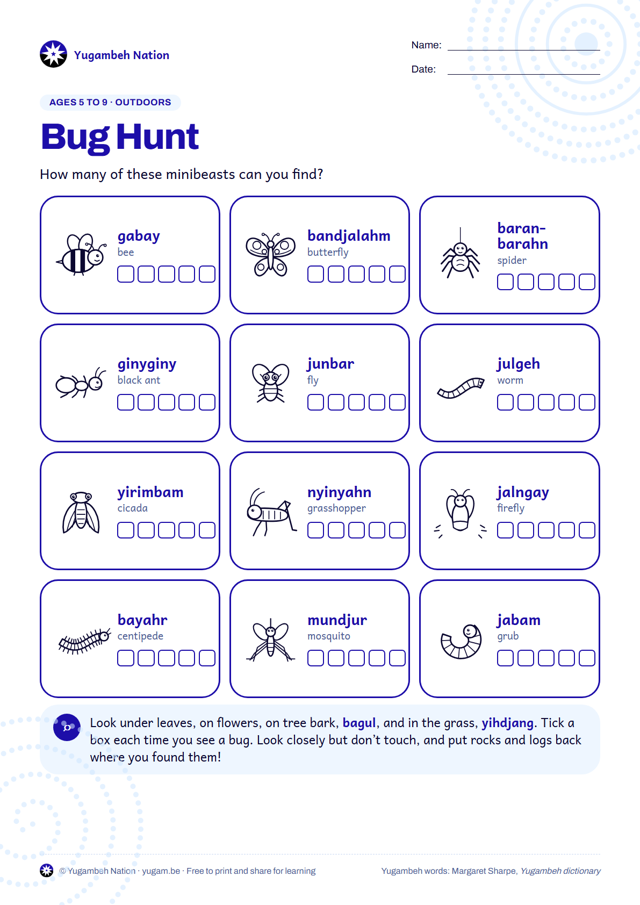
Yugambeh Bug Hunt
Take this checklist outside and go on a bug hunt! Twelve minibeasts with their Yugambeh names, from gabay the bee to julgeh the worm, with tally boxes.
View and download →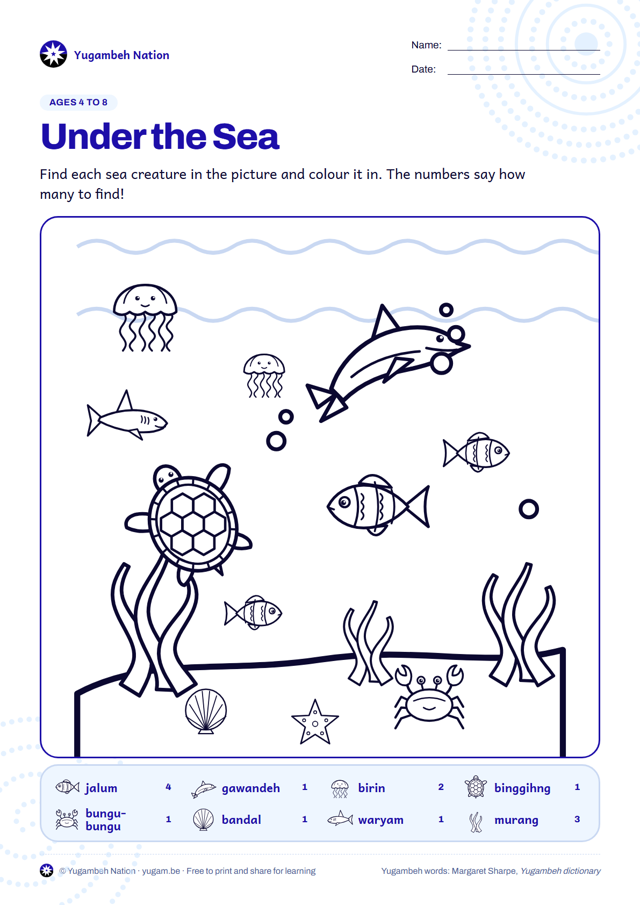
Under the Sea: Colour and Find
A big under-the-sea colouring scene with fish, a dolphin, a turtle, a crab, jellyfish and shells, and a find-it list of Yugambeh words.
View and download →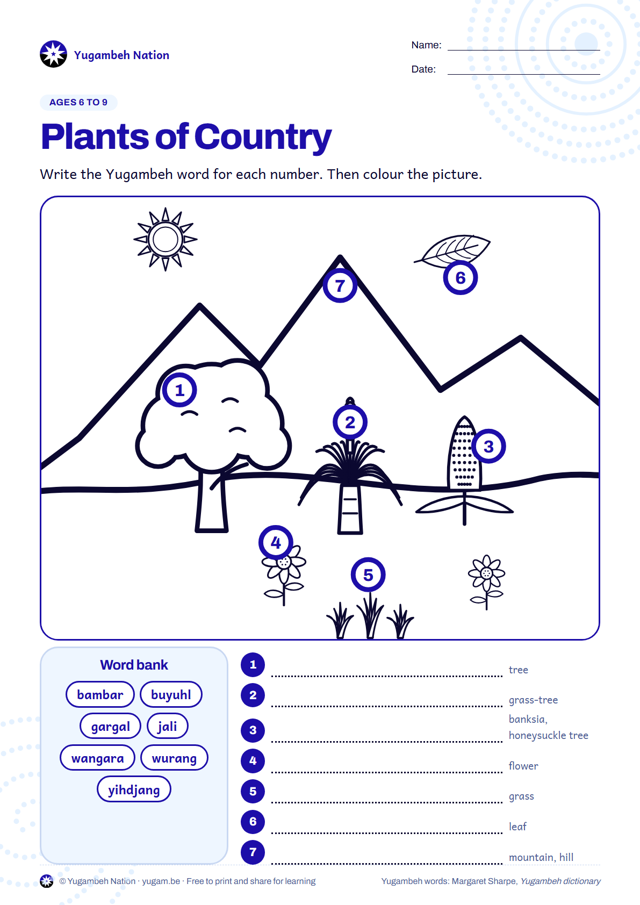
Plants of Yugambeh Country: Label and Colour
Label a bush scene with Yugambeh words for tree, grass-tree, banksia, flower, grass, leaf and mountain, then colour it in.
View and download →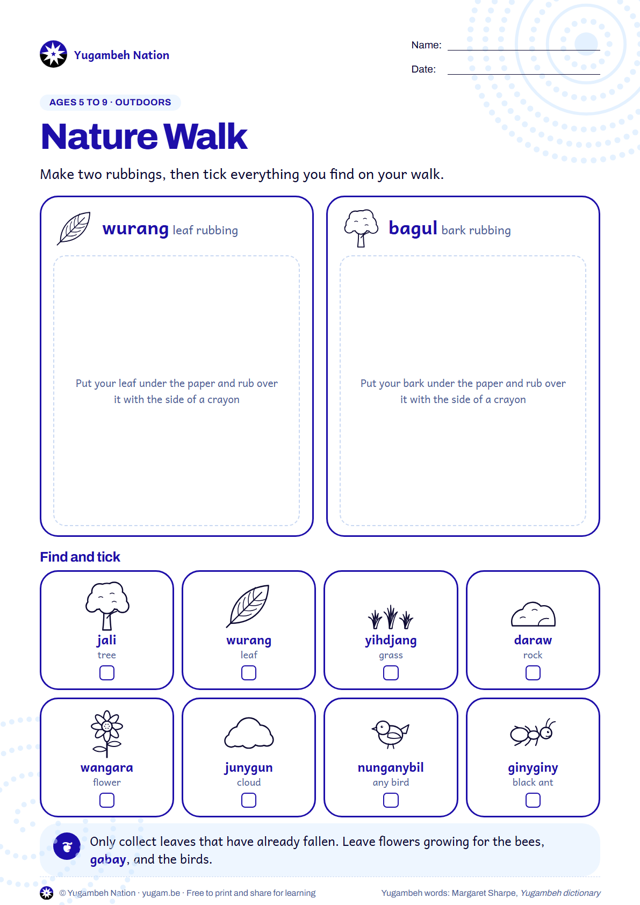
Nature Walk: Leaf and Bark Rubbings
Go on a nature walk, make a leaf rubbing and a bark rubbing, and tick off what you find using Yugambeh words.
View and download →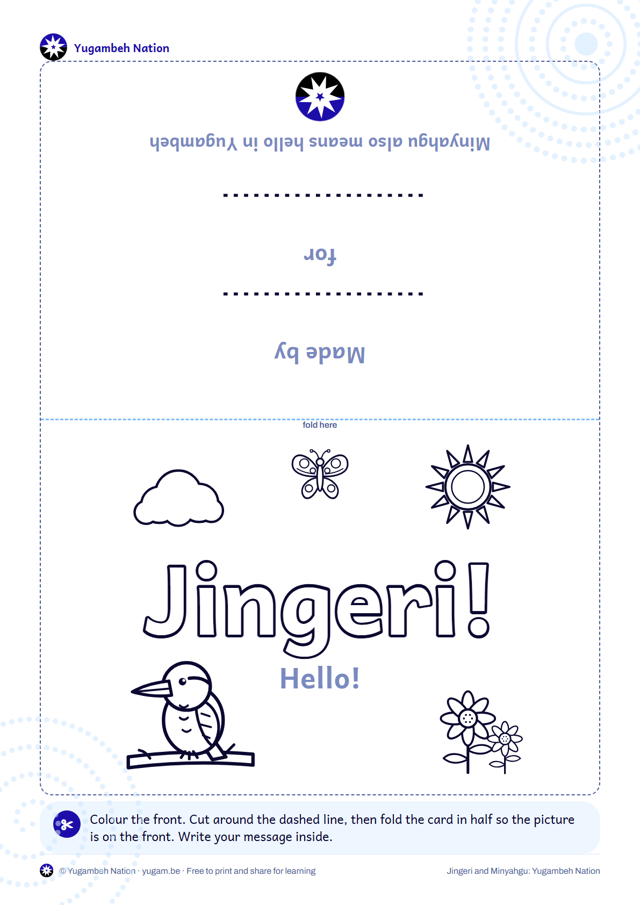
Jingeri! A Yugambeh Hello Card
A fold-in-half card to colour and give someone, saying hello in Yugambeh: Jingeri! Write a message inside.
View and download →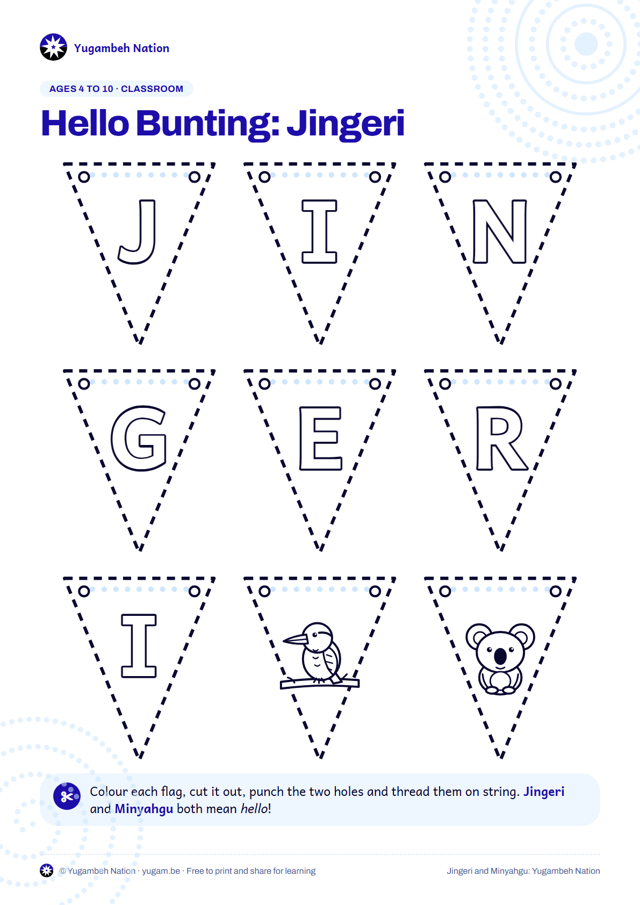
Jingeri and Minyahgu Hello Bunting
Colour, cut out and string up hello bunting for your classroom: JINGERI and MINYAHGU, the two ways to say hello in Yugambeh, with animal flags.
View and download →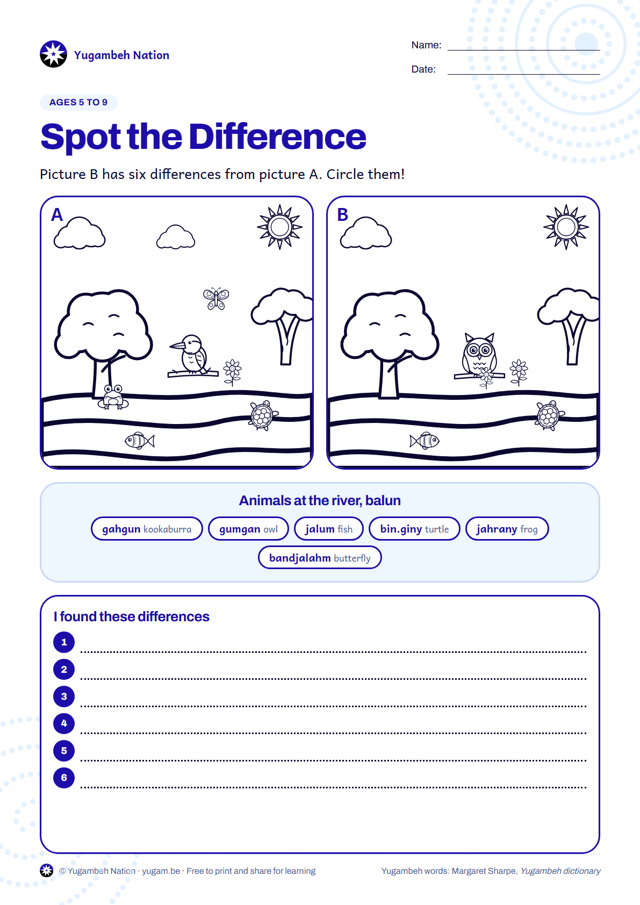
Spot the Difference at the River
Two river pictures with six differences to find. Circle them, then colour the pictures and name the animals in Yugambeh. Includes an answer key.
View and download →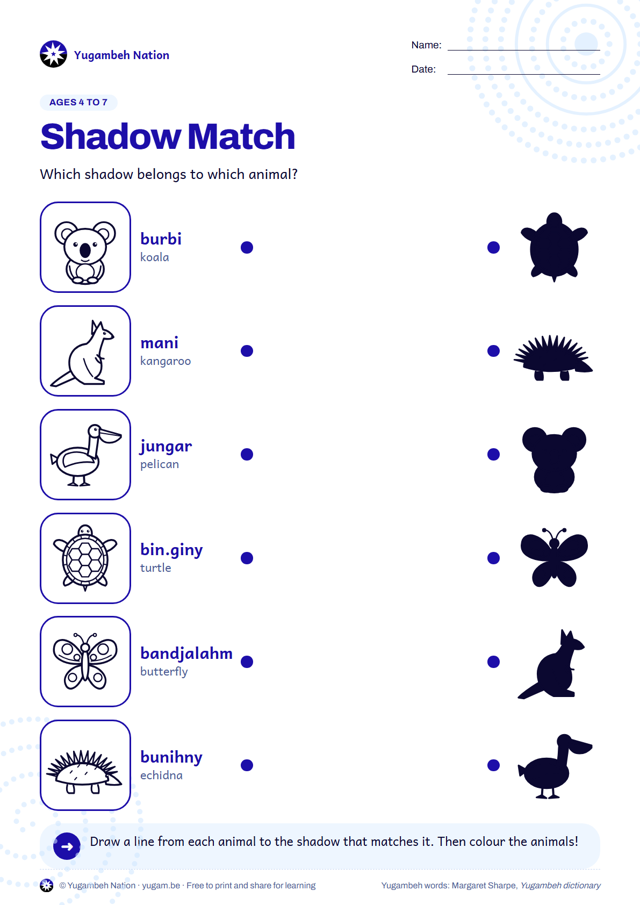
Animal Shadow Match
Draw a line from each Yugambeh animal to its shadow: burbi, mani, jungar, bin.giny, bandjalahm and bunihny.
View and download →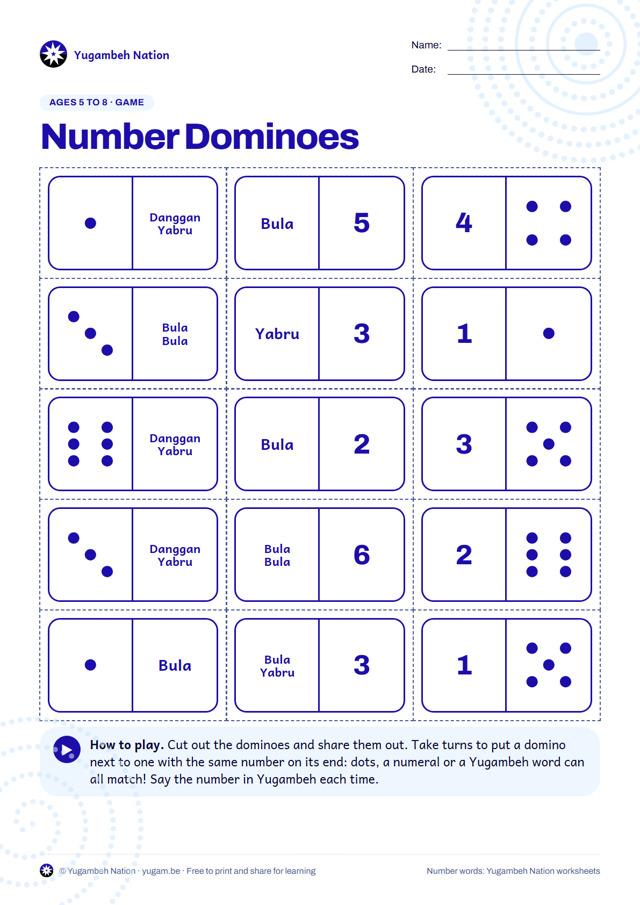
Yugambeh Number Dominoes
Cut out fifteen dominoes that mix dots, numerals and Yugambeh number words from Yabru (1) to Danggan Yabru (6), and play by matching numbers.
View and download →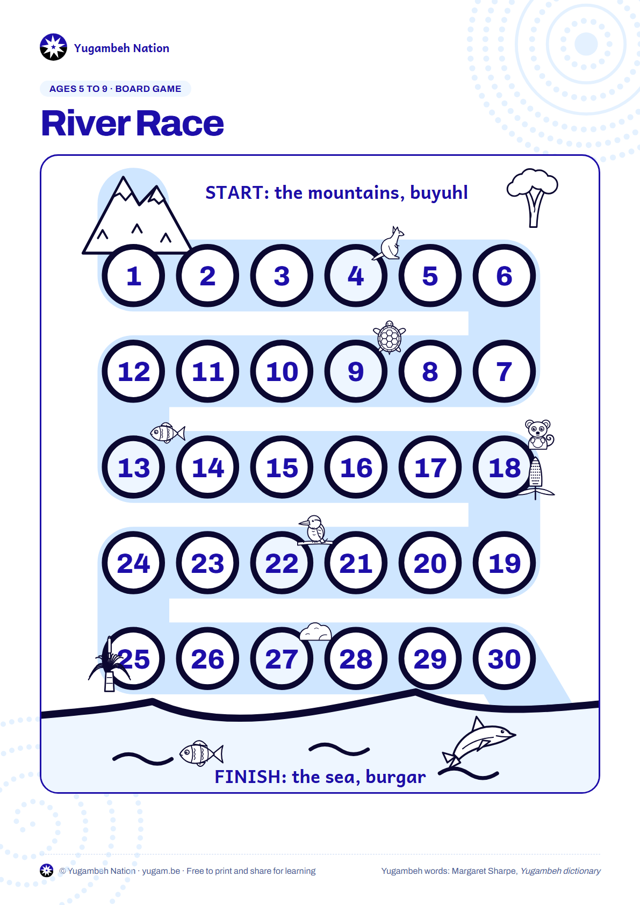
River Race: A Yugambeh Counting Board Game
A board game from the mountains to the sea. Roll a die, say the number in Yugambeh, and follow the river past animals that help or slow you down.
View and download →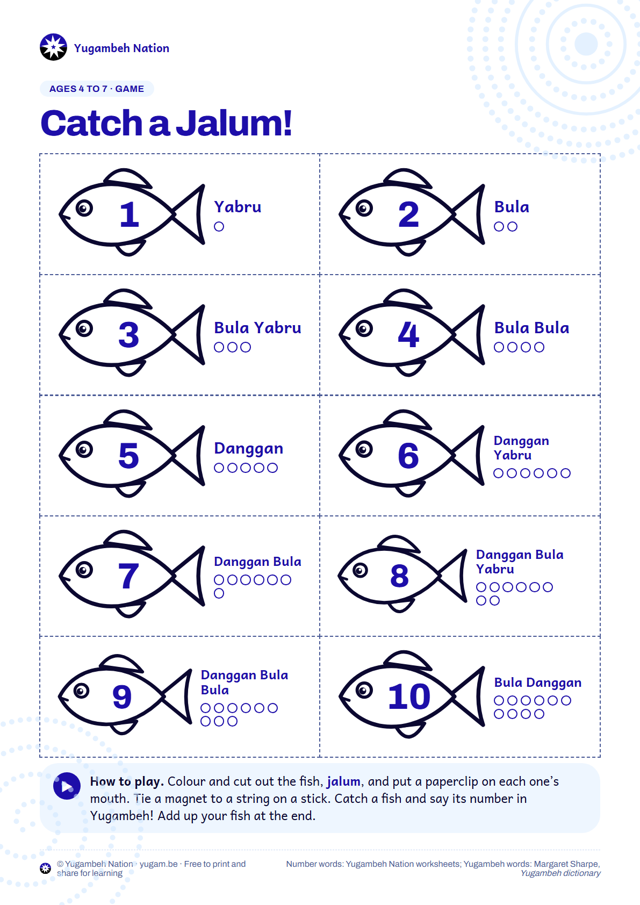
Catch a Jalum: Counting Fish Game
Ten fish to colour and cut out, numbered 1 to 10 with their Yugambeh number words. Add a paperclip and go fishing with a magnet!
View and download →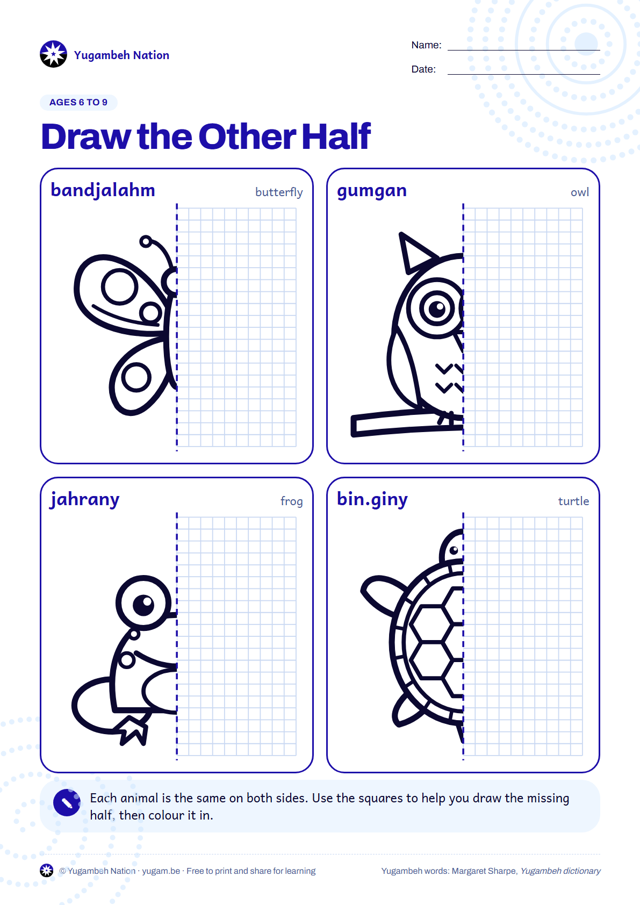
Draw the Other Half
Finish four symmetrical pictures by drawing the missing half: bandjalahm the butterfly, gumgan the owl, jahrany the frog and bin.giny the turtle.
View and download →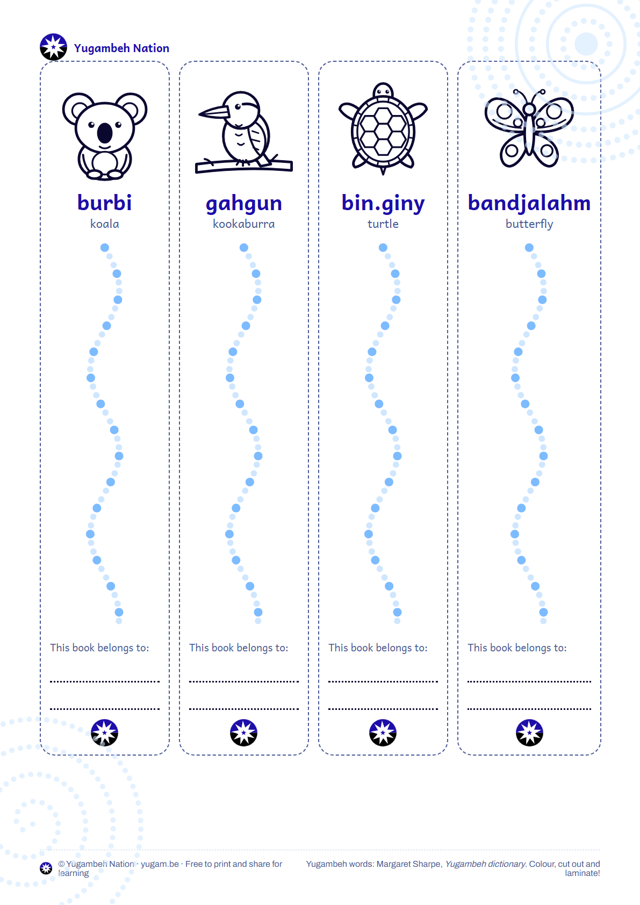
Yugambeh Animal Bookmarks
Four bookmarks to colour and cut out, each with a Yugambeh animal: burbi the koala, gahgun the kookaburra, bin.giny the turtle and bandjalahm the butterfly.
View and download →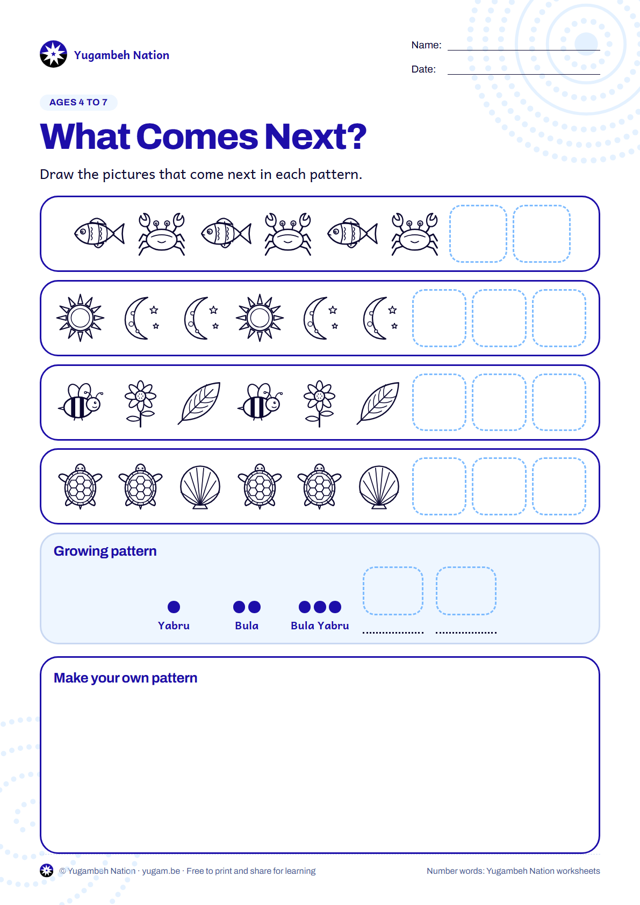
What Comes Next? Picture and Number Patterns
Finish picture patterns of fish and crabs, suns and moons, bees and flowers, then a growing pattern with Yugambeh number words.
View and download →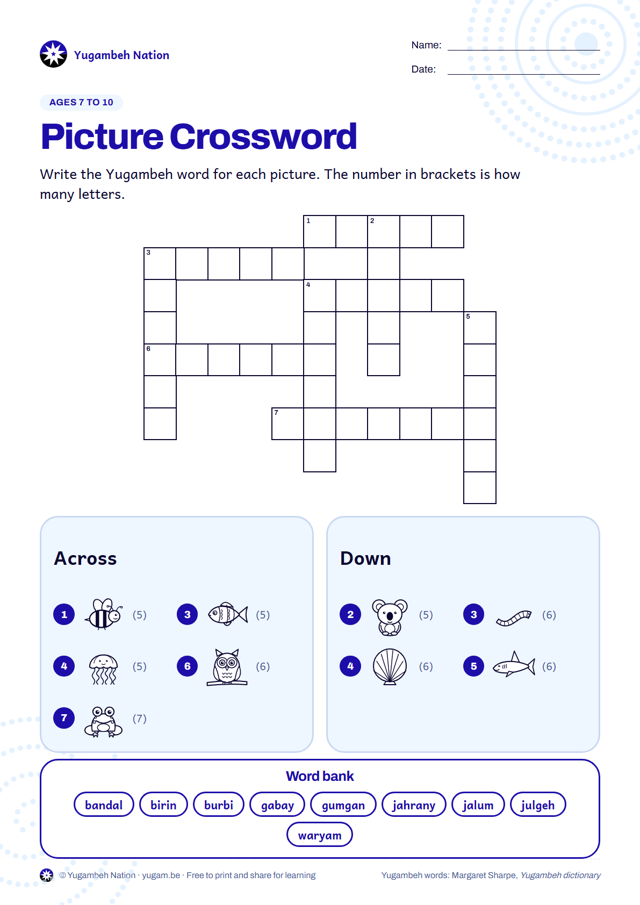
Yugambeh Picture Crossword
A crossword with picture clues: write the Yugambeh word for each animal, from jalum the fish to gumgan the owl. Includes a word bank and an answer key.
View and download →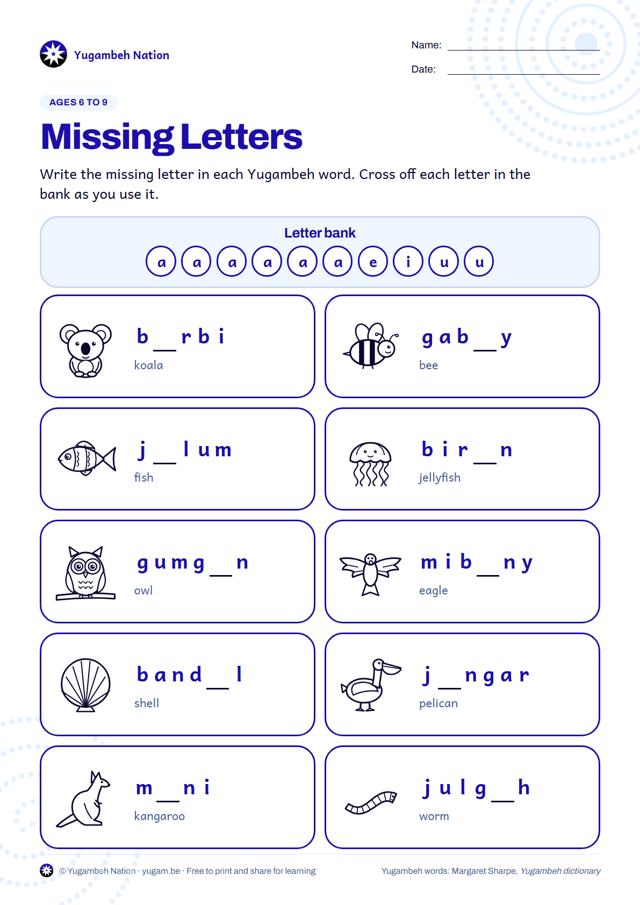
Missing Letters: Yugambeh Animal Words
Fill in the missing letter in ten Yugambeh animal words, using the picture and the letter bank to help.
View and download →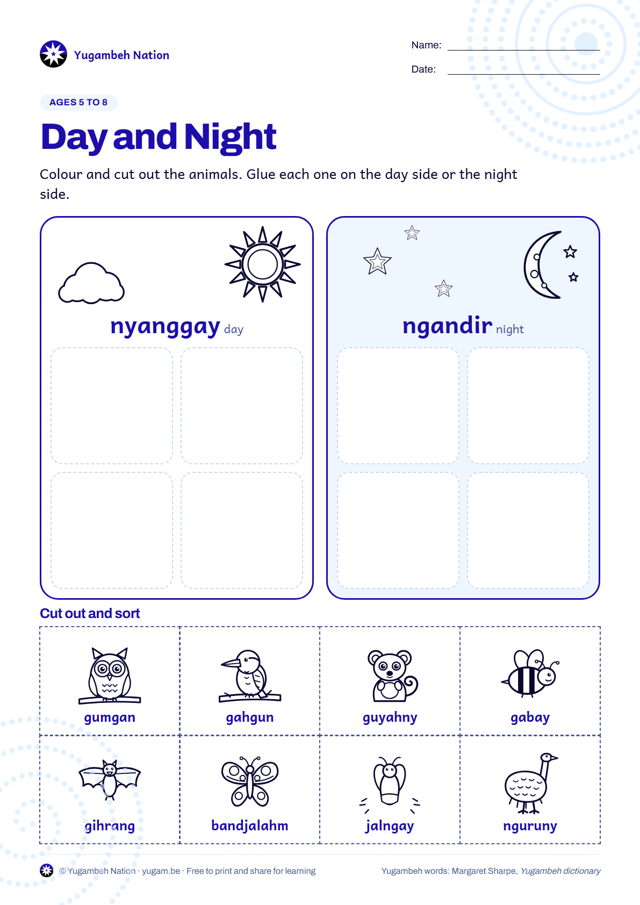
Day and Night: Nyanggay and Ngandir
Sort eight Yugambeh animals into day, nyanggay, and night, ngandir. Which animals are busy when the sun is up, and which come out under the moon?
View and download →For older students
Reading, history, language, civics and discussion for high school. 63 worksheets.
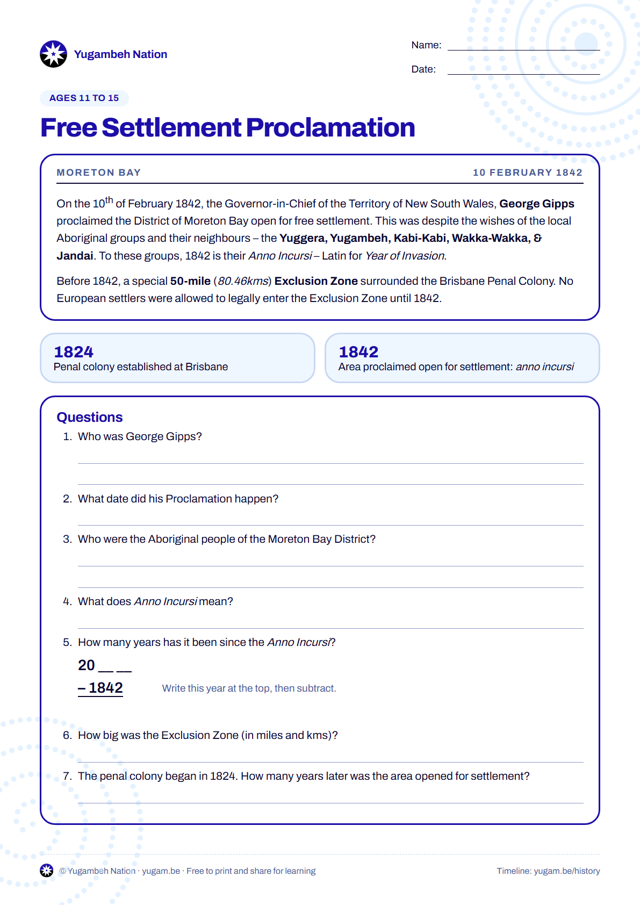
Free Settlement Proclamation Worksheet
Learn about the year 1842, the Proclamation of George Gipps, and what it meant for local Aboriginal people, in this simple worksheet.
View and download →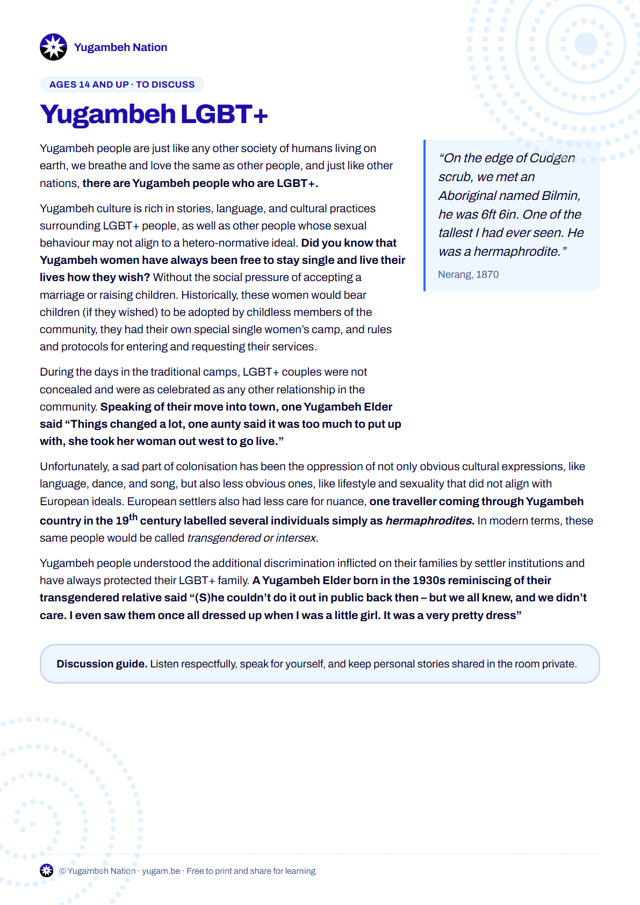
Yugambeh LGBT+ Discussion Sheet
A discussion activity introducing students to Yugambeh LGBT+ history and culture.
View and download →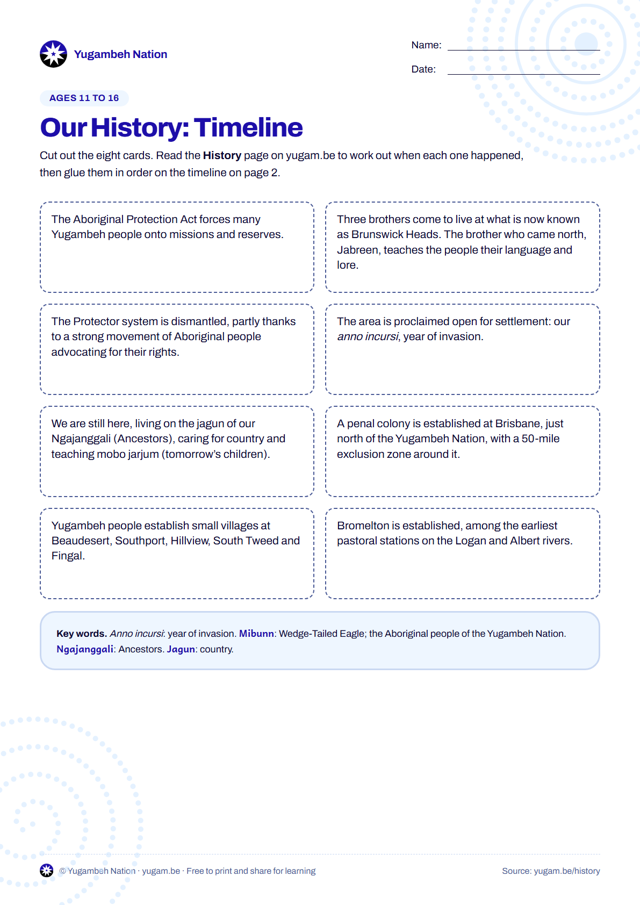
Our History: Timeline Activity
Cut out eight moments in Yugambeh history, from the Dreaming to today, put them in order on the timeline and answer the questions.
View and download →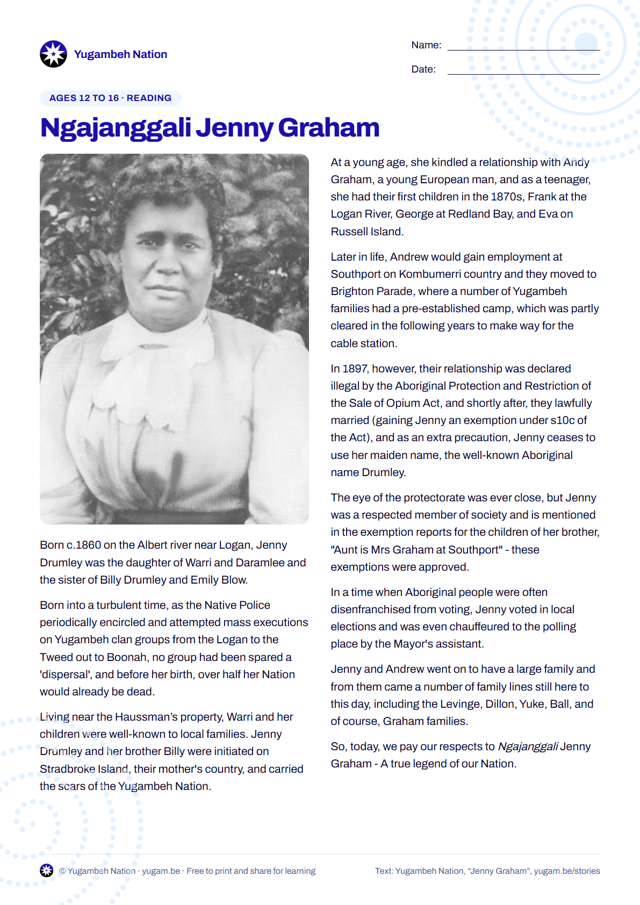
Jenny Graham: Reading Comprehension
Read the story of Ngajanggali Jenny Graham, a true legend of our Nation, and answer questions about her life and times.
View and download →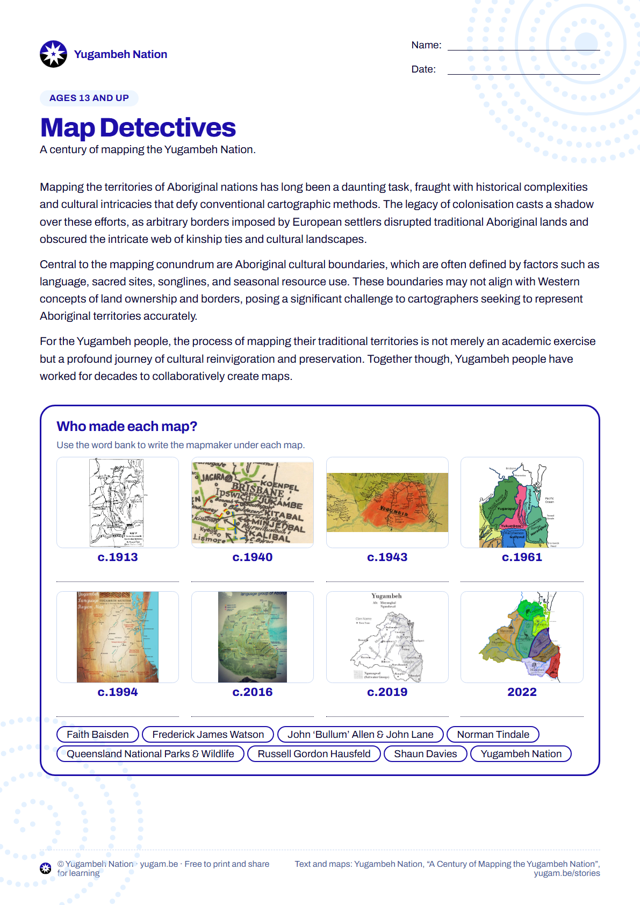
Map Detectives: A Century of Mapping
Explore more than a hundred years of maps of the Yugambeh Nation, from 1913 to today, and think about who makes maps and why.
View and download →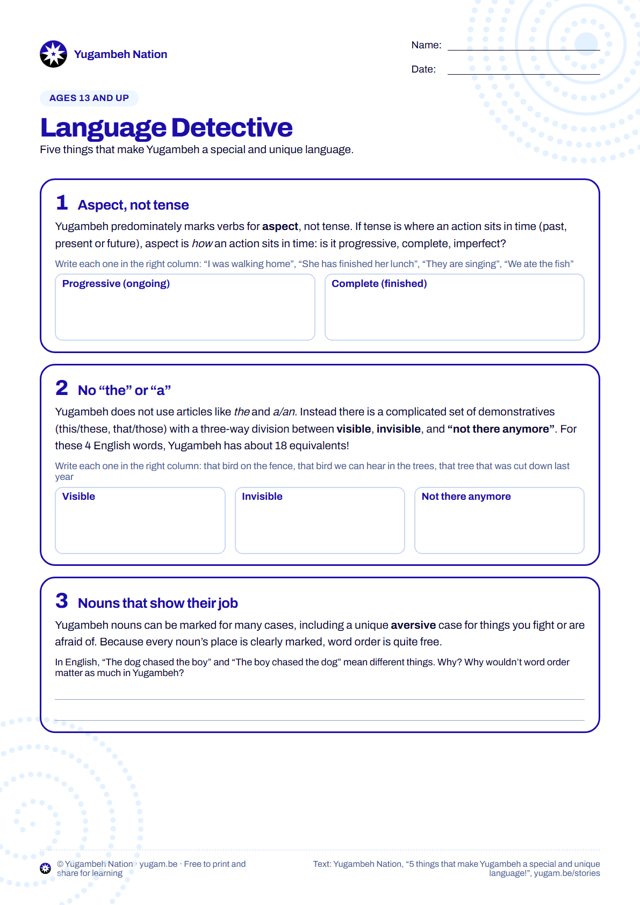
Language Detective: What Makes Yugambeh Special
Five things that make Yugambeh a special and unique language, with puzzles that show how its grammar works compared with English.
View and download →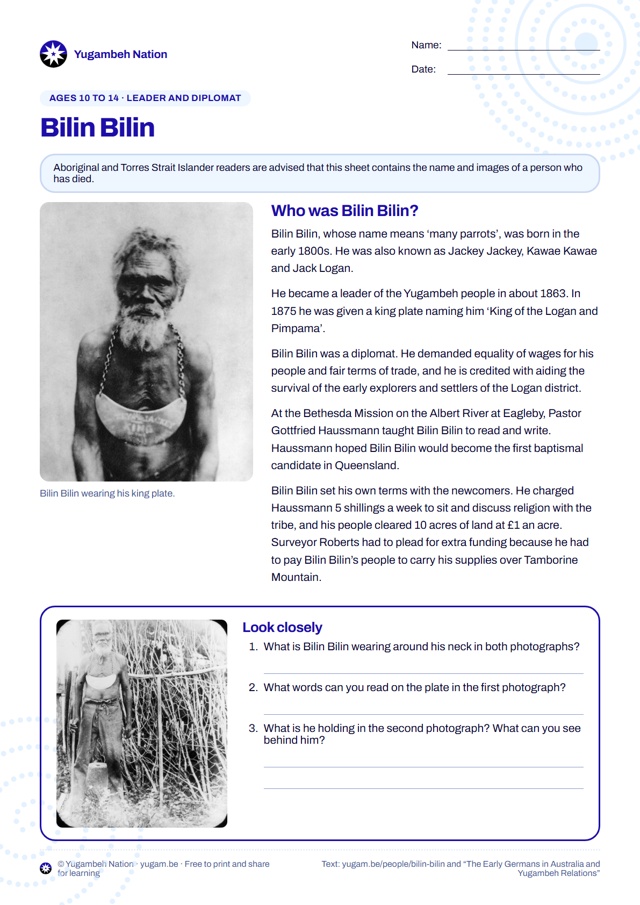
Bilin Bilin: Leader and Diplomat
Look closely at two historic photographs of Bilin Bilin, read about the leader who demanded equal wages for his people, and answer questions.
View and download →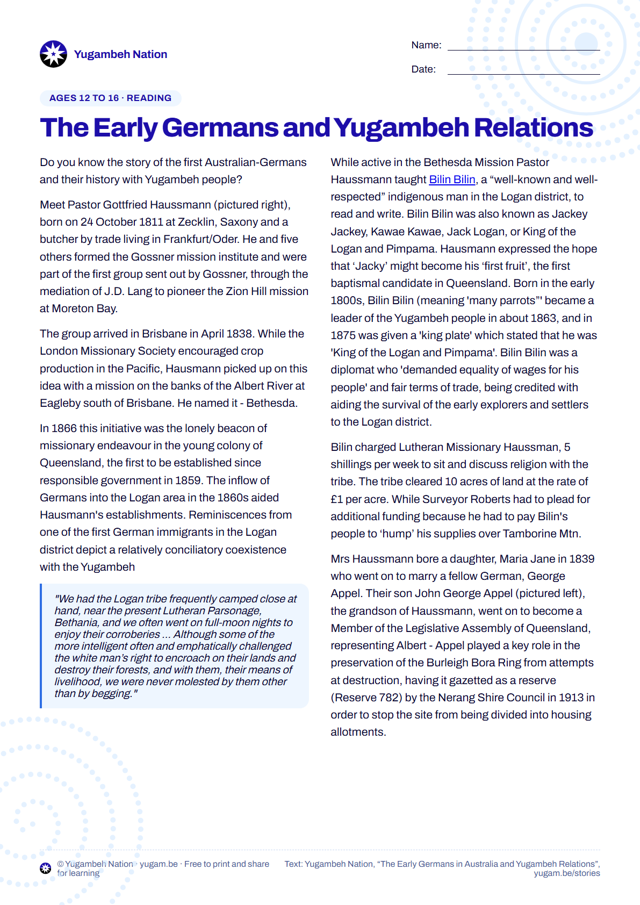
The Early Germans and Yugambeh Relations
Read about Pastor Haussmann’s Bethesda mission, Bilin Bilin’s terms of trade and the Burleigh Bora Ring, then answer the questions.
View and download →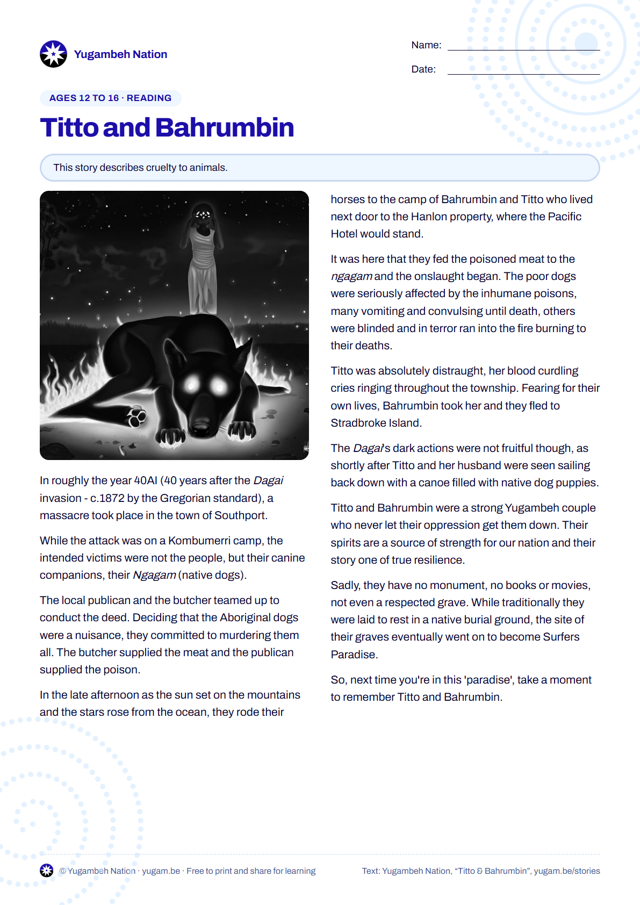
Titto and Bahrumbin: Reading and Reflection
Read the story of Titto and Bahrumbin, a strong Yugambeh couple, answer questions and design a monument to remember them.
View and download →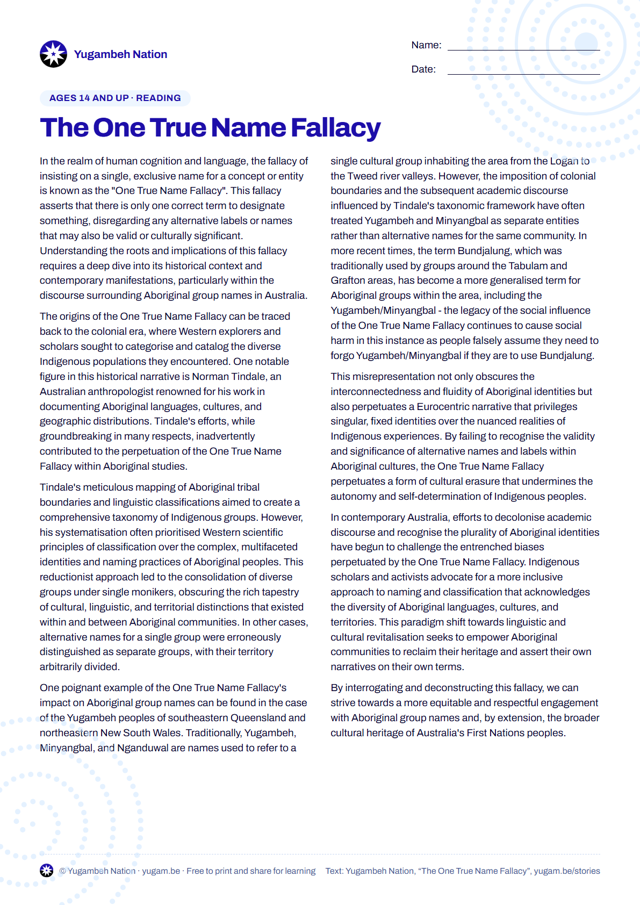
The One True Name Fallacy
Read about the One True Name Fallacy and how it shaped the names Yugambeh, Minyangbal and Bundjalung, then think critically about names.
View and download →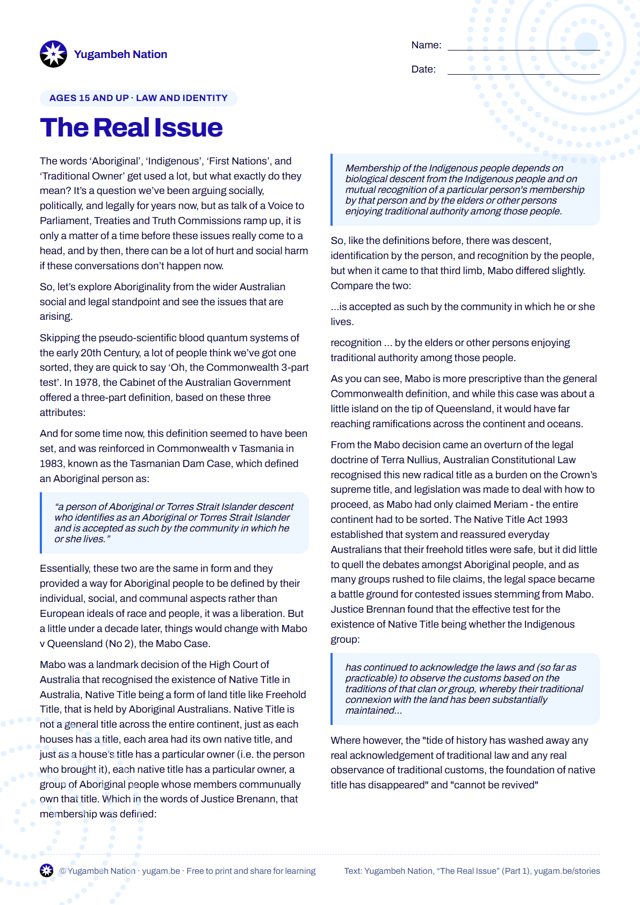
The Real Issue: Who Is an Aboriginal Person?
Explore the three-part test, the Tasmanian Dam Case and the Mabo decision, and compare how the law has defined Aboriginality.
View and download →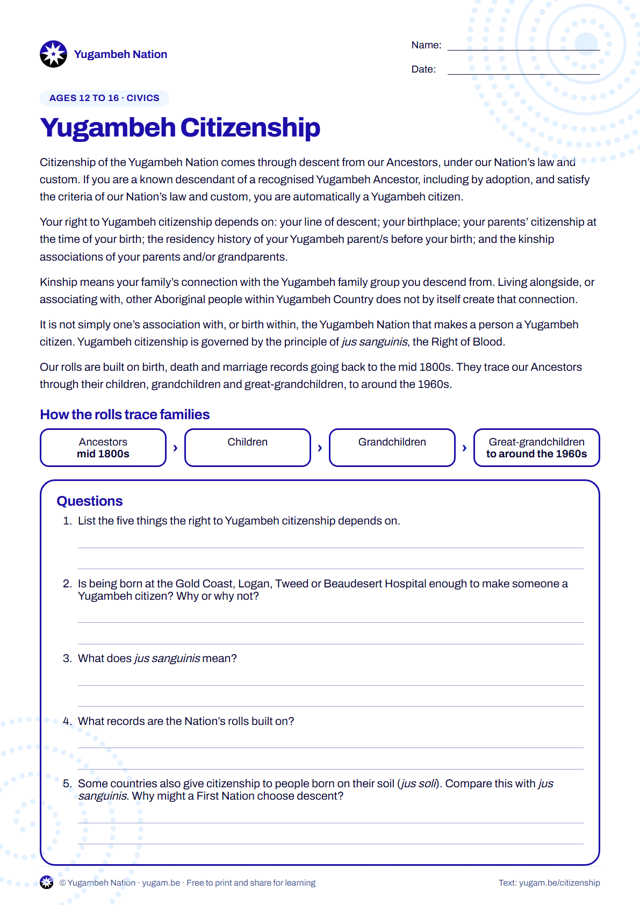
Yugambeh Citizenship
Learn how citizenship of the Yugambeh Nation works, from the right of blood to the Nation’s rolls, and compare it with other ways nations decide citizenship.
View and download →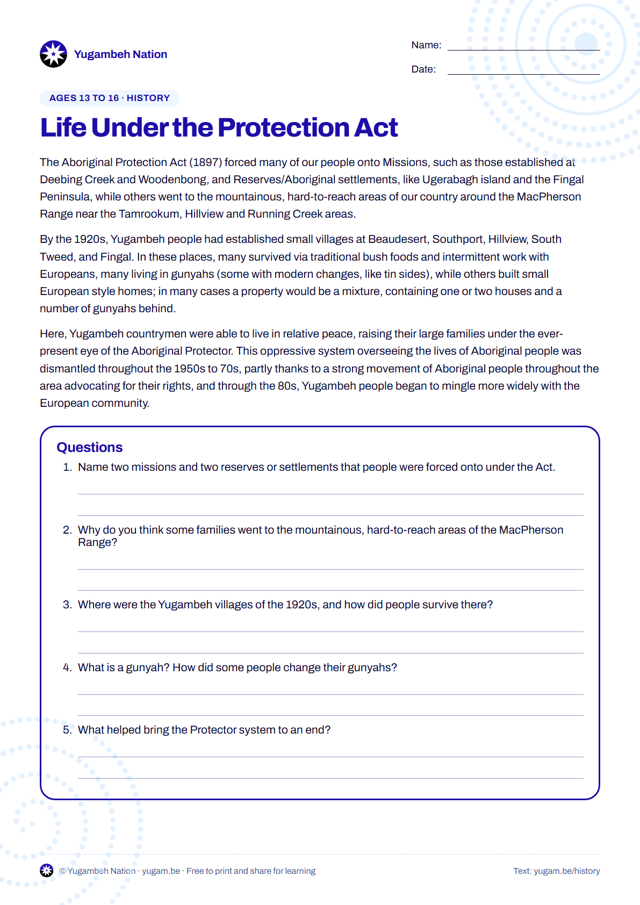
Life Under the Protection Act
Read how the Aboriginal Protection Act of 1897 changed the lives of Yugambeh people, and how families survived, then write a diary entry.
View and download →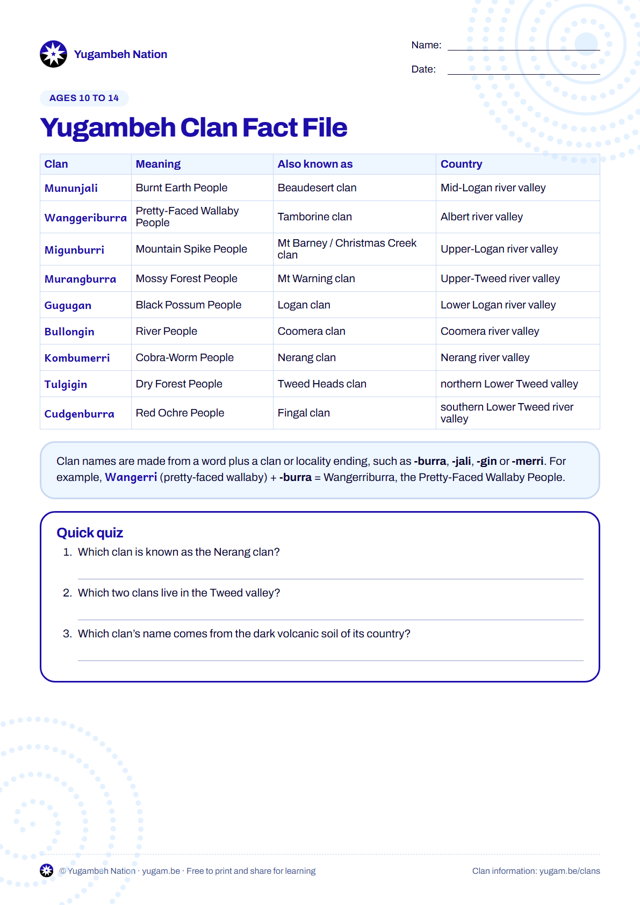
Yugambeh Clan Fact File
A reference table of the nine Yugambeh clans and a fact-file template for researching one clan in depth.
View and download →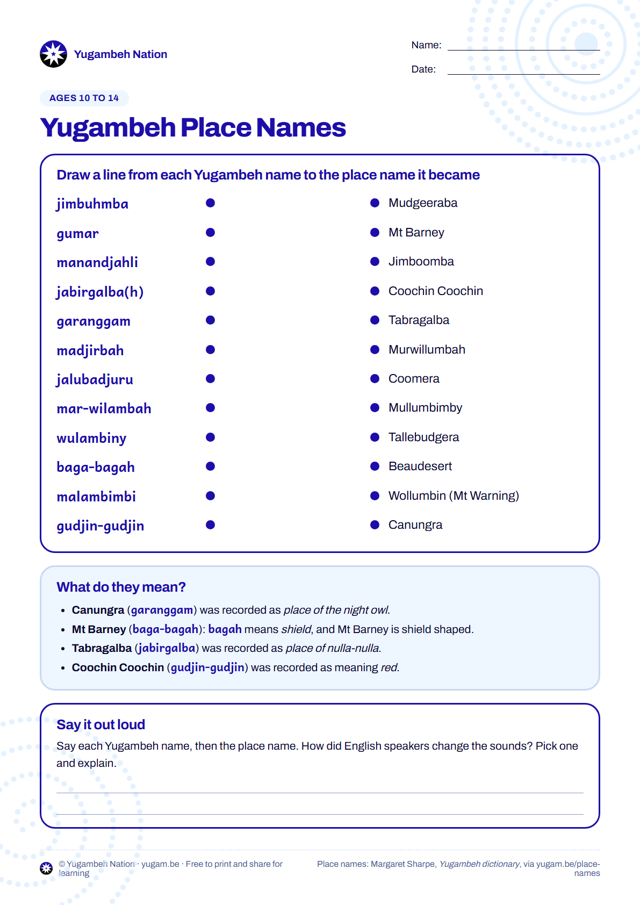
Yugambeh Place Names
Match twelve modern place names to the Yugambeh names they came from, and discover what some of them mean.
View and download →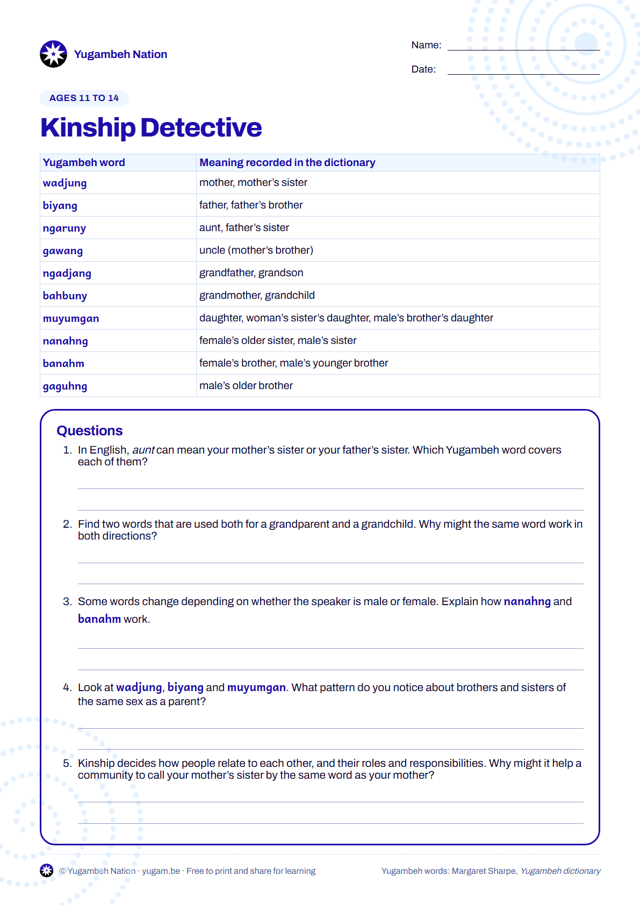
Kinship Detective
Compare Yugambeh and English family words and work out the patterns in how Yugambeh kinship terms group relatives.
View and download →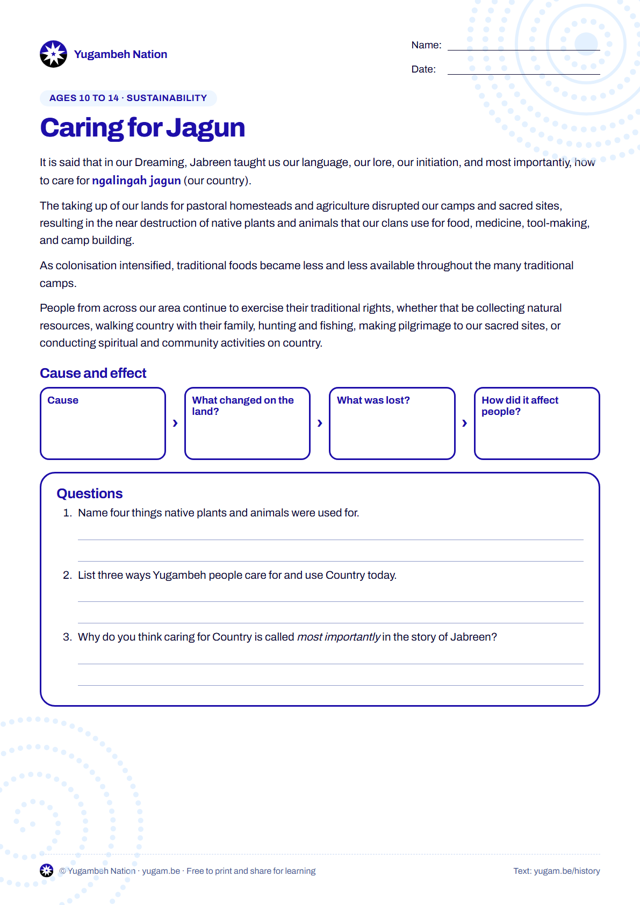
Caring for Jagun
Learn how colonisation changed the plants, animals and foods of Yugambeh Country, how Yugambeh people care for Country today, and plan an action of your own.
View and download →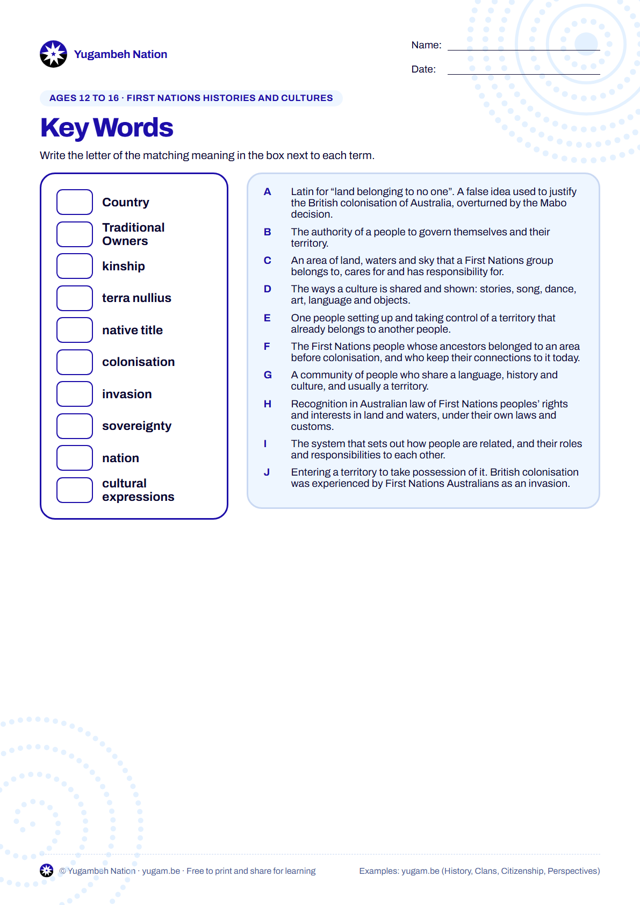
Key Words: First Nations Histories and Cultures
Match ten key terms, from Country and kinship to terra nullius and sovereignty, to their meanings and to Yugambeh examples.
View and download →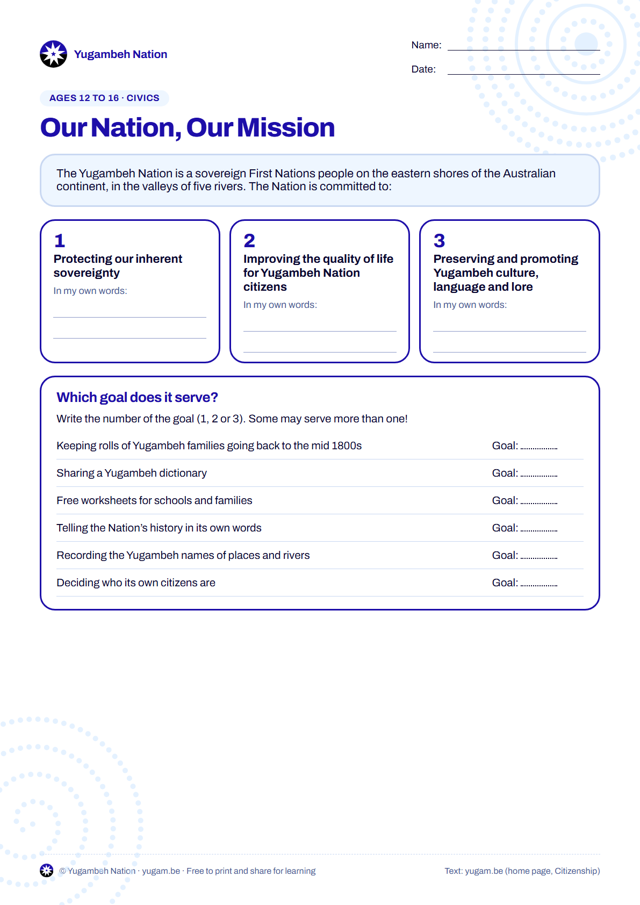
Our Nation, Our Mission
Explore the Yugambeh Nation’s three commitments, sovereignty, quality of life, and culture, language and lore, and design a project for one of them.
View and download →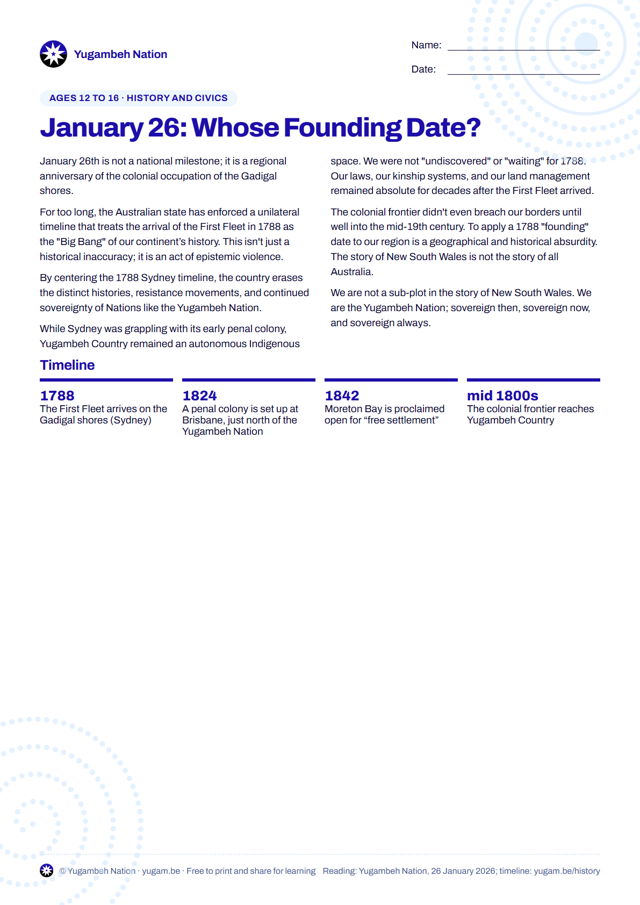
January 26: Whose Founding Date?
Read the Nation’s view of January 26, build a timeline from 1788 to 1842, and think about why one national date doesn’t fit every Nation.
View and download →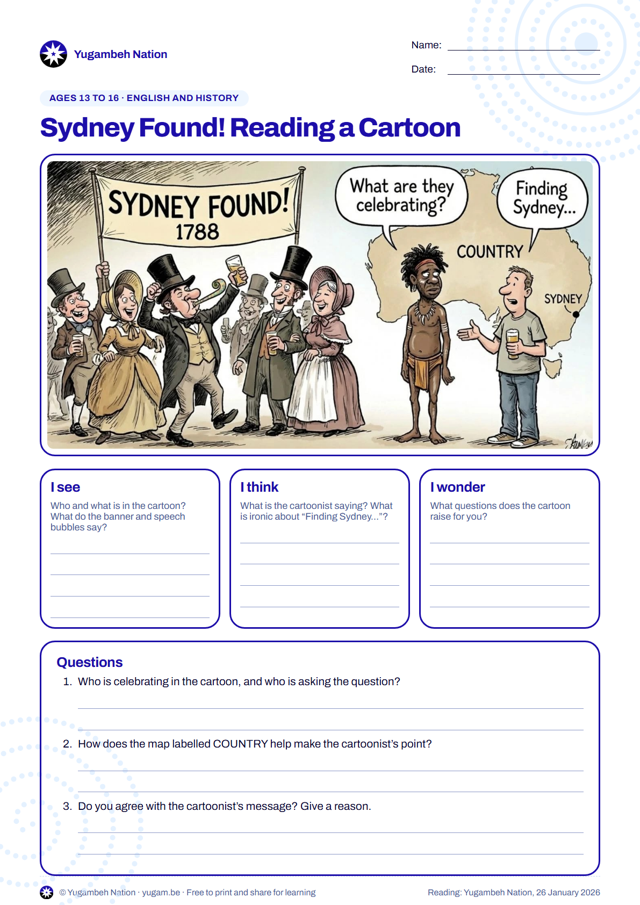
Sydney Found! Reading a Political Cartoon
Analyse a cartoon about January 26: what you see, what you think it means, and what the cartoonist wants you to understand.
View and download →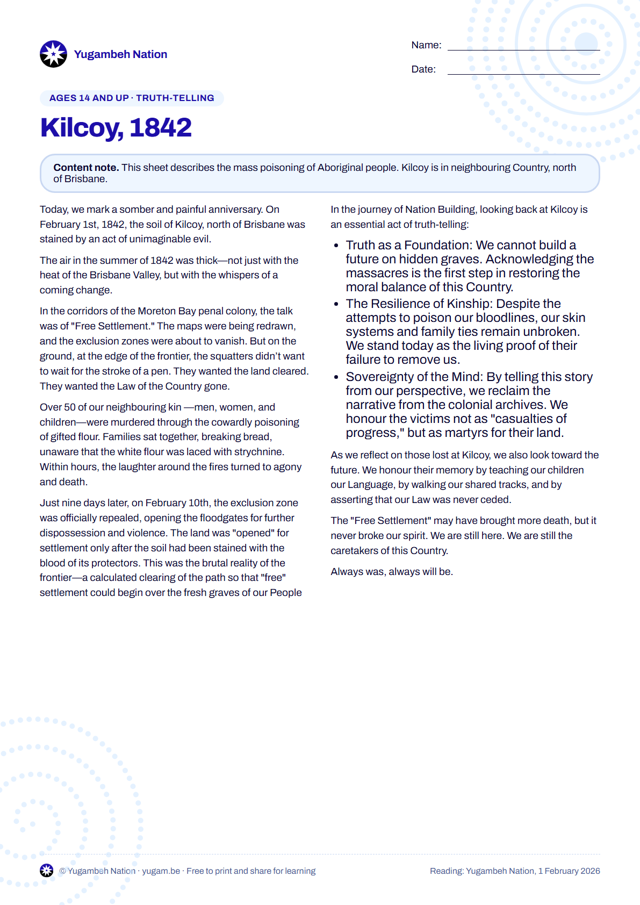
Kilcoy, 1842: Truth-Telling
Read the Nation’s remembrance of the Kilcoy poisoning of February 1842 in neighbouring Country, and reflect on why truth-telling matters for Nation Building.
View and download →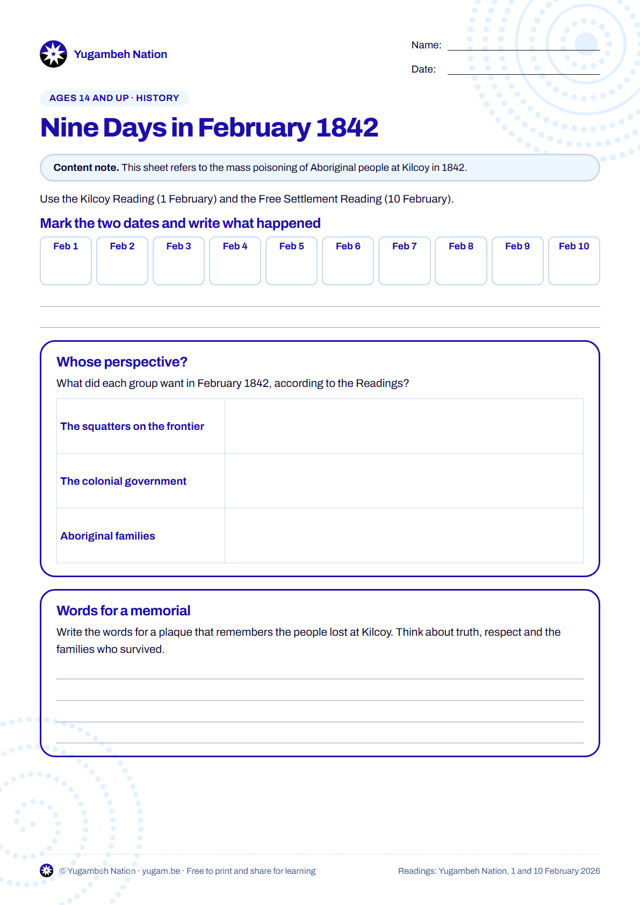
Nine Days in February 1842
Connect the Kilcoy poisoning of 1 February 1842 to the opening of Moreton Bay for “free settlement” on 10 February, and write words for a memorial.
View and download →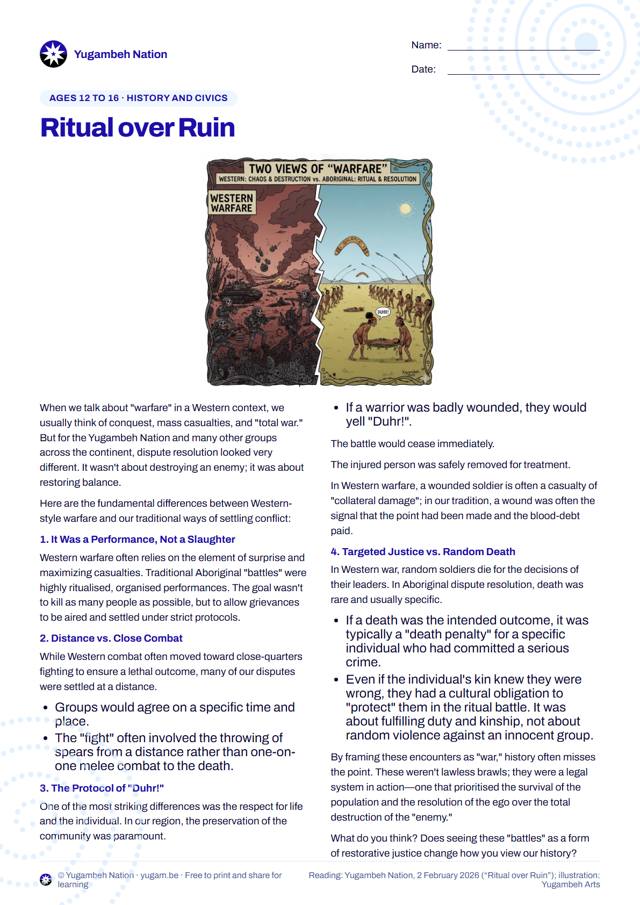
Ritual over Ruin: Two Views of Warfare
Compare Western-style warfare with traditional Aboriginal dispute resolution, from agreed meeting places to the call of “Duhr!”.
View and download →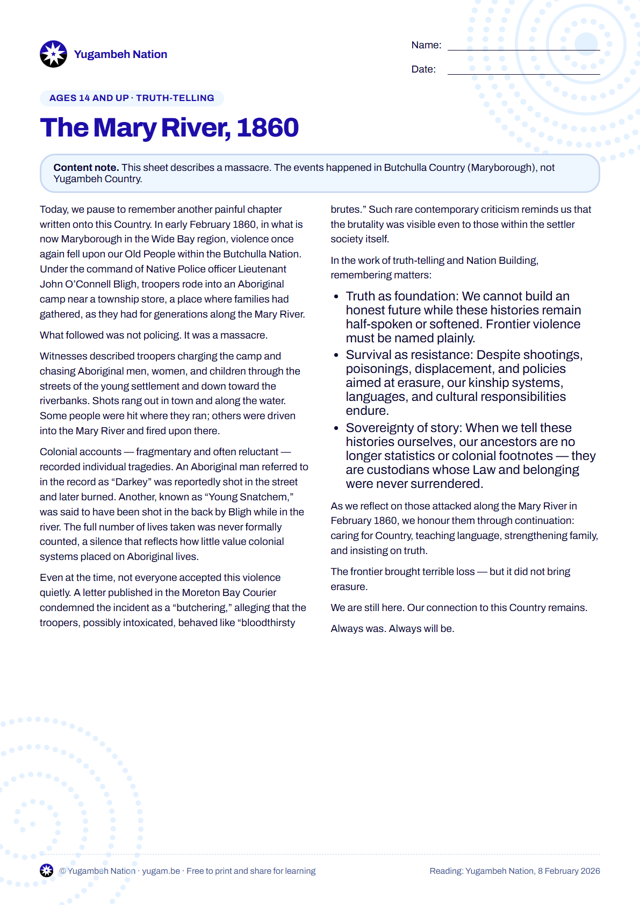
The Mary River, 1860: Truth-Telling
Read the Nation’s remembrance of the Native Police attack at Maryborough in Butchulla Country in February 1860, and reflect on remembering and survival.
View and download →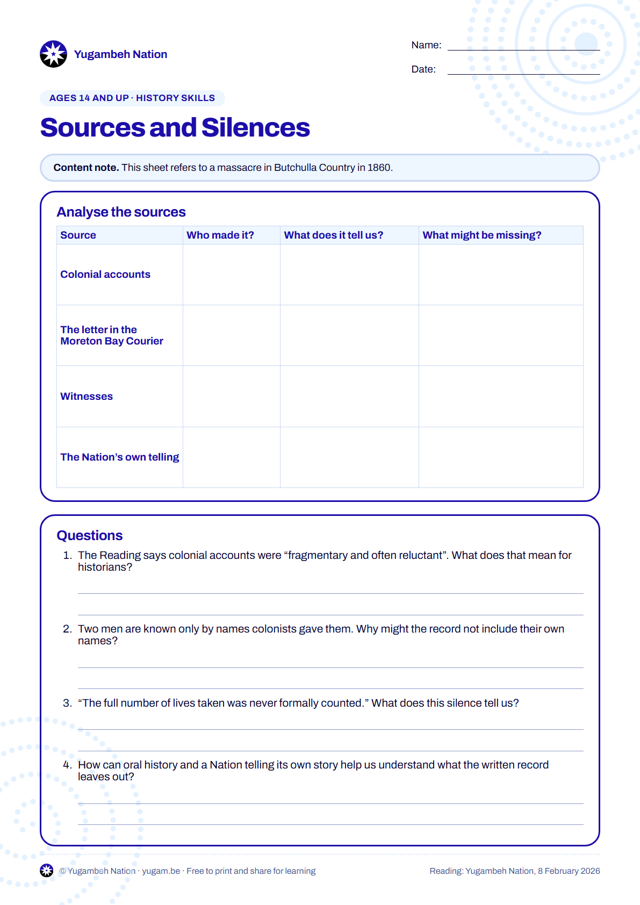
Sources and Silences: Reading the Historical Record
Use the Mary River Reading to think about historical sources: who wrote them, what they tell us, what they leave out, and how truth-telling fills the gaps.
View and download →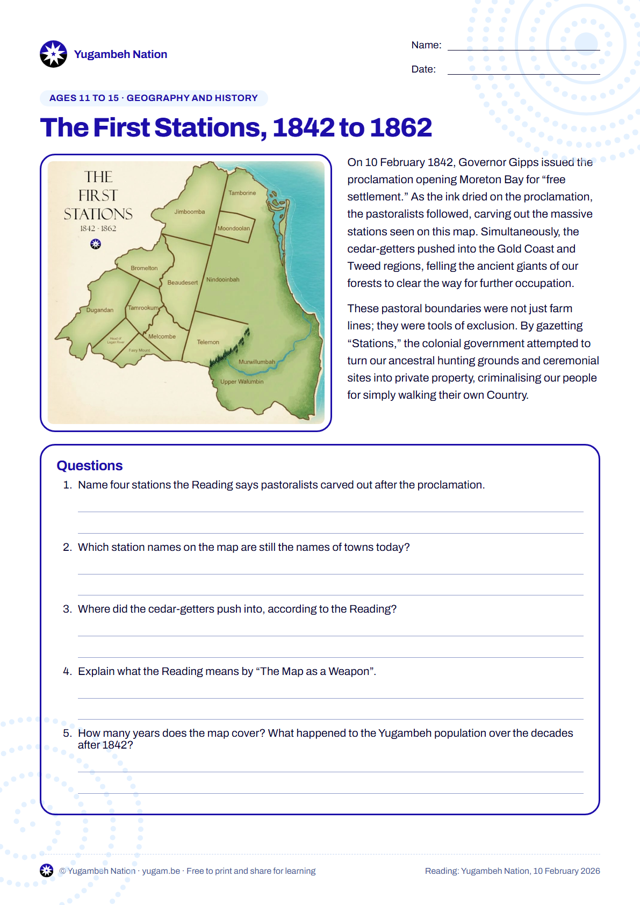
The First Stations, 1842 to 1862
Study a map of the first pastoral stations on Yugambeh Country and how the 1842 proclamation turned Country into private property.
View and download →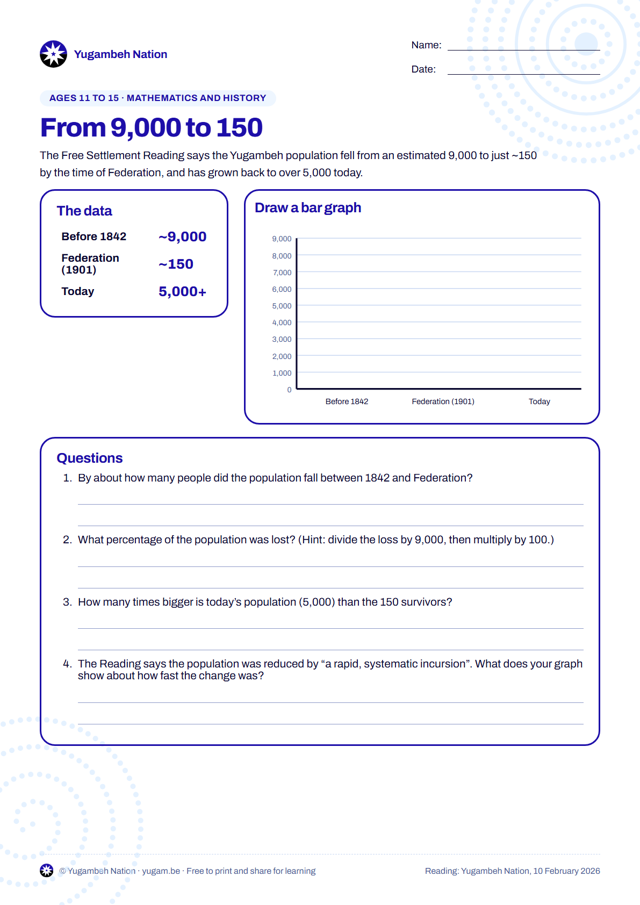
From 9,000 to 150: Graphing a Population
Graph the Yugambeh population from about 9,000 before 1842, to about 150 by Federation, to more than 5,000 today, and calculate the changes.
View and download →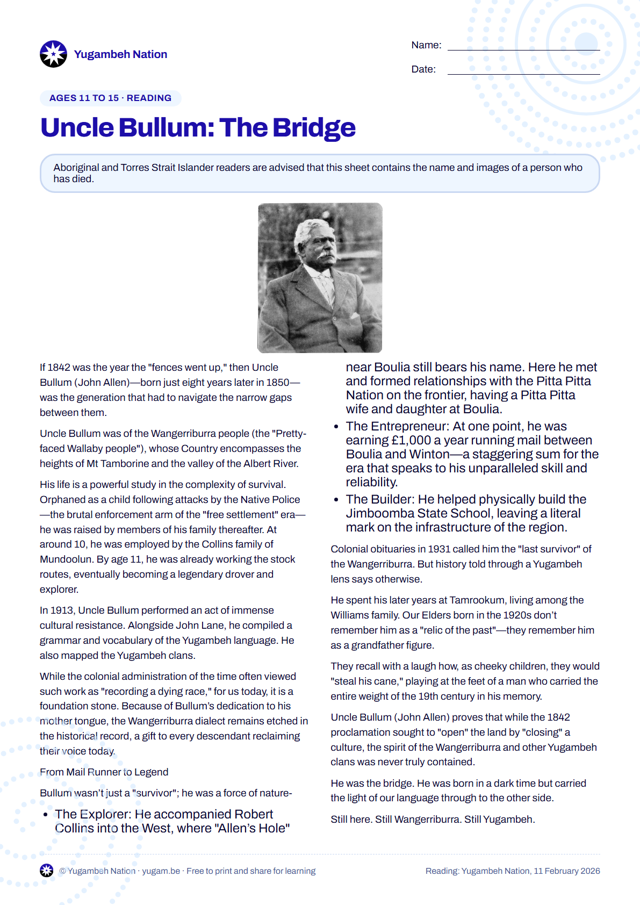
Uncle Bullum (John Allen): The Bridge
Read about Uncle Bullum, the Wangerriburra man who carried the Yugambeh language through the nineteenth century, and answer questions about his life.
View and download →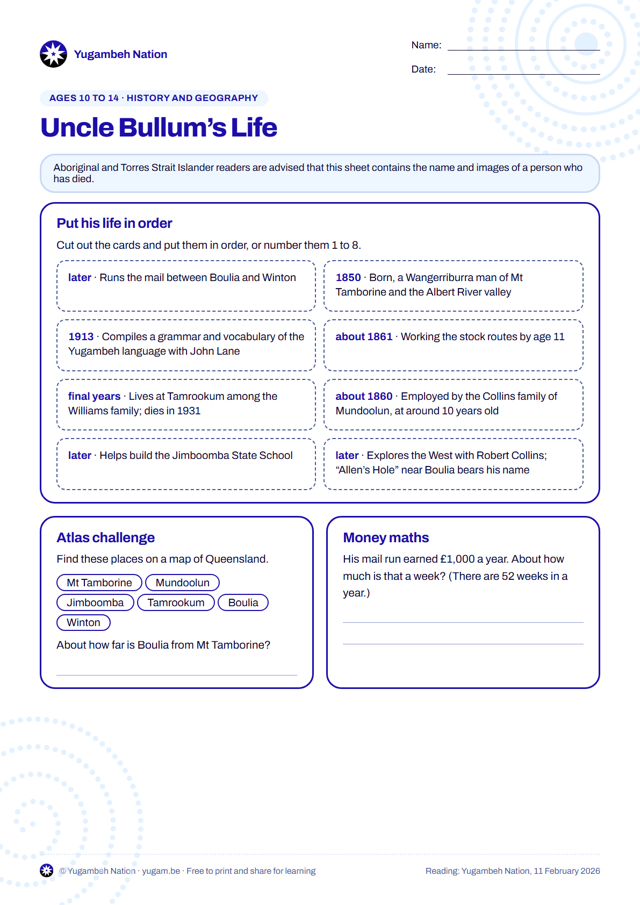
Uncle Bullum’s Life: Timeline and Atlas
Put the events of Uncle Bullum’s life in order, find the places he lived and worked in an atlas, and work out what his mail run earned.
View and download →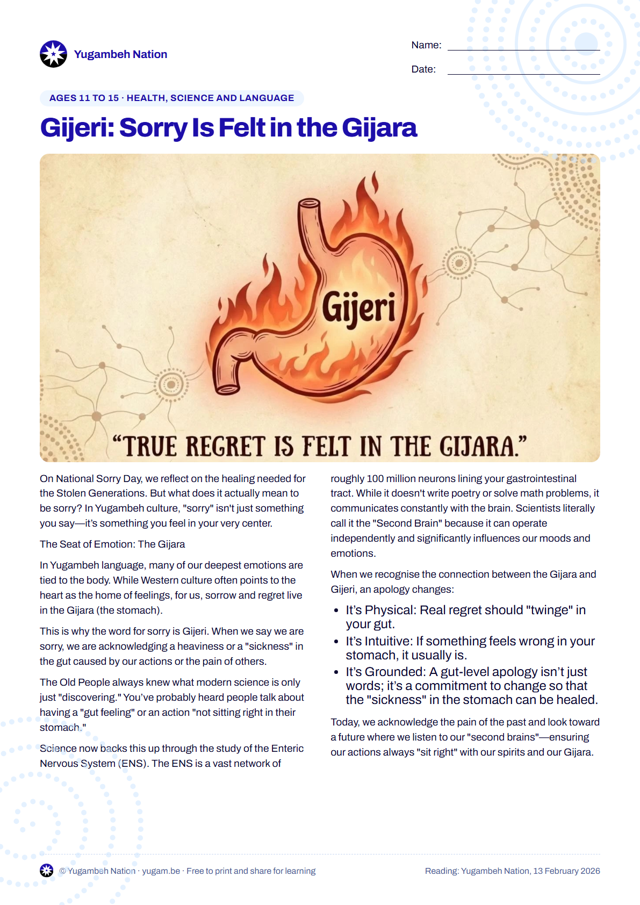
Gijeri: Sorry Is Felt in the Gijara
Learn why in Yugambeh, sorry (gijeri) is felt in the stomach (gijara), and how science calls the gut a “second brain”.
View and download →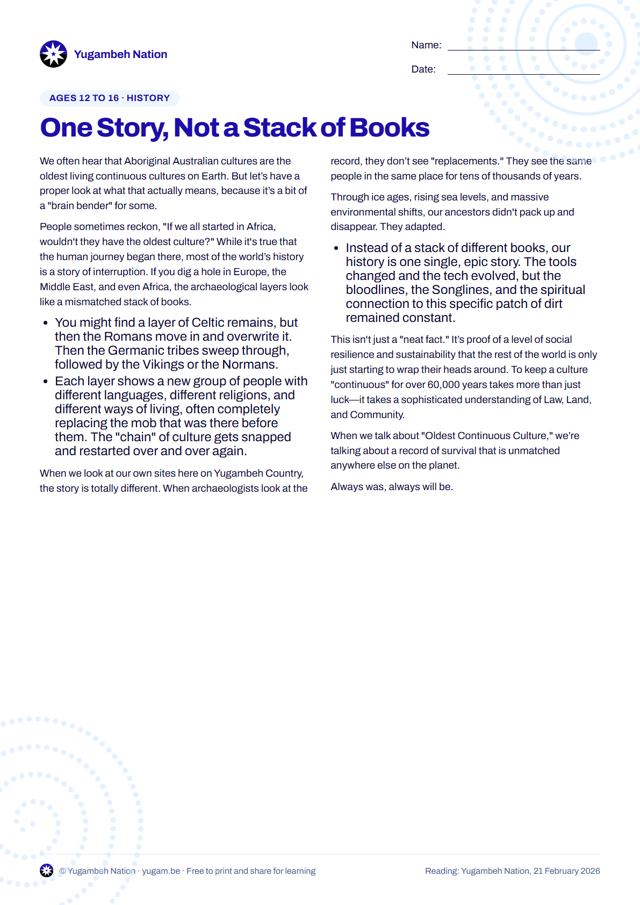
One Story, Not a Stack of Books
Find out why “continuous” is the most important word in our history, by comparing the archaeological layers of Europe with Yugambeh Country.
View and download →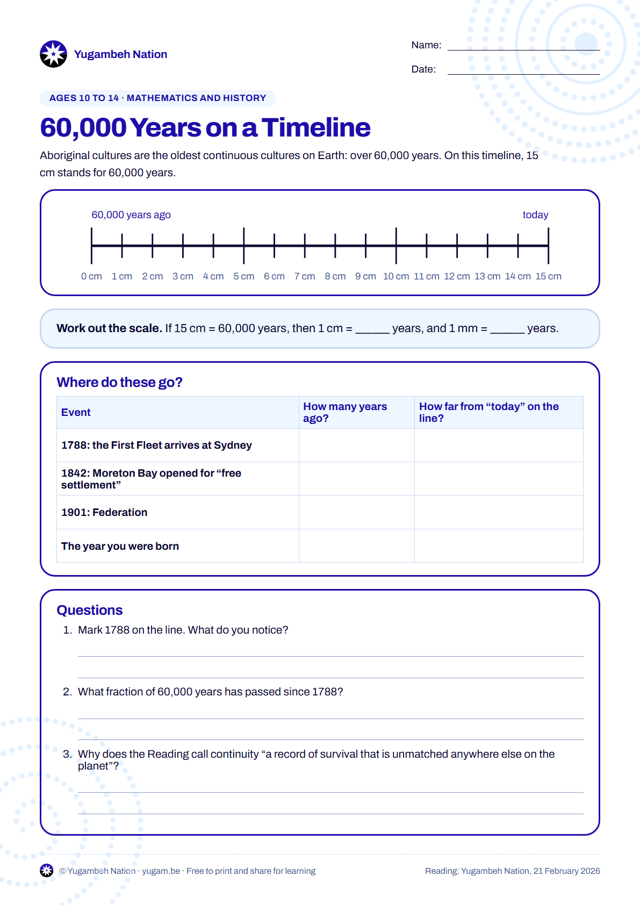
60,000 Years on a Timeline
Use scale to put more than 60,000 years of continuous culture on a 15 cm timeline, and see how short the colonial era really is.
View and download →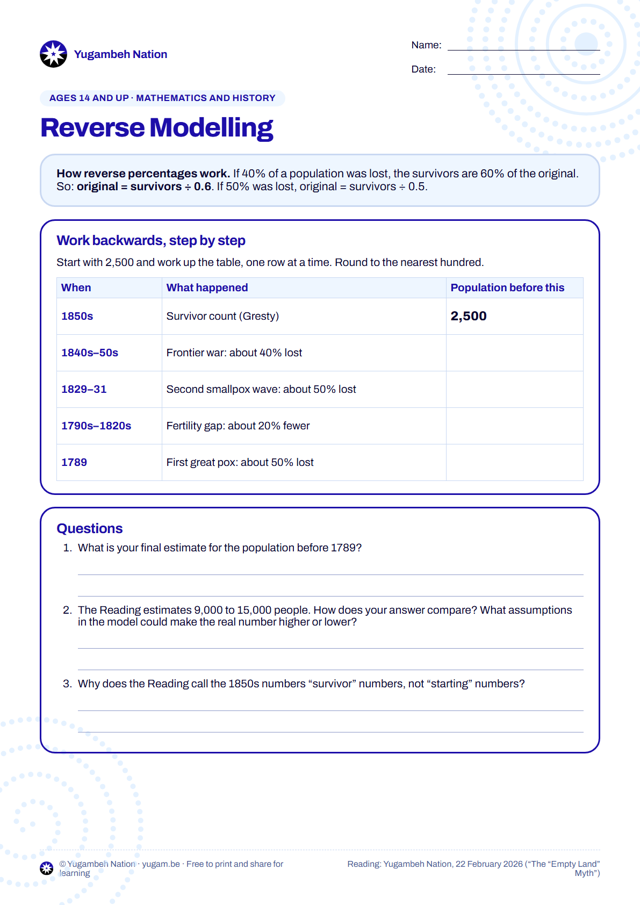
Reverse Modelling: How Many People Were Here?
Use reverse percentages to work backwards from the 2,500 people recorded in the 1850s to estimate how many Yugambeh people lived here before colonisation.
View and download →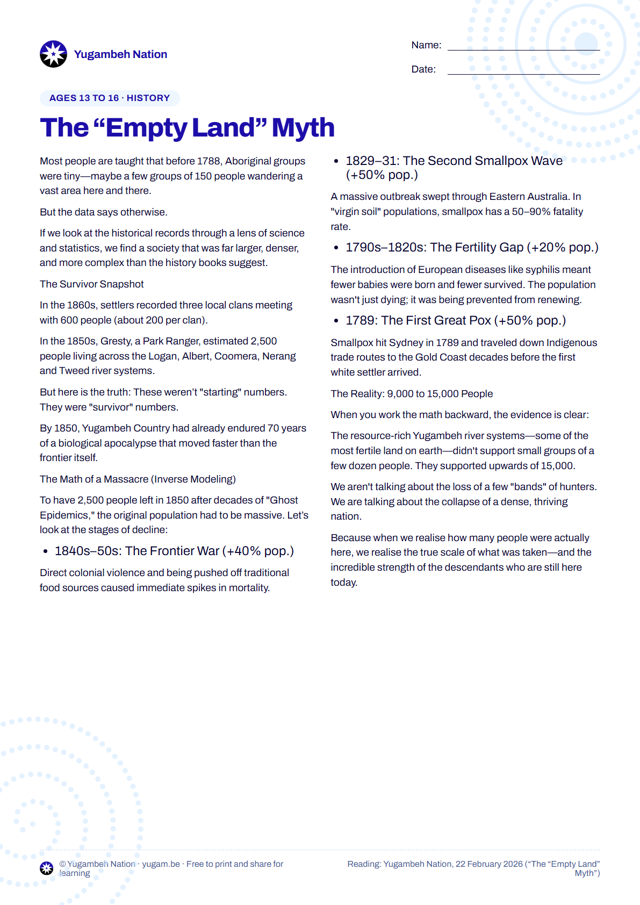
Survivor Numbers: The “Empty Land” Myth
Read how historical records of Yugambeh numbers were survivor counts, and how disease travelled ahead of the frontier, then challenge the “empty land” myth.
View and download →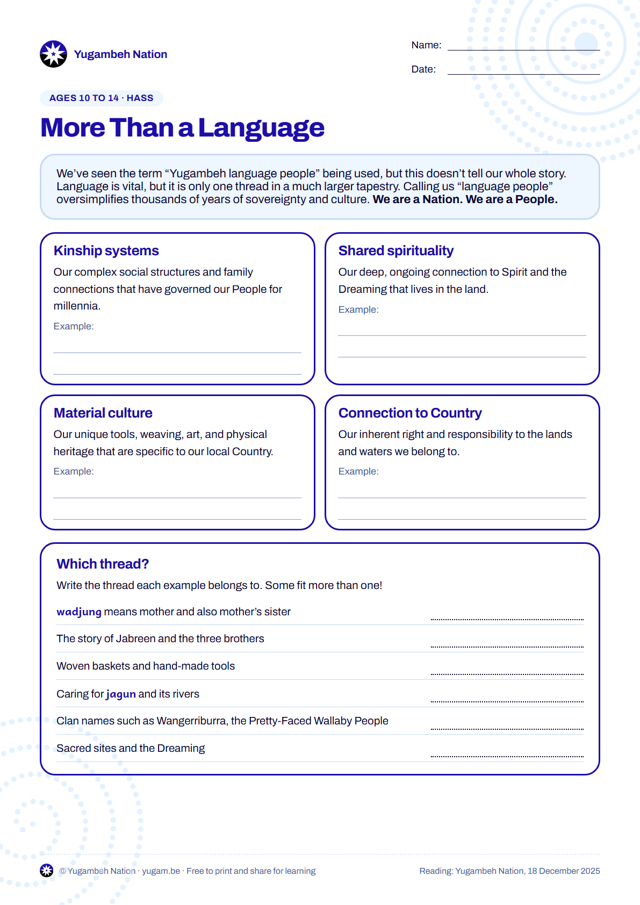
More Than a Language: What Makes a Nation?
Learn the four threads that make the Yugambeh a Nation, not just “language people”, and sort examples from Yugambeh culture into each one.
View and download →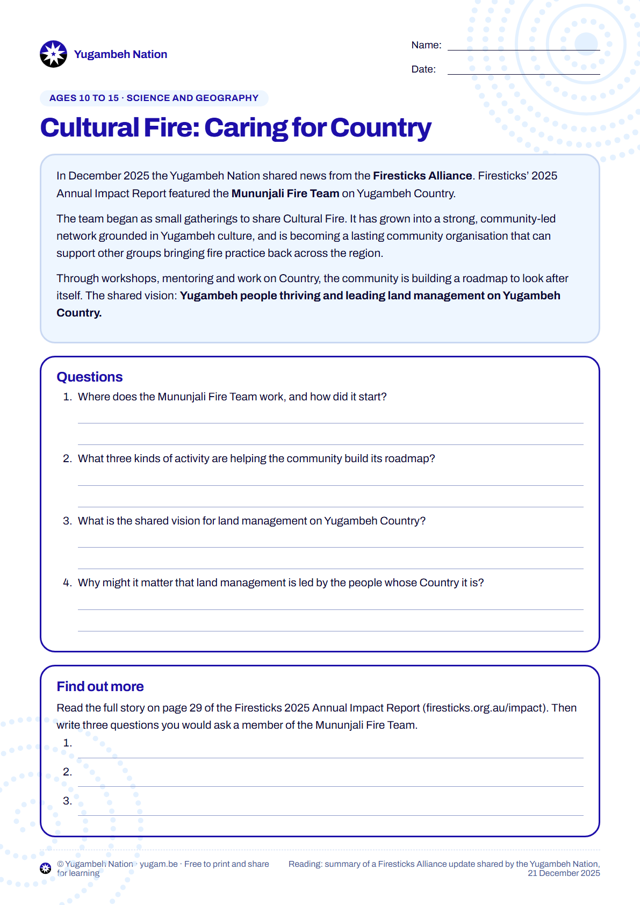
Cultural Fire: Caring for Country
Learn about the Mununjali Fire Team on Yugambeh Country and how Cultural Fire is being brought back to care for the land, then plan your own research.
View and download →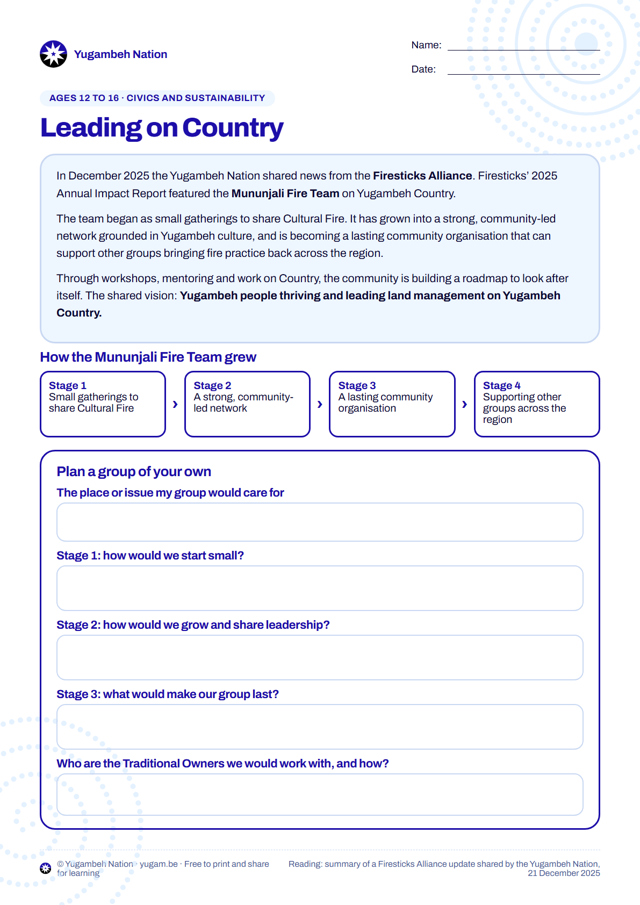
Leading on Country: How a Community Group Grows
Follow how the Mununjali Fire Team grew from small gatherings to a community organisation, and plan how a group could grow to care for a place you know.
View and download →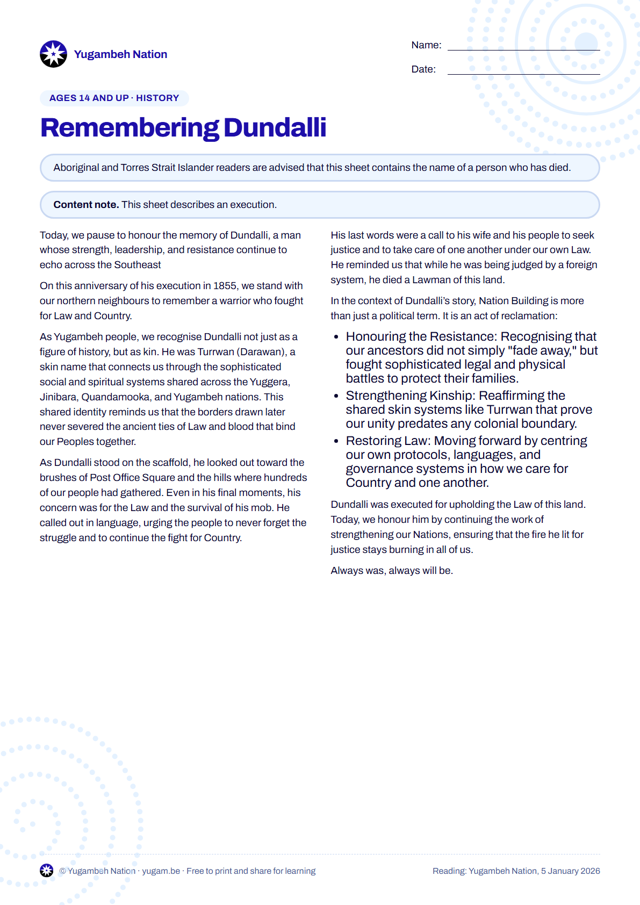
Remembering Dundalli
Read the Yugambeh Nation’s tribute to Dundalli, the Lawman executed in Brisbane in 1855, and what his story means for Nation Building.
View and download →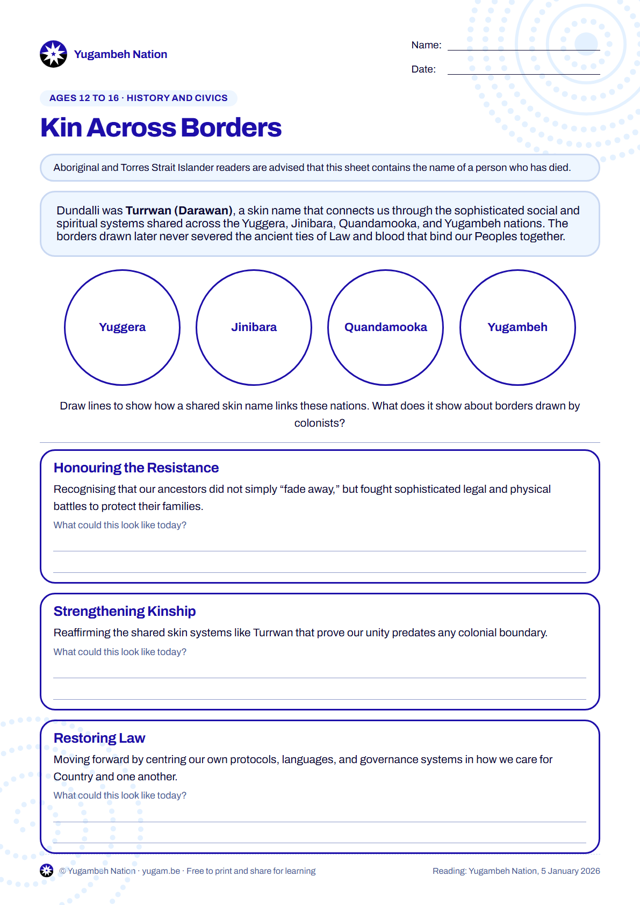
Kin Across Borders: Skin Names and Shared Law
Explore how a shared skin name, Turrwan, connects the Yuggera, Jinibara, Quandamooka and Yugambeh nations, and how kinship predates colonial borders.
View and download →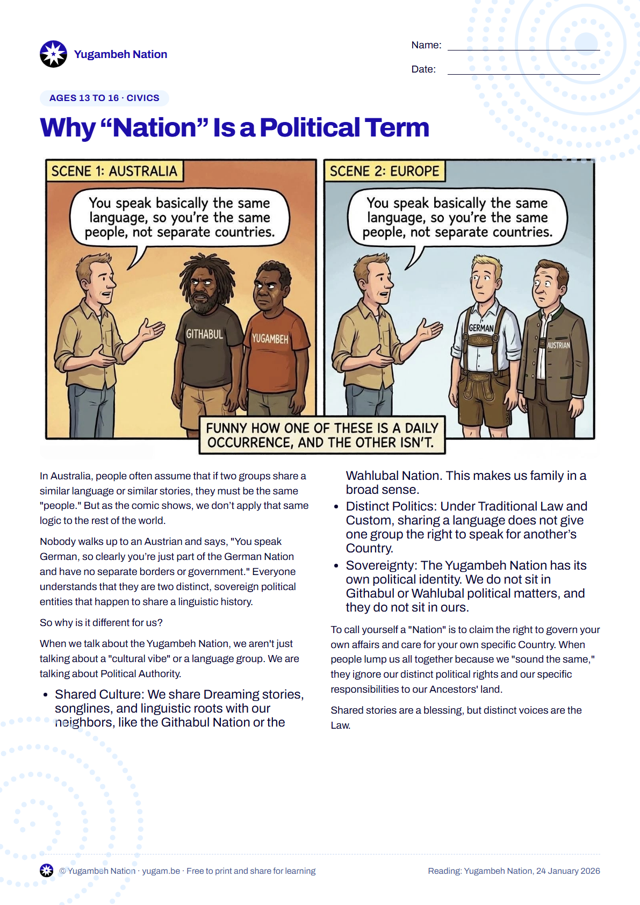
Why “Nation” Is a Political Term
Use a comic about Germany and Austria to explore why sharing a language doesn’t make two peoples one nation, and what sovereignty means for the Yugambeh Nation.
View and download →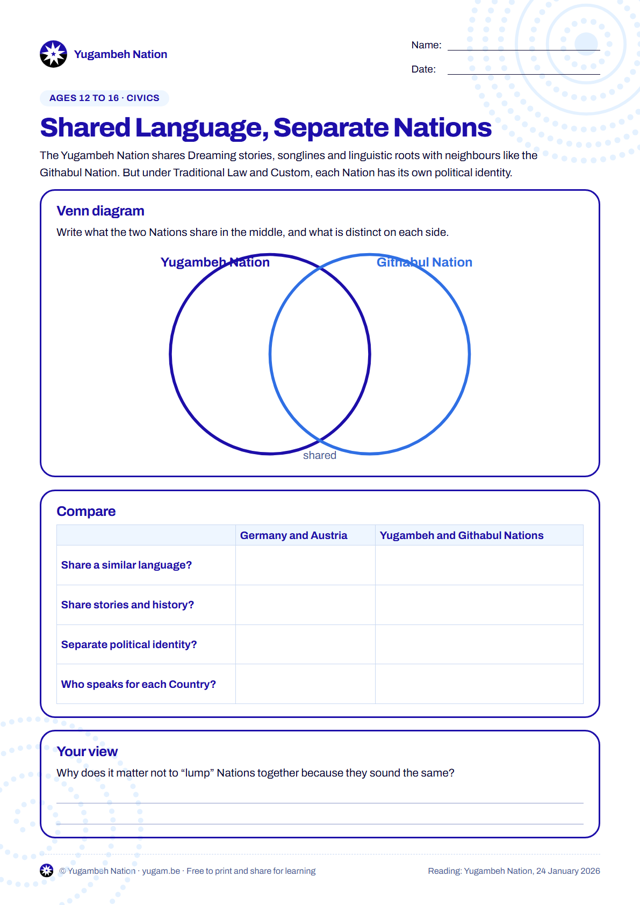
Shared Language, Separate Nations
Compare Germany and Austria with the Yugambeh and Githabul Nations using a Venn diagram, and explain the difference between shared culture and political authority.
View and download →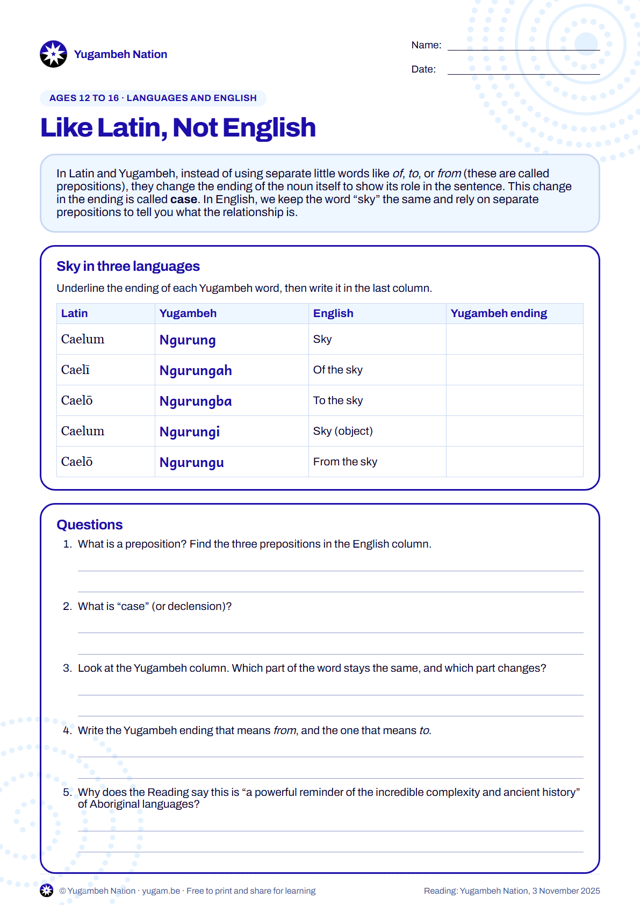
Like Latin, Not English: Case Endings
Discover how Yugambeh, like Latin, changes the ending of a word to show its role in a sentence, where English uses little words like of, to and from.
View and download →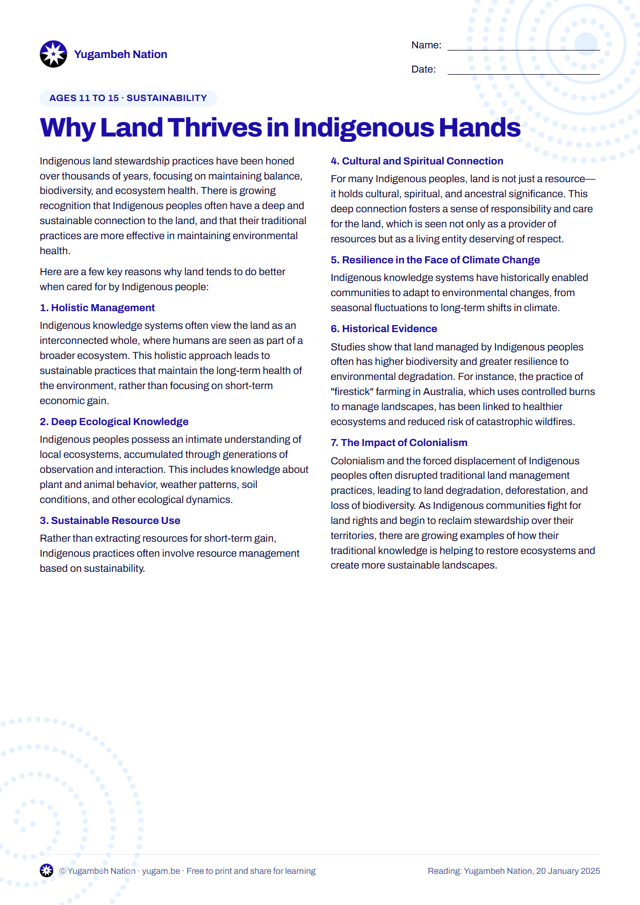
Why Land Thrives in Indigenous Hands
Read seven reasons land tends to do better when cared for by Indigenous people, from holistic management to firestick farming, and answer questions.
View and download →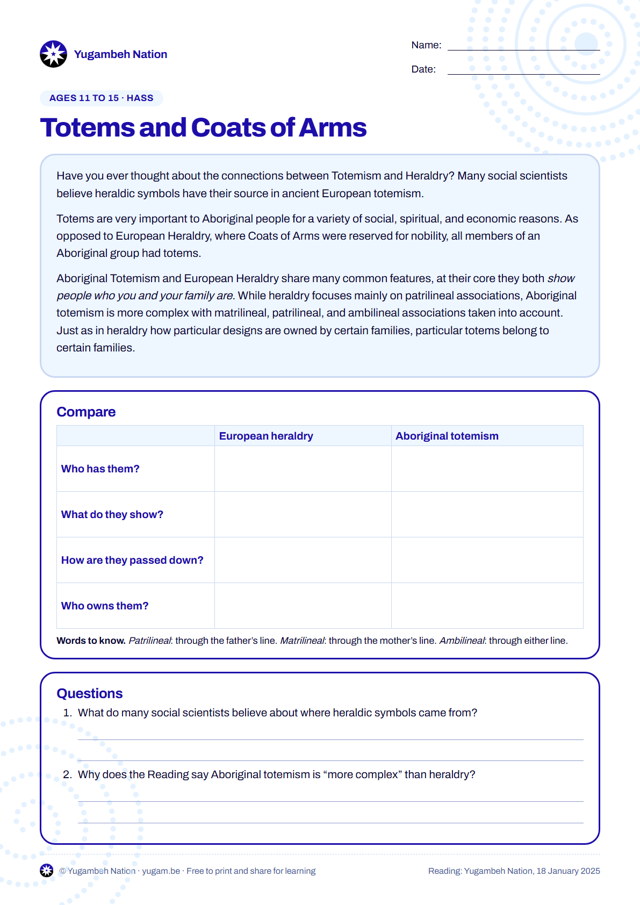
Totems and Coats of Arms
Compare Aboriginal totemism with European heraldry: who has them, how they are passed down, and how both show who you and your family are.
View and download →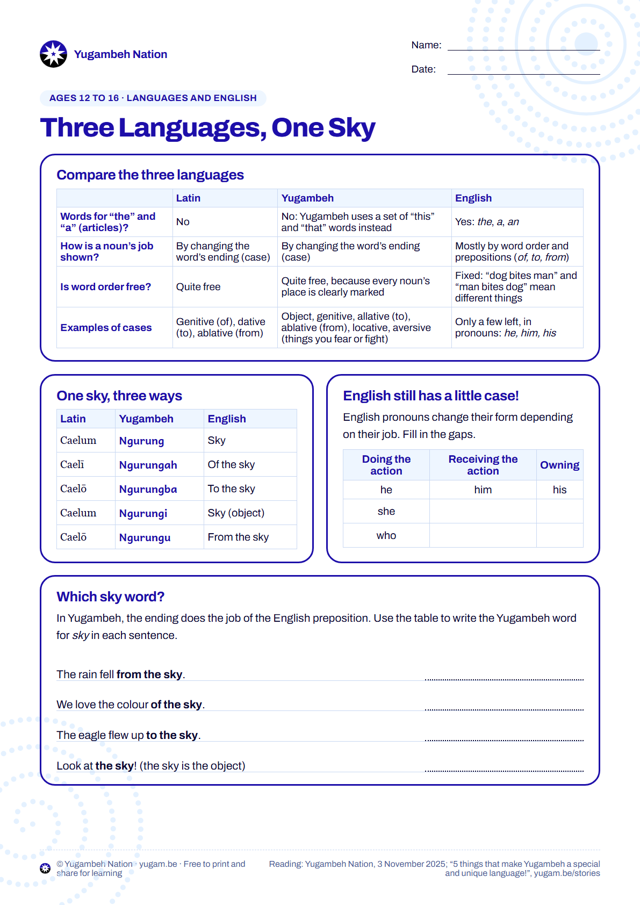
Three Languages, One Sky: Latin, Yugambeh and English
Compare how Latin, Yugambeh and English show a word’s job in a sentence, from case endings to prepositions and word order, then discuss what it tells us about languages.
View and download →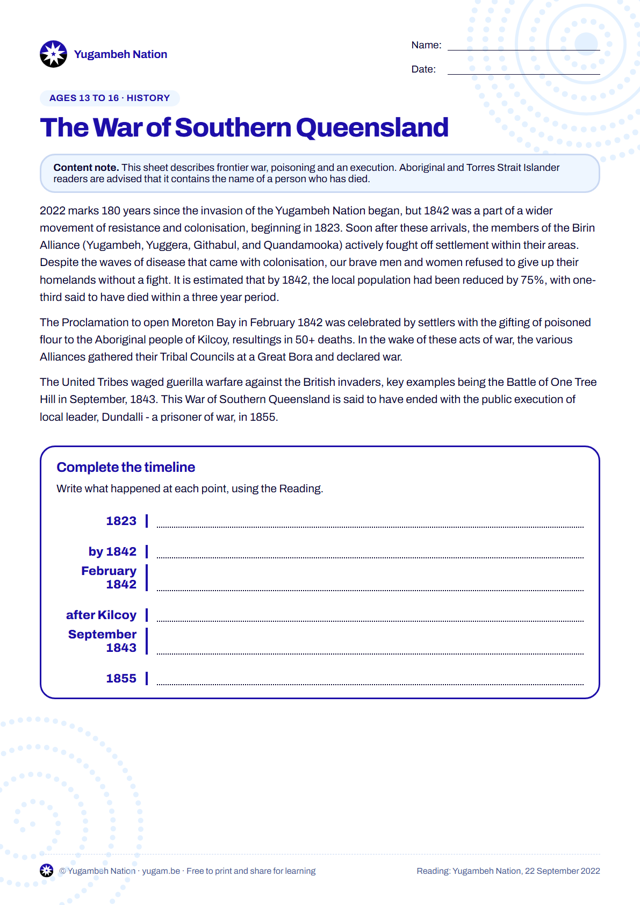
The War of Southern Queensland, 1823 to 1855
Read how the Birin Alliance resisted invasion from 1823, how war was declared after the Kilcoy poisoning, and how the war ended with Dundalli’s execution in 1855.
View and download →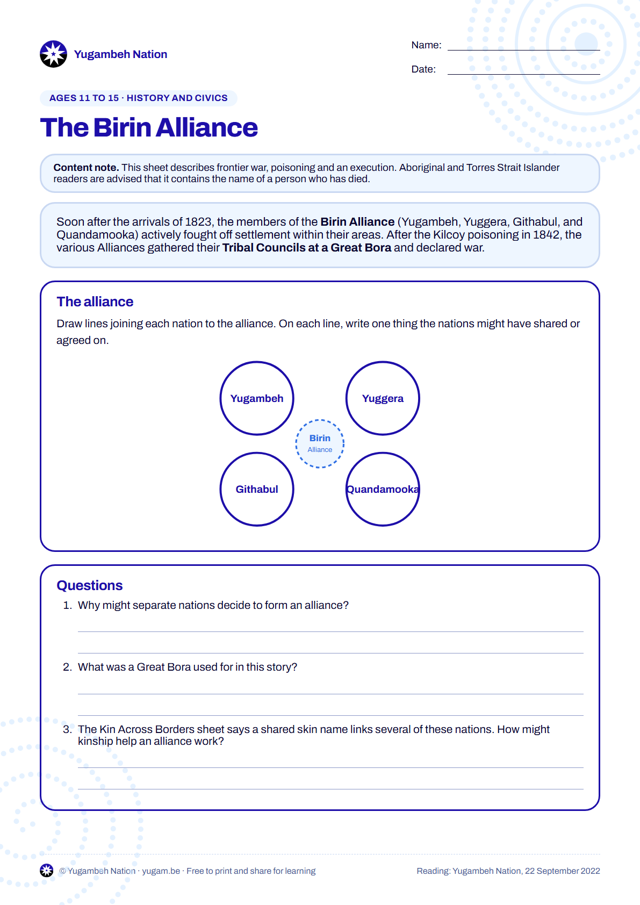
The Birin Alliance: Nations Working Together
Explore how the Yugambeh, Yuggera, Githabul and Quandamooka formed the Birin Alliance to resist invasion, and think about why nations form alliances.
View and download →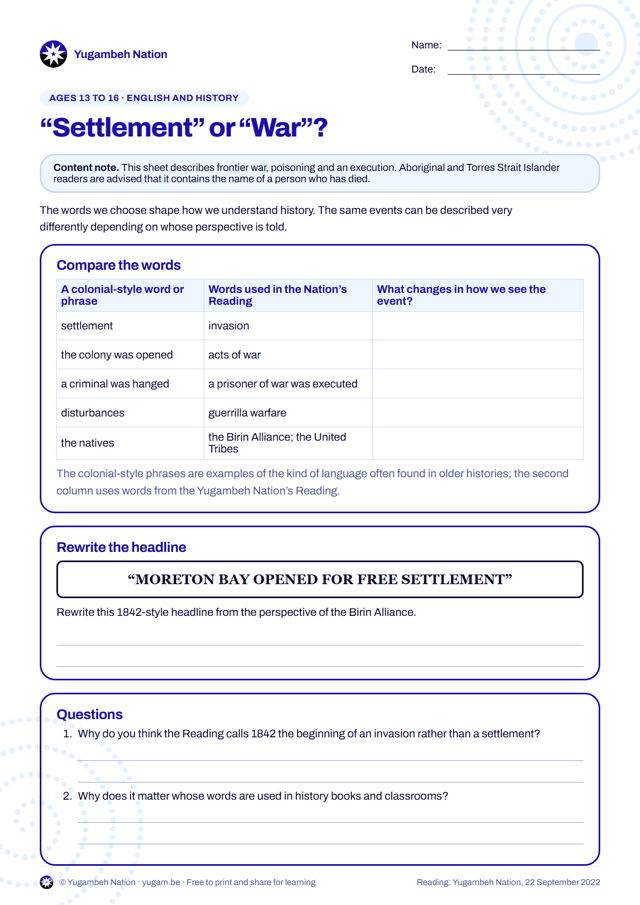
“Settlement” or “War”? Words and Perspective
Compare the words used to describe the same events from a colonial point of view and from the Yugambeh Nation’s, and rewrite a headline from a different perspective.
View and download →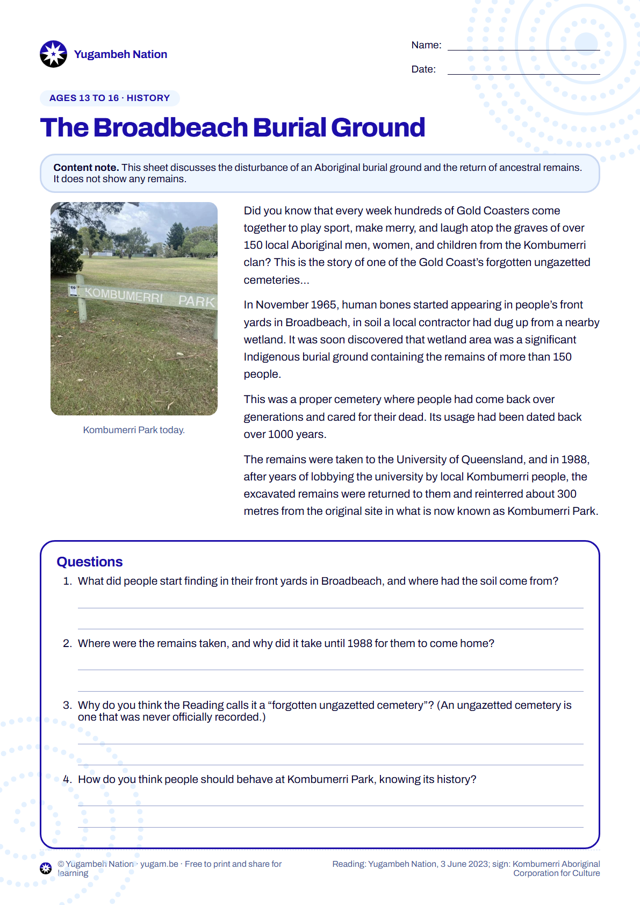
The Broadbeach Burial Ground and Kombumerri Park
Read the story of the Broadbeach burial ground, used by Kombumerri people for over a thousand years, and how the ancestral remains came home to Kombumerri Park in 1988.
View and download →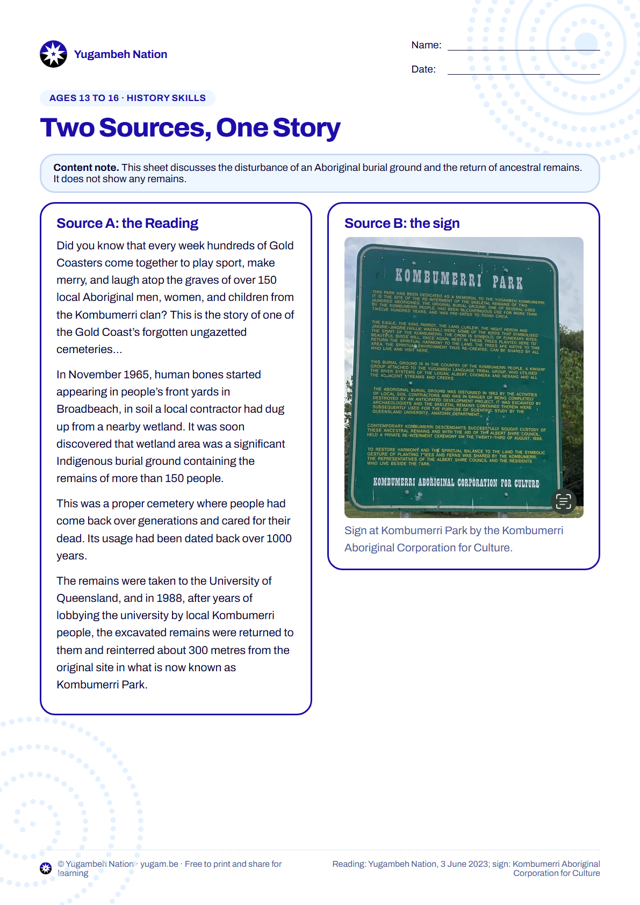
Two Sources, One Story: The Reading and the Sign
Compare two sources about the Broadbeach burial ground, a Reading and the sign at Kombumerri Park, and work out why their dates and numbers differ.
View and download →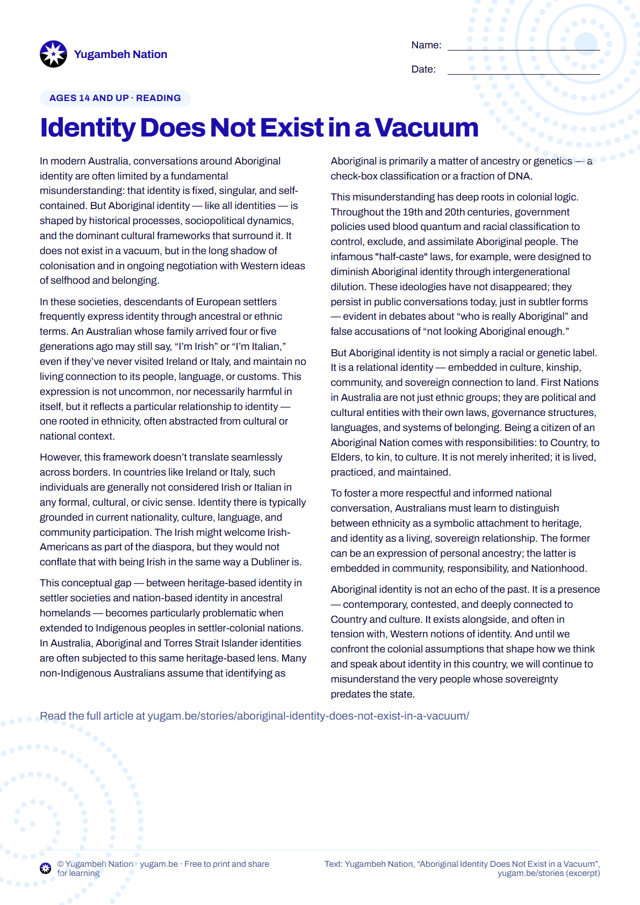
Aboriginal Identity Does Not Exist in a Vacuum
Read why Aboriginal identity is relational, sovereign and connected to Country, not a matter of ancestry alone, and answer questions on the argument.
View and download →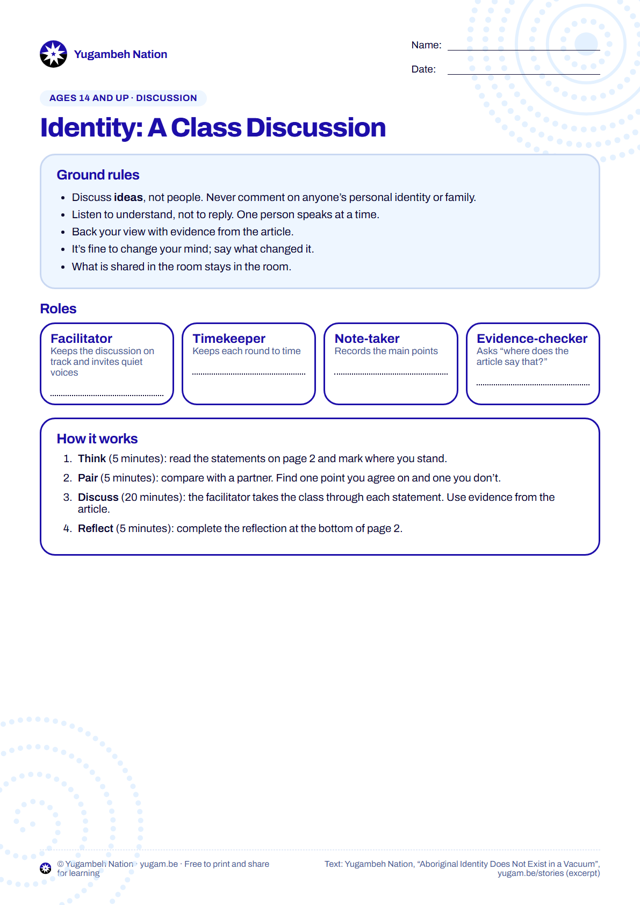
Identity: A Structured Class Discussion
A structured, respectful class discussion on the ideas in “Aboriginal Identity Does Not Exist in a Vacuum”, with ground rules, roles, statements to weigh up and a reflection.
View and download →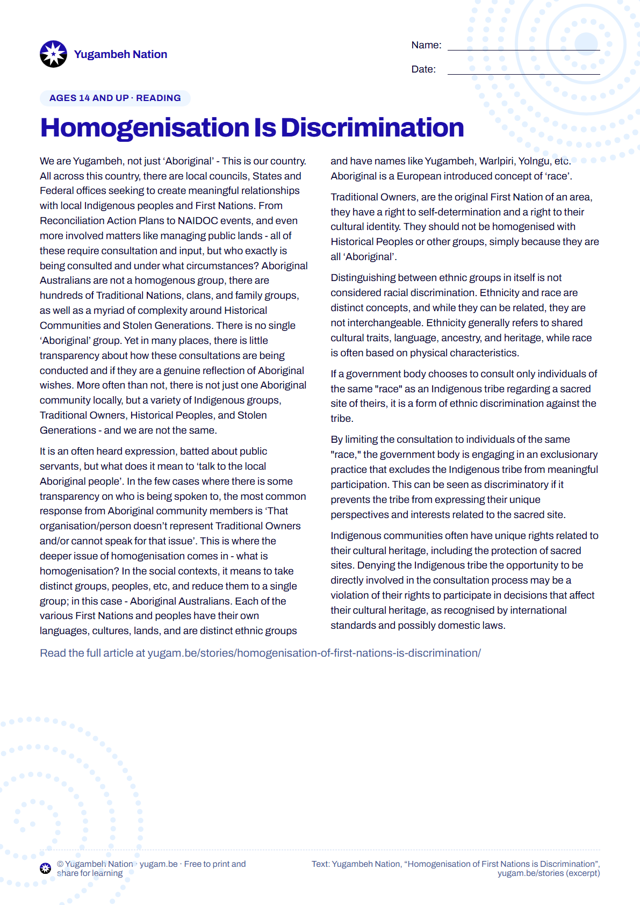
Homogenisation of First Nations Is Discrimination
Read why treating all Aboriginal people as one group in consultations can silence Traditional Owners, and what the difference is between race and ethnicity.
View and download →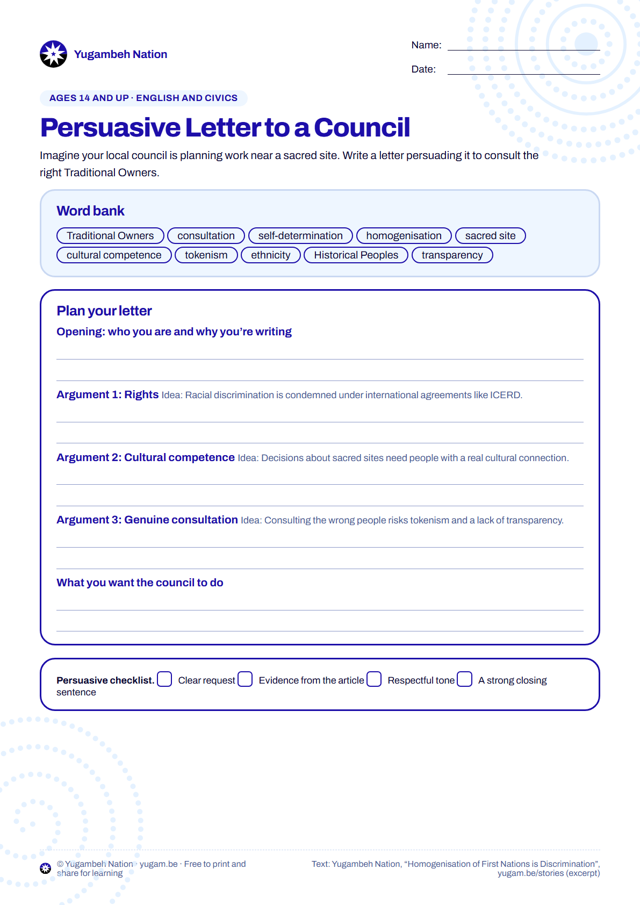
Write a Persuasive Letter to a Council
Use the arguments in “Homogenisation of First Nations is Discrimination” to write a persuasive letter asking a council to consult Traditional Owners properly.
View and download →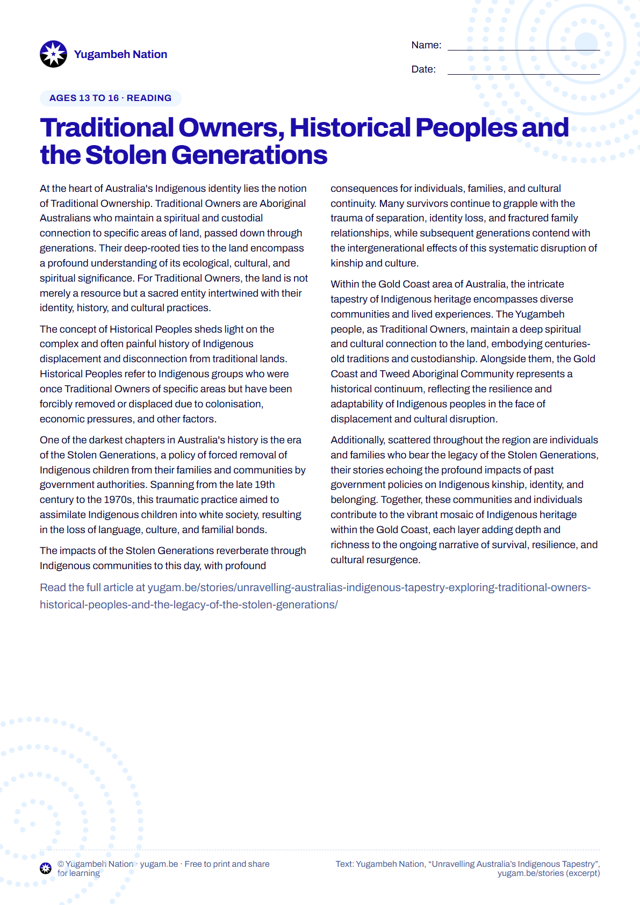
Traditional Owners, Historical Peoples and the Stolen Generations
Read about Traditional Owners, Historical Peoples and the Stolen Generations, and how these communities live side by side on the Gold Coast today.
View and download →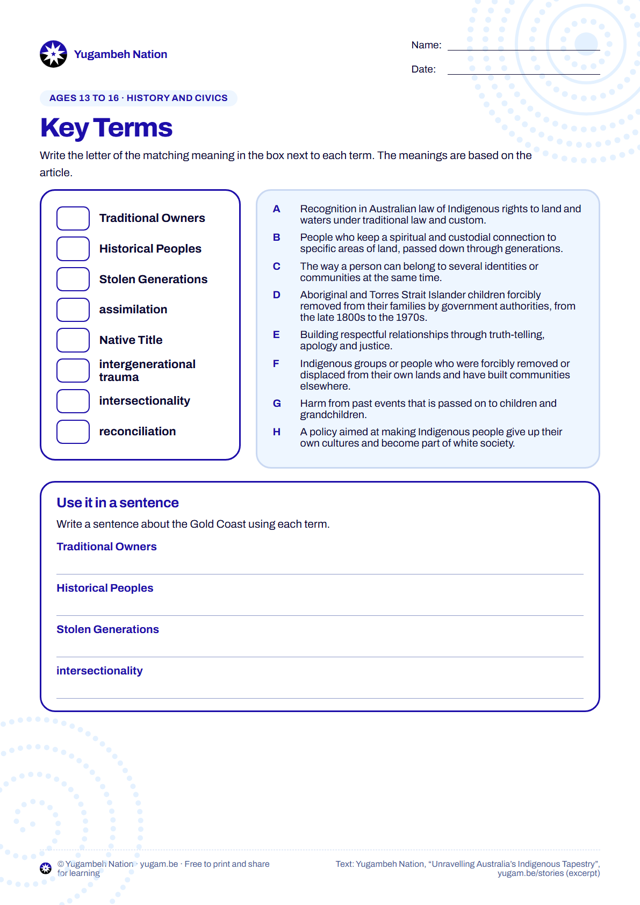
Key Terms: Traditional Owners to the Stolen Generations
Match eight key terms, from Traditional Owners and Historical Peoples to assimilation and intersectionality, to their meanings and use them in your own sentences.
View and download →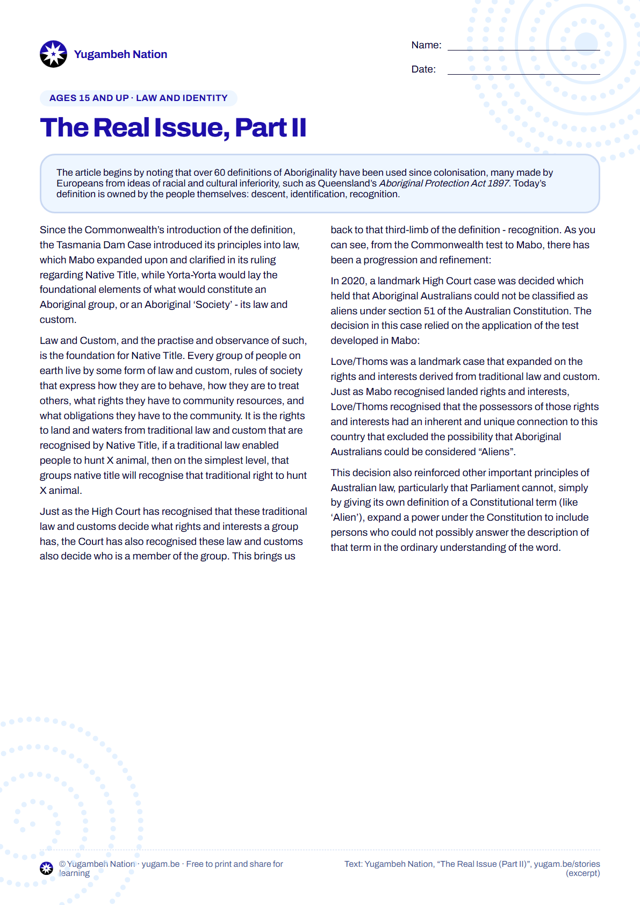
The Real Issue, Part II: Law, Custom and Society
Follow on from Part I: how traditional law and custom decide both land rights and membership, and how the Love and Thoms case found Aboriginal Australians are not “aliens”.
View and download →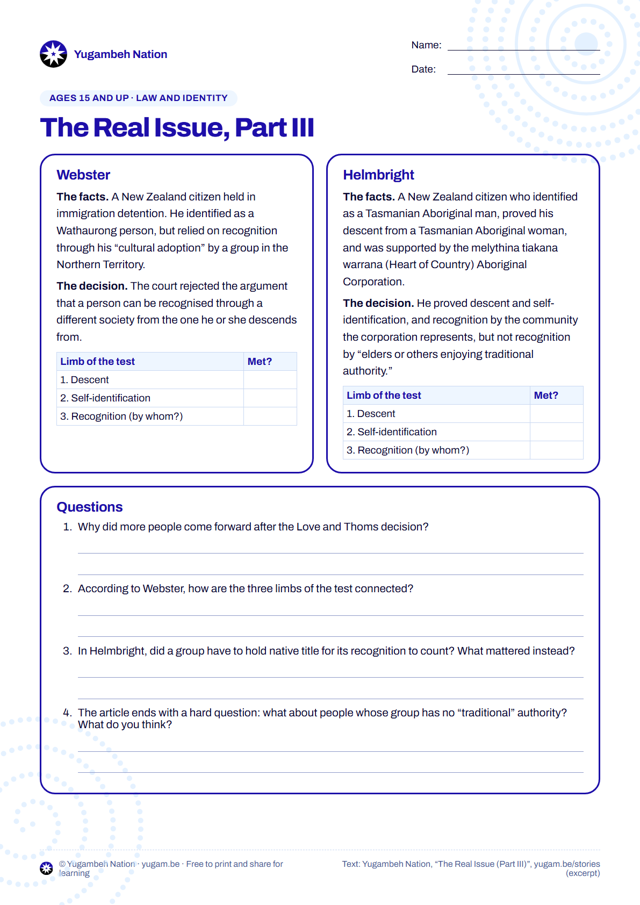
The Real Issue, Part III: Testing the Test
Examine two Federal Court cases, Webster and Helmbright, that tested the three-part Mabo test, and work out which part of the test each man did not meet.
View and download →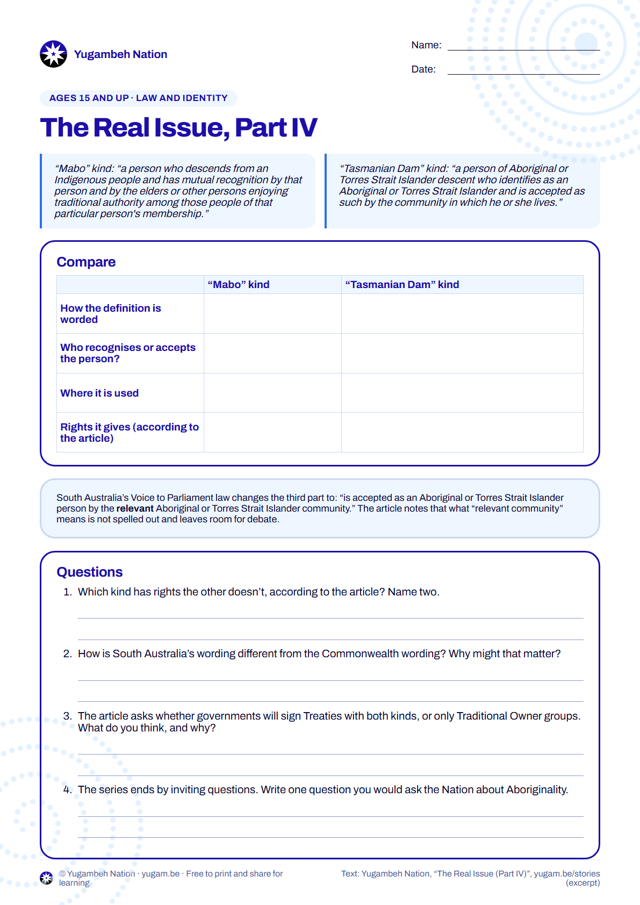
The Real Issue, Part IV: Two Kinds of Aboriginality and the Voice
Compare the “Mabo kind” and the “Tasmanian Dam kind” of Aboriginality, look at how South Australia’s Voice defines a First Nations person, and form your own questions.
View and download →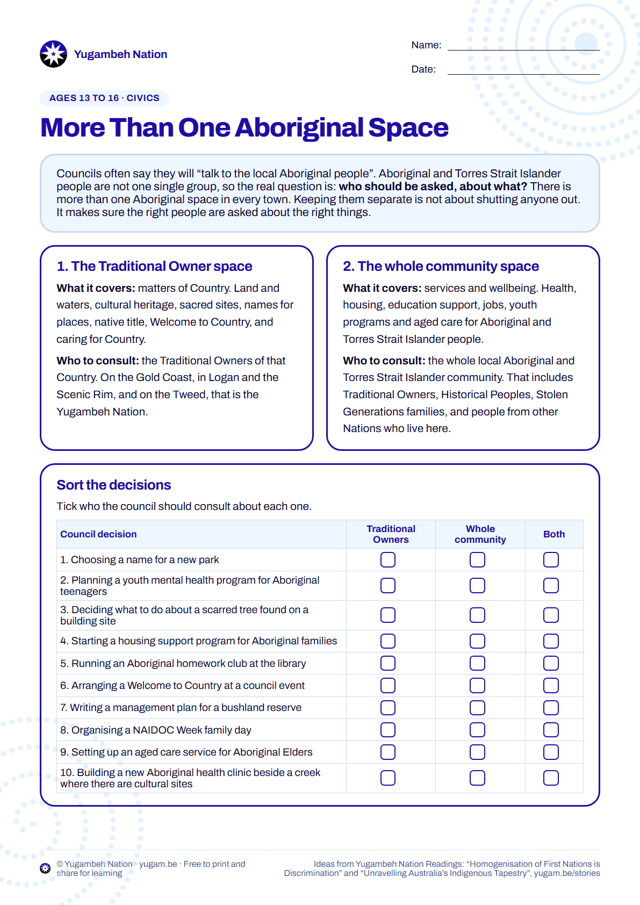
More Than One Aboriginal Space: Who Should a Council Consult?
Learn the difference between matters of Country for Traditional Owners and services for the whole local Aboriginal community, sort ten council decisions, and write to a council.
View and download →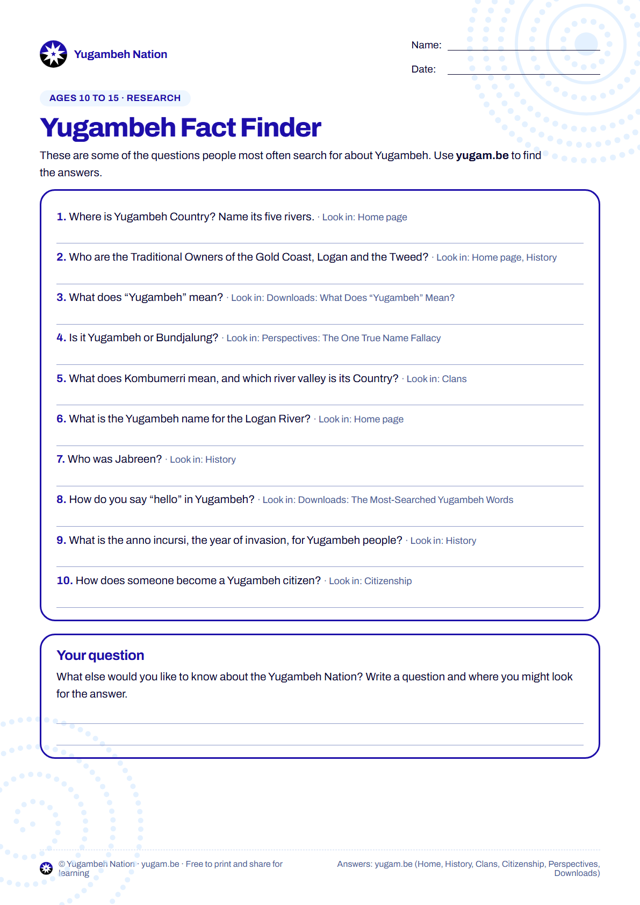
Yugambeh Fact Finder: The Most-Asked Questions
A research hunt through yugam.be answering the questions people most often search for about Yugambeh, from where Yugambeh Country is to who Jabreen was.
View and download →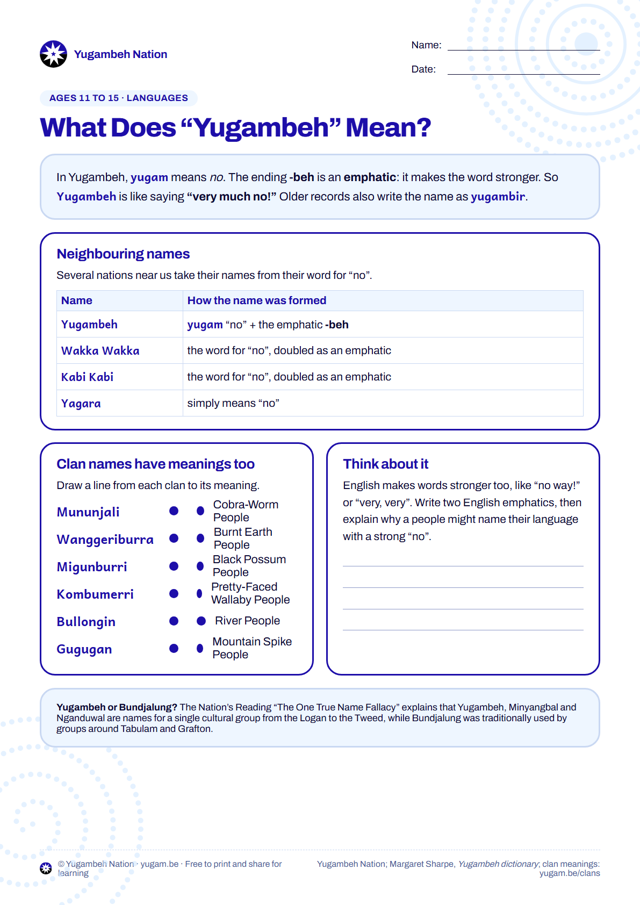
What Does “Yugambeh” Mean?
Discover that Yugambeh comes from yugam, “no”, with an emphatic ending, compare how neighbouring nations’ names were formed, and explore clan-name meanings.
View and download →No worksheets match. Try another subject or year, or clear the filters.