Use the Mary River Reading to think about historical sources: who wrote them, what they tell us, what they leave out, and how truth-telling fills the gaps.
Download nowPDF · 226 KBPrints on A4. Free to print and share for learning; please keep the Yugambeh Nation’s name on it.
What students do
- Analyse who made historical sources and what they leave out
- Consider the role of oral history
Australian Curriculum
- Year levels
- Years 9 and 10
- Learning areas
- History
- A_TSICP2Colonisation under terra nullius, experienced as an invasionCountry/Place
- A_TSIP2Strong systems of family, kinship, law, governance and authorityPeople
Suggested links to version 9.0 of the Australian Curriculum cross-curriculum priorities: First Nations histories and cultures. Summaries are in our own words; see ACARA for the full organising ideas.
More worksheets
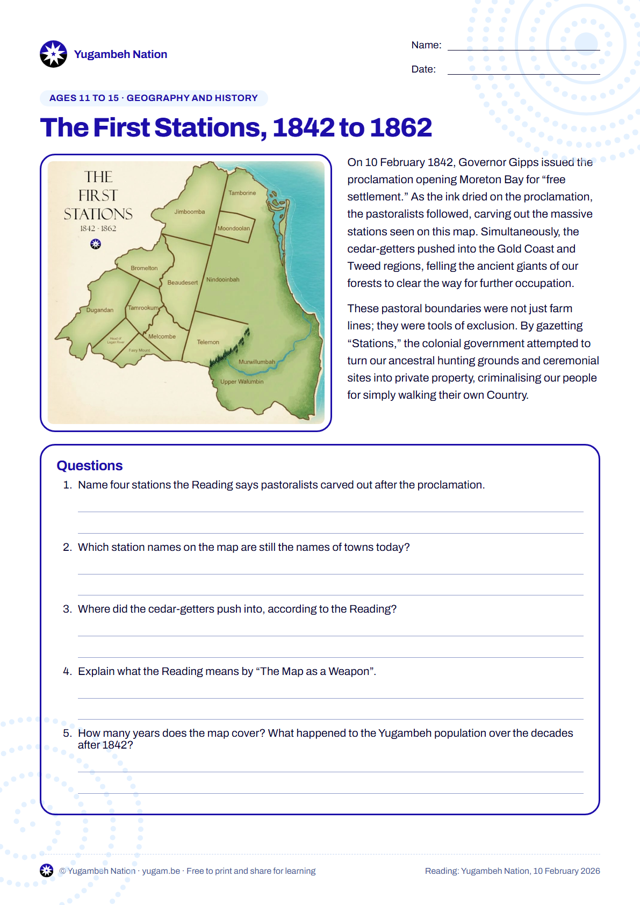
The First Stations, 1842 to 1862
Study a map of the first pastoral stations on Yugambeh Country and how the 1842 proclamation turned Country into private property.
View and download →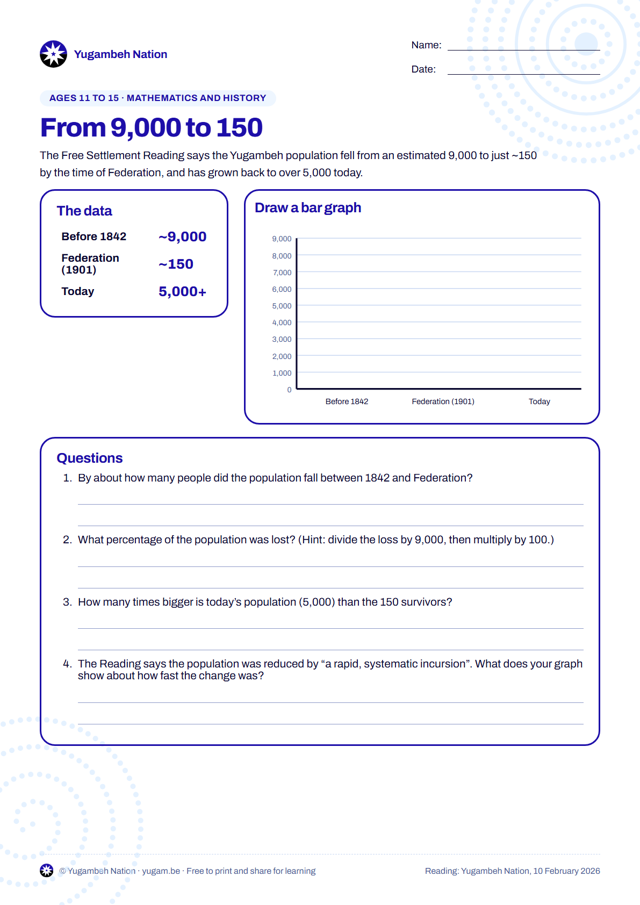
From 9,000 to 150: Graphing a Population
Graph the Yugambeh population from about 9,000 before 1842, to about 150 by Federation, to more than 5,000 today, and calculate the changes.
View and download →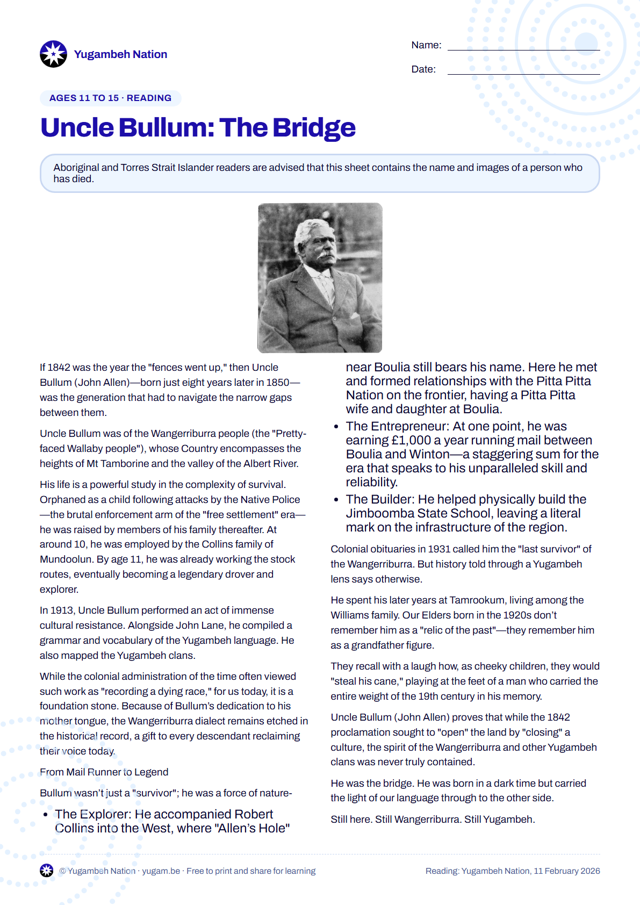
Uncle Bullum (John Allen): The Bridge
Read about Uncle Bullum, the Wangerriburra man who carried the Yugambeh language through the nineteenth century, and answer questions about his life.
View and download →