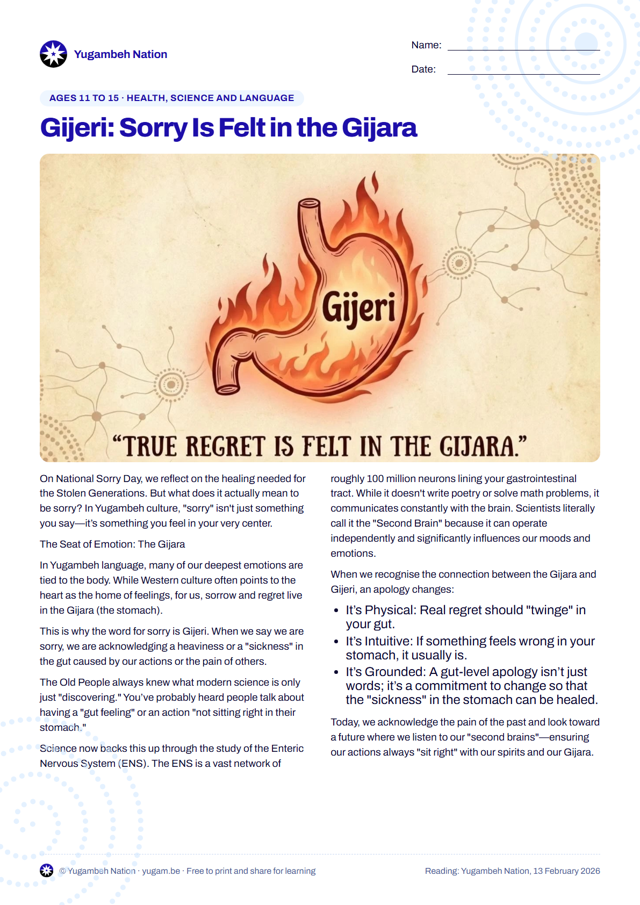
Learn why in Yugambeh, sorry (gijeri) is felt in the stomach (gijara), and how science calls the gut a “second brain”.
Download nowPDF · 418 KBPrints on A4. Free to print and share for learning; please keep the Yugambeh Nation’s name on it.
What students do
- Learn why sorry is felt in the stomach in Yugambeh
- Connect it to the science of the “second brain”
Australian Curriculum
- Year levels
- Years 6 to 9
- Learning areas
- Health and Physical EducationScienceLanguages
- A_TSIC1Diverse languages and cultural expressions, and the right to maintain and control themCulture
- A_TSIC2Unique ways of being, knowing, thinking and doingCulture
Suggested links to version 9.0 of the Australian Curriculum cross-curriculum priorities: First Nations histories and cultures. Summaries are in our own words; see ACARA for the full organising ideas.
More worksheets
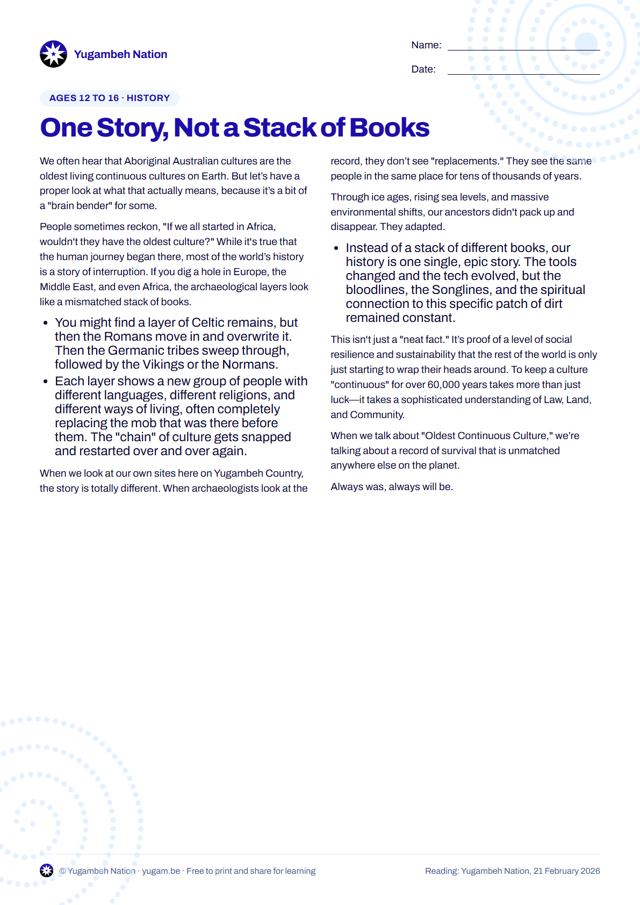
One Story, Not a Stack of Books
Find out why “continuous” is the most important word in our history, by comparing the archaeological layers of Europe with Yugambeh Country.
View and download →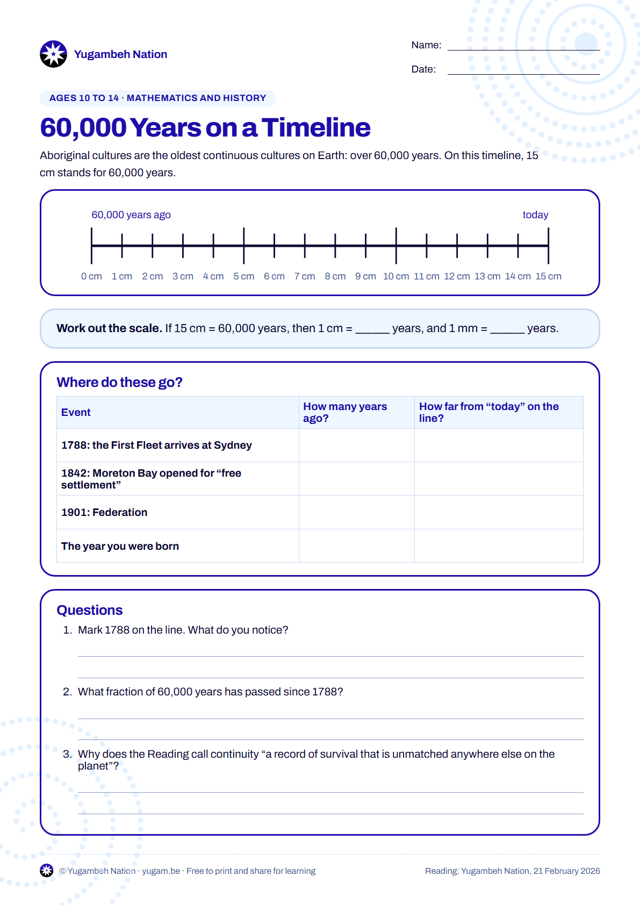
60,000 Years on a Timeline
Use scale to put more than 60,000 years of continuous culture on a 15 cm timeline, and see how short the colonial era really is.
View and download →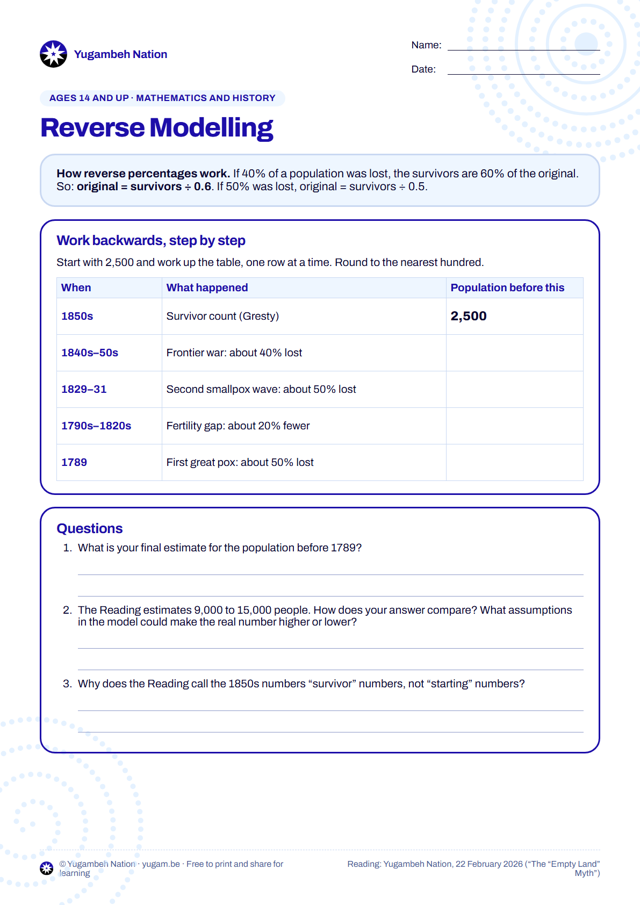
Reverse Modelling: How Many People Were Here?
Use reverse percentages to work backwards from the 2,500 people recorded in the 1850s to estimate how many Yugambeh people lived here before colonisation.
View and download →