When we reflect on the healing needed for the Stolen Generations, a question follows: what does it actually mean to be sorry? In Yugambeh culture, sorry is not just something you say. It is something you feel in your very centre.
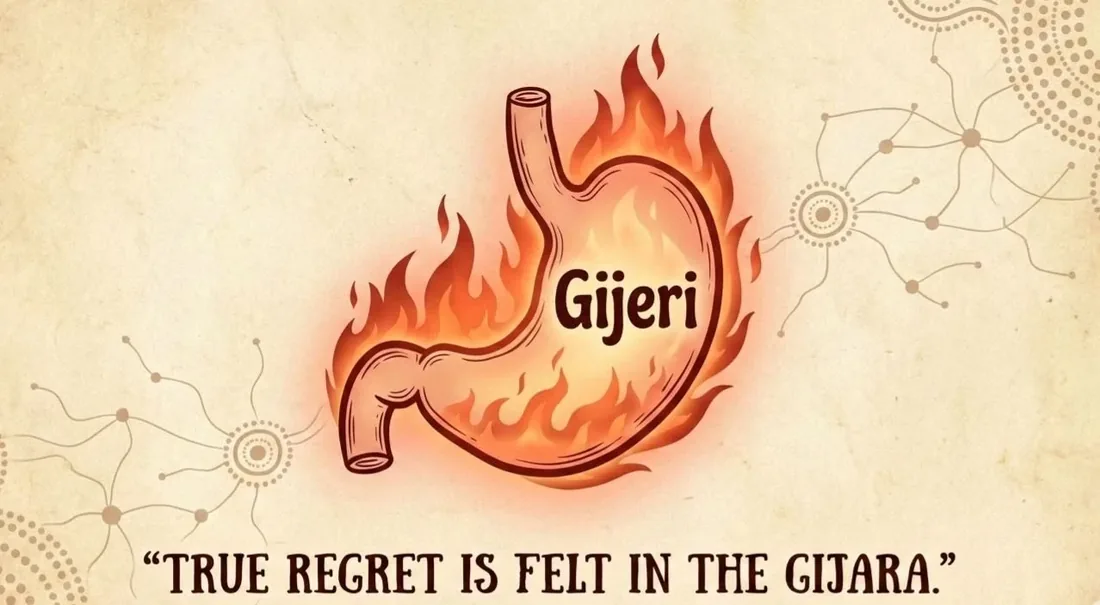
The seat of emotion: the Gijara
In Yugambeh language, many of our deepest emotions are tied to the body. Where Western culture often points to the heart as the home of feelings, for us sorrow and regret live in the Gijara, the stomach.
This is why the word for sorry is Gijeri. When we say we are sorry, we are acknowledging a heaviness, or a sickness, in the gut, caused by our own actions or by the pain of others.
Margaret Sharpe’s Yugambeh dictionary records the same pairing in older spelling: gidjir, stomach or bowels, and gidjir, sorry.
The second brain
The Old People always knew what modern science is only now discovering. You have probably heard people talk about a gut feeling, or an action that does not sit right in their stomach.
Science now backs this up through the study of the enteric nervous system (ENS). The ENS is a vast network of roughly 100 million neurons lining the gastrointestinal tract. It does not write poetry or solve maths problems, but it communicates constantly with the brain. Scientists call it the ‘second brain’ because it can operate independently and has a significant influence on our moods and emotions.
A gut-level apology
When we recognise the connection between the Gijara and Gijeri, an apology changes:
- It is physical. Real regret should twinge in your gut.
- It is intuitive. If something feels wrong in your stomach, it usually is.
- It is grounded. A gut-level apology is more than words; it is a commitment to change, so that the sickness in the stomach can be healed.
We acknowledge the pain of the past and look toward a future where we listen to our second brains, so that our actions always sit right with our spirits and our Gijara.
Adapted from a Yugambeh Nation post of 13 February 2026.