In Australia, people often assume that if two groups share a similar language or similar stories, they must be the same people. As the comic shows, we do not apply that same logic to the rest of the world.
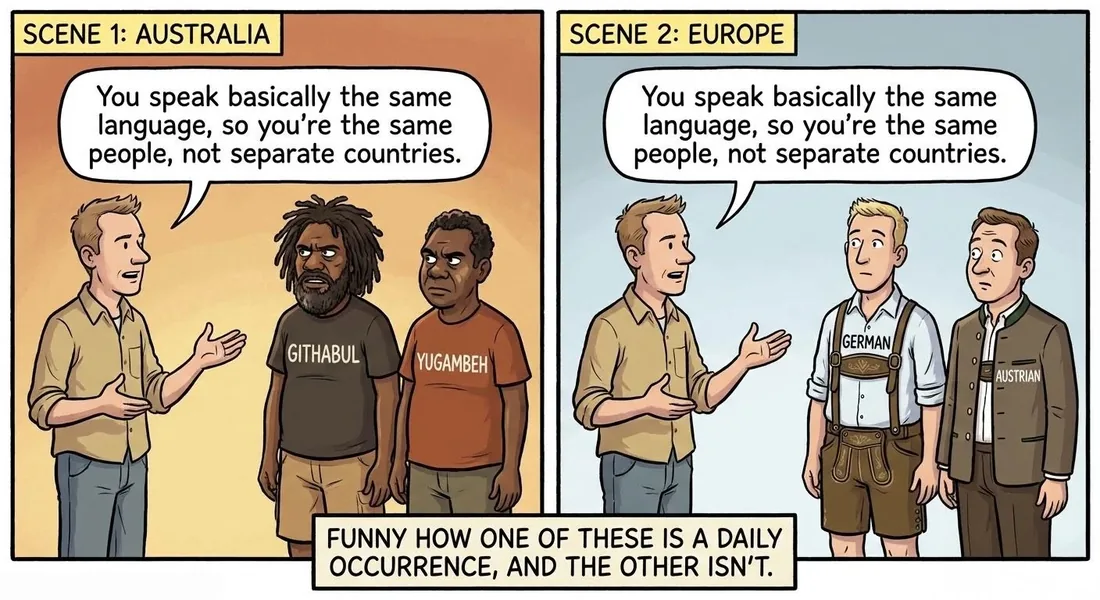
Nobody walks up to an Austrian and says, ‘You speak German, so clearly you’re just part of the German Nation and have no separate borders or government.’ Everyone understands that they are two distinct, sovereign political entities that happen to share a linguistic history.
Why, then, is it different for us?
Political authority
When we talk about the Yugambeh Nation, we are not just talking about a cultural vibe or a language group. We are talking about political authority.
- Shared culture. We share Dreaming stories, Songlines and linguistic roots with our neighbours, such as the Githabul Nation and the Wahlubal Nation. This makes us family in a broad sense.
- Distinct politics. Under Traditional Law and Custom, sharing a language does not give one group the right to speak for another’s Country.
- Sovereignty. The Yugambeh Nation has its own political identity. We do not sit in Githabul or Wahlubal political matters, and they do not sit in ours.
To call yourself a Nation is to claim the right to govern your own affairs and care for your own specific Country. When people lump us all together because we ‘sound the same’, they ignore our distinct political rights and our specific responsibilities to our Ancestors’ land.
More than a language
Individual Aboriginal Nations, like the Yugambeh people, are united by much more than the words we speak. We have seen the term ‘Yugambeh language people’ in use, but it does not tell our whole story. Language is vital, but it is only one thread in a much larger tapestry. When you acknowledge us, remember that we are defined by:
- Kinship systems. Our complex social structures and family connections, which have governed our people for millennia.
- Shared spirituality. Our deep, ongoing connection to Spirit and to the Dreaming that lives in the land.
- Material culture. Our unique tools, weaving, art and physical heritage, specific to our local Country.
- Connection to Country. Our inherent right and responsibility to the lands and waters we belong to.
Calling us ‘language people’ oversimplifies thousands of years of sovereignty and culture. Our FAQs explain how Yugambeh sits among its neighbours in the wider Bundjalung region.
We are a Nation. We are a People.
Adapted from a Yugambeh Nation post of 18 December 2025 and 24 January 2026.