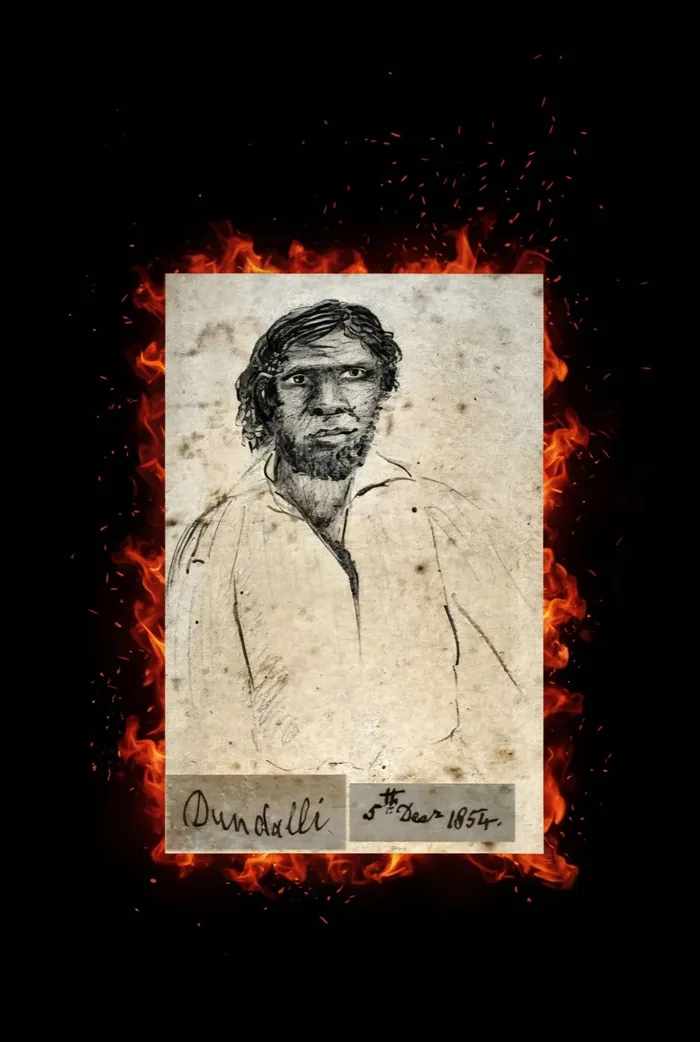
We pause to honour the memory of Dundalli, a man whose strength, leadership and resistance continue to echo across the south-east. On 5 January, the anniversary of his execution in 1855, we stand with our northern neighbours to remember a warrior who fought for Law and Country.
Kin
As Yugambeh people, we recognise Dundalli not just as a figure of history, but as kin. He was Turrwan (Darawan), a skin name that connects us through the sophisticated social and spiritual systems shared across the Yuggera, Jinibara, Quandamooka and Yugambeh nations. This shared identity reminds us that the borders drawn later never severed the ancient ties of Law and blood that bind our peoples together.
On the scaffold
As Dundalli stood on the scaffold, he looked out toward the brushes of Post Office Square and the hills where hundreds of our people had gathered. Even in his final moments, his concern was for the Law and the survival of his mob. He called out in language, urging the people never to forget the struggle and to continue the fight for Country.
His last words were a call to his wife and his people to seek justice and to take care of one another under our own Law. He reminded us that while he was being judged by a foreign system, he died a Lawman of this land.
Nation Building as reclamation
In the context of Dundalli’s story, Nation Building is more than a political term. It is an act of reclamation:
- Honouring the resistance. Recognising that our ancestors did not simply fade away, but fought sophisticated legal and physical battles to protect their families.
- Strengthening kinship. Reaffirming shared skin systems such as Turrwan, which prove that our unity predates any colonial boundary.
- Restoring Law. Moving forward by centring our own protocols, languages and governance systems in how we care for Country and one another.
Dundalli was executed for upholding the Law of this land. Today we honour him by continuing the work of strengthening our Nations, so that the fire he lit for justice stays burning in all of us.
Always was, always will be.
Adapted from a Yugambeh Nation post of 5 January 2026.