When we talk about warfare in a Western context, we usually think of conquest, mass casualties and total war. For the Yugambeh Nation and many other groups across the continent, dispute resolution looked very different. It was not about destroying an enemy; it was about restoring balance.
Here are the fundamental differences between Western-style warfare and our traditional ways of settling conflict.
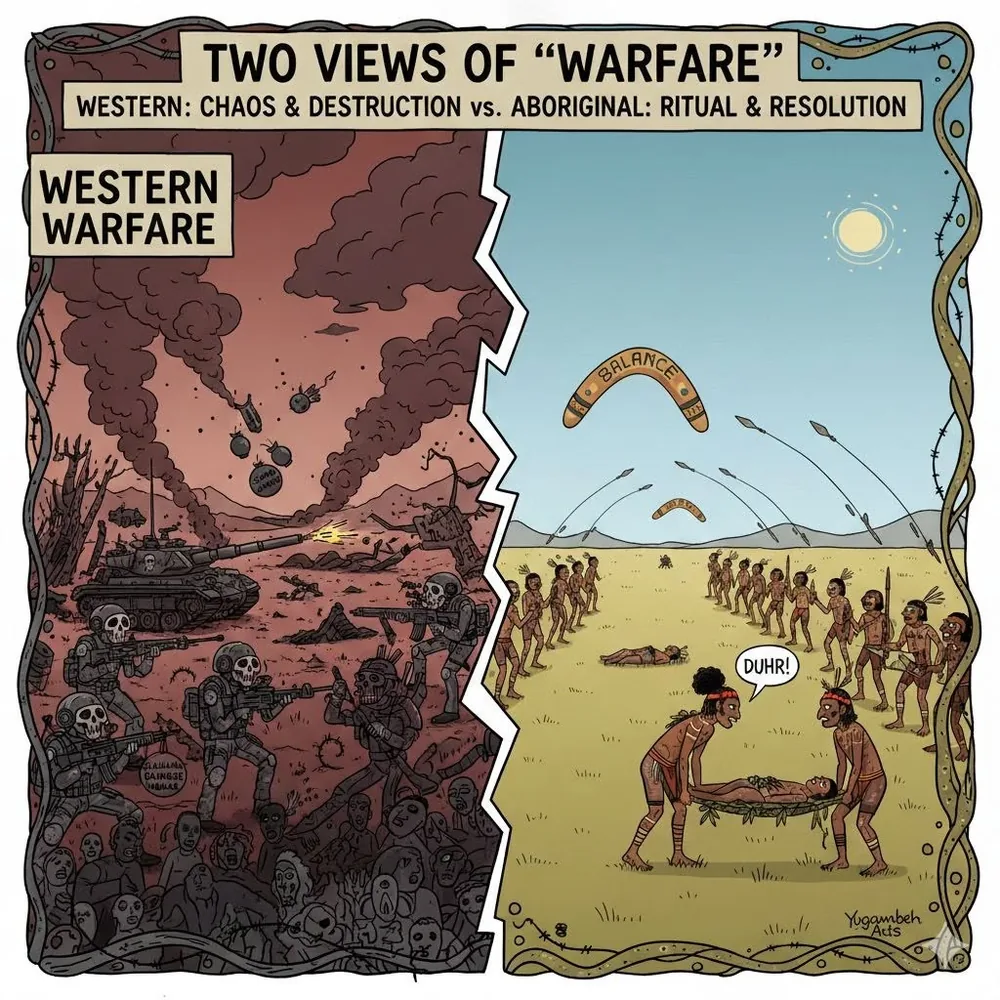
A performance, not a slaughter
Western warfare often relies on the element of surprise and on maximising casualties. Traditional Aboriginal ‘battles’ were highly ritualised, organised performances. The goal was not to kill as many people as possible, but to allow grievances to be aired and settled under strict protocols.
Distance, not close combat
While Western combat often moved toward close-quarters fighting to ensure a lethal outcome, many of our disputes were settled at a distance.
- Groups would agree on a specific time and place.
- The ‘fight’ often involved throwing spears from a distance, rather than one-on-one combat to the death.
The protocol of ‘Duhr!’
One of the most striking differences was the respect for life and for the individual. In our region, the preservation of the community was paramount.
- If a warrior was badly wounded, they would call out ‘Duhr!’.
- The battle would stop immediately.
- The injured person was safely removed for treatment.
In Western warfare, a wounded soldier is often written off as collateral damage. In our tradition, a wound was often the signal that the point had been made and the blood-debt paid.
Targeted justice, not random death
In Western war, ordinary soldiers die for the decisions of their leaders. In Aboriginal dispute resolution, death was rare and usually specific.
- If a death was the intended outcome, it was typically a death penalty for a specific individual who had committed a serious crime.
- Even if that person’s kin knew they were in the wrong, they had a cultural obligation to protect them in the ritual battle. It was about fulfilling duty and kinship, not about random violence against an innocent group.
A legal system in action
By framing these encounters as ‘war’, history often misses the point. These were not lawless brawls; they were a legal system in action, one that prioritised the survival of the population and the resolution of the ego over the total destruction of the ‘enemy’.
Does seeing these battles as a form of restorative justice change how you view our history?
Adapted from a Yugambeh Nation post of 2 February 2026.