Two dates nine days apart in February 1842 fundamentally altered the landscape of our Country. On 1 February, more than 50 of our neighbouring kin were poisoned at Kilcoy, north of Brisbane. On 10 February, Governor Gipps issued the proclamation opening Moreton Bay for ‘free settlement’.
Colonial history often celebrates the proclamation as the birth of local industry. For the Yugambeh Nation, it was the formal onset of an era of profound loss, displacement and survival: our anno incursi, year of invasion.
Kilcoy, 1 February 1842
The air in the summer of 1842 was thick, not just with the heat of the Brisbane Valley, but with the whispers of a coming change. In the corridors of the Moreton Bay penal colony, the talk was of free settlement. The maps were being redrawn, and the exclusion zones were about to vanish. On the ground at the edge of the frontier, the squatters did not want to wait for the stroke of a pen. They wanted the land cleared. They wanted the Law of the Country gone.
At Kilcoy, more than 50 of our neighbouring kin, men, women and children, were murdered through the cowardly poisoning of gifted flour. Families sat together, breaking bread, unaware that the white flour was laced with strychnine. Within hours, the laughter around the fires turned to agony and death.
The proclamation, 10 February 1842
Just nine days later, on 10 February, the exclusion zone was officially repealed, opening the floodgates for further dispossession and violence. The land was ‘opened’ for settlement only after its soil had been stained with the blood of its protectors. This was the brutal reality of the frontier: a calculated clearing of the path, so that free settlement could begin over the fresh graves of our people.
The first stations
The frontier moved with devastating speed. As the ink dried on the proclamation, the pastoralists followed, carving out the massive stations shown on this map: Nindooinbah, Tamborine, Jimboomba and Beaudesert among them. At the same time, the cedar-getters pushed into the Gold Coast and Tweed regions, felling the ancient giants of our forests to clear the way for further occupation.
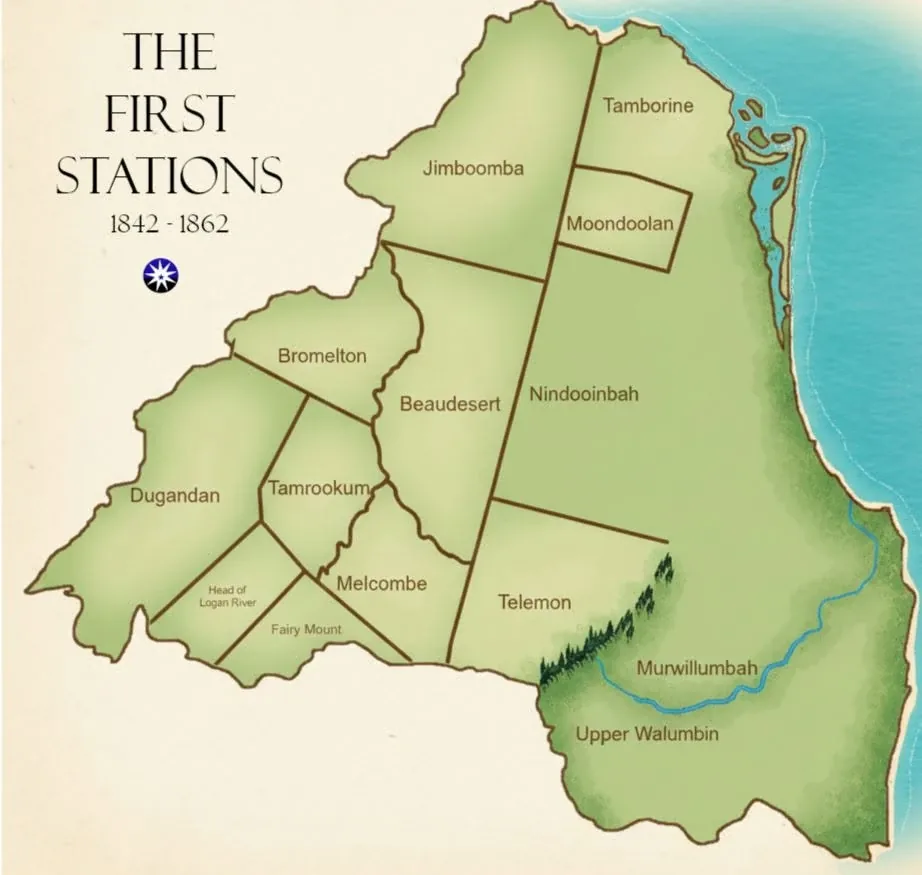
This was not a peaceful transition of land. It was a rapid, systematic incursion that reduced our population from an estimated 9,000 to just 150 or so by the time of Federation.
Why remembering matters
In the work of truth-telling and Nation Building, remembering matters:
- Truth as a foundation. We cannot build a future on hidden graves. Acknowledging the massacres is the first step in restoring the moral balance of this Country.
- The map as a weapon. The pastoral boundaries were not just farm lines; they were tools of exclusion. By gazetting stations, the colonial government attempted to turn our ancestral hunting grounds and ceremonial sites into private property, criminalising our people for simply walking their own Country.
- The cost of industry. Behind every log of cedar taken from the coast and every head of cattle grazed on the rivers, there is a story of environmental upheaval. The opening of the land meant the closing of ancient food sources, and the destruction of sacred groves that had been managed by our families for millennia.
- Sovereignty of the mind. By telling this story from our own perspective, we reclaim the narrative from the colonial archives. We honour the people of Kilcoy not as casualties of progress, but as martyrs for their land.
- The resilience of kinship. Despite the decades of turmoil, disease and warfare that followed 1842, and the attempts to poison our bloodlines, the Yugambeh and neighbouring peoples were never erased. From a remnant of 150 survivors, the Yugambeh have grown back to over 5,000 people today. Our skin systems, family ties and cultural responsibilities outlasted the original pastoral leases.
Still here
We honour our Ŋajaŋgali (Ancestors). They saw the moonless night begin, they felt the fences go up, and they made sure that we would be here today to tell the truth of it. We honour them by teaching our children our language, by walking our shared tracks, and by asserting that our Law was never ceded.
The free settlement may have brought more death, but it never broke our spirit. We are still here. We are still the caretakers of this Country.
Always was, always will be. May the Yugambeh forever soar like eagles.
Adapted from a Yugambeh Nation post of 1 and 10 February 2026.